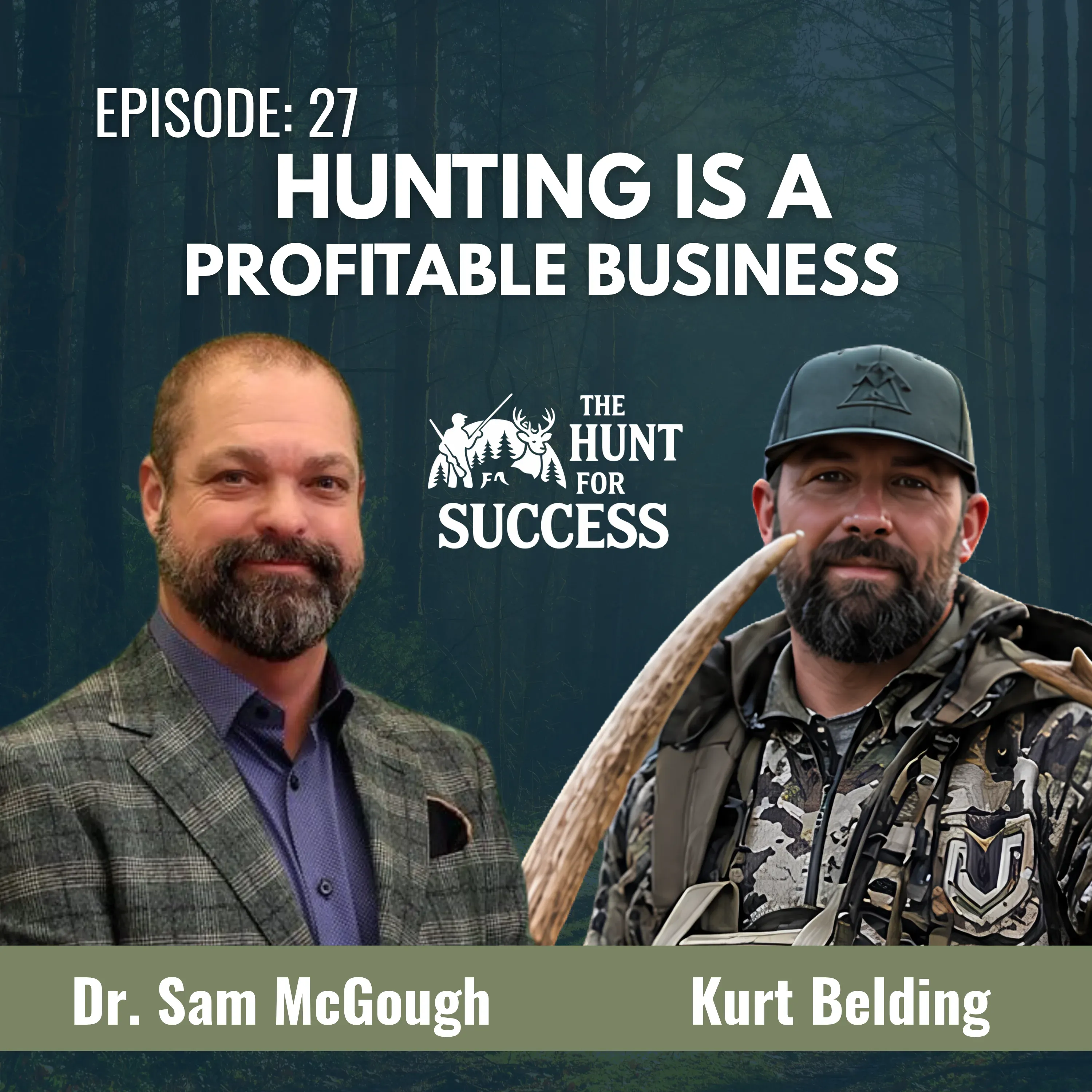
Episode 27 with Kurt Belding. An automatically generated, edited condensation of the conversation, not a verbatim transcript. Timestamps are approximate. Watch or listen above for the complete interview.
SAM McGOUGH · 0:00
All right, everybody. Welcome again to another episode of The Hunt for Success, where each week we talk with entrepreneurs and business people that have built a business but also love the outdoors and the outdoor lifestyle. This week we have an incredible guest, Kurt Belding, the founder of Western Obsessions. He has a long history of building businesses, built a large business, and then stopped everything and decided to go hunting for a couple years, which anybody listening could probably really, really wish they could do the same. So Kurt, thanks for being here.
KURT BELDING · 0:42
Absolutely, Sam. I enjoy being on. I’m looking forward to kicking a whole bunch of stuff around with you. Let’s go for it.
SAM McGOUGH · 0:42
Let’s do it. Let’s start off with this. You built this large franchise, it looks like a nutritional and supplement company, and you had all kinds of things going. A CrossFit gym, you were even an outfitter, and at 40 you decided to just stop everything. Tell me a little bit about that.
KURT BELDING · 0:42
Yeah. I think a lot of guys go through something similar, and most people will call it a midlife crisis, right? But I think it’s really just discovering who you really are, and you find out, “Wait, I might not be the guy of the life that I’m living right now.” I’m actually reading a book on mastery, and it alludes to how the thing that really lights you up as a kid, you sometimes lose sight of, but it may come back later in life. That’s kind of what happened to me. I’ve always been entrepreneurial. I did pretty well with a sports nutrition company. I franchised it and had a lot of locations. I had a couple supplement lines I created myself that I was selling through the locations, a healthy meal prep company, a gym. So I was doing a lot of stuff in the fitness industry, which doesn’t mean I was making a lot of money, but I was doing a lot of stuff. And one day I was like, “Man, I just don’t really enjoy this life.” It was paying the bills, but I went to the wife and said, “Look, I wanna try to do this other thing.” I have a good wife, man, because she’s super supportive. She said, “Sure, go for it.” And I’m like, “Man, this is a huge risk.” So I sold anything I could sell, but I ended up closing a lot, because it’s pretty hard to sell a business unless the numbers show real well, and even then it’s hard to find a buyer real quick, and I was moving pretty quick. I made enough money where I could go hunt and film my hunts for a couple years, and then I started running out of money pretty quick. But I would regret it if I was 80 years old on my deathbed and looked back and didn’t at least give it a shot. So I gave it a shot, I’m starting to figure it out now, and here I am about seven years later or something like that.
SAM McGOUGH · 3:26
Man, that’s super nice. I had a similar thing where I built a business up. Do you ever get to that moment where you think, I’m still here, I’m still making it? Because you made that jump and you’re still here making it, and I think a lot of guys are too scared to do that.
KURT BELDING · 3:26
Maybe not on a macro scale. I always set really big goals, because that changes my decision-making and how I look at things. So I’m not there on my big goal yet, but my little goal of “All right, I gotta figure out how to pay bills doing this outdoor hunting stuff,” I’m there. So there’s a brief moment of, “Whew, man, I think I made that. I can at least pay some bills.” But I don’t sit in that moment very long. I’m like, “Okay, cool. Made it to this point. Now let’s go to the next point.” And I’m moving on pretty fast.
SAM McGOUGH · 4:07
I think that’s a pretty common thing with the higher achievers, that they don’t really rest on the achievement and they move on to the next one. My team has gotten onto me many, many times, because when we hit a goal I’m going, “Okay, we could’ve done twice as much,” or, “Now the next goal.” So I can understand that one. So let’s go back. You turned everything off and sold what you could sell. How did that first year shape the business?
KURT BELDING · 4:49
I had no clue, to be honest with you, how I was gonna make money. Usually when you have a business plan, you have some understanding of how to make money. I really didn’t. All I knew was I wanted to go on really cool adventures, and I wanted to film them and entertain other people. So my thought was if I could just do that well and have enough attention, I’d figure out down the road what I needed to do to make money. It was a huge struggle that first year, learning how to use camera equipment, editing, marketing in that realm. Honestly, I struggled for five years figuring out how to do that. Just in the last 18 months or so have I really started figuring out my niche and where it would be possible to make a living.
SAM McGOUGH · 5:31
Now you’ve started a booking agency. Tell me a little bit about that. Are you booking other talent? Just give me an explanation.
KURT BELDING · 5:31
Yeah. So I get to go on these cool adventures, and I get to know and build relationships with outfitters. I don’t always use an outfitter, but on a lot of these hunts you have to. If I go to Alaska on a mountain goat hunt or a grizzly bear hunt, you have to use an outfitter or a guide, and when you go to a different country it’s probably pretty smart to use one. So I built good relationships with them, and they knew I had a business background and a marketing and sales background. They asked me to help them with their marketing, whether it was a website or something else, and I realized most outfitters don’t do very well on the sales side. So I started helping them sell a little bit of trips and hunts, and I realized, “Hey, this has got some teeth here. I think this is feasible to scale.” I tested it for about six months, and I think we did about $600,000 in gross sales in those six months. And I was like, “No, this has definitely got teeth.” So in January I hired a bunch of guys, trained them, and built a team. From January to October, we’re at about $2.5 million in gross revenue. Just like everything, there are always problems that come up, but we’re starting to figure it out as we go.
SAM McGOUGH · 7:40
Nice. I wanna switch gears for a second. You’ve been on some pretty cool adventures. If you could do only one of them again, what would it be?
KURT BELDING · 7:40
Man, I really like Alaska, so probably something in Alaska. I just came back from a moose hunt in Alaska, and honestly, I didn’t really enjoy the moose hunt. I thought it was super boring. But Alaska’s beautiful, man, and it’s the most wild of the wild places you can go, and that’s what I really enjoy, getting to very remote wild places. Alaska’s it. So I’d probably redo that grizzly bear hunt, and that mountain goat hunt on Kodiak Island would be something I would wanna do. But I’m always looking to the future, so I’m sure my best adventure is still to be had. I’m still looking.
SAM McGOUGH · 8:22
Right. I understand that, and I was explaining this to my wife. I was just in Canada, and I’ve never made it to Alaska, but I just enjoy being somewhere that’s so far away from everything, where it’s an adventure just to get there. You gotta take a plane, then a float plane, then another thing to even get there. For me, that’s part of the excitement. Not the hunt, just getting there is sometimes incredible.
KURT BELDING · 9:03
For sure. I went to Italy with my wife this year, and that’s an adventure too, right? You get on a plane to jump on another plane, to a train, to a bus, to a taxi. That’s a pretty cool adventure, and I enjoyed it, but I was not in the wild chasing an animal that will way outsmart me and that I have a low percent chance of finding.
SAM McGOUGH · 9:03
It’s funny, we’re living the same life. We went to Italy this year too, and I love travel in general, experiencing the food, seeing the culture and all the different sights. But there’s nothing like this year when I was in Canada. We were moose hunting, sitting there forever calling a moose, and you’d hear it in the distance. I finally decided to go take a pee, and when I look up, there’s a black bear 30 feet away just staring at me. You can’t get stuff like that in the city. I thought it was the coolest thing, because he was just hanging out watching me. I’d been sitting there for an hour and never saw him. But anyway, so now you’re a booking agent, booking hunts for the outfitters. That’s a great thing, because guys like me need a trusted source. There’s so much stuff out there. How do you vet these guys?
KURT BELDING · 10:24
By going hunting with them. Either I’ll hunt with them or my colleagues will, and we have a pretty good network of guys we’ve hunted with and built relationships with, so we know whether it’s a good outfitter or not. There are plenty of bad outfitters out there that are happy to take your money and walk you around the woods without seeing anything. So it’s trial and error, finding the right guys, and once we find them, they may recommend other outfitters to us. If my trusted, vetted outfitter says, “You should probably help Joe out over here. I trust him. He’s a great outfitter,” that transfer of trust happens too, and at some point we’re gonna go hunt with them. When guys are looking to go on their bucket list adventure, it’s a pretty scary thing, man. You look at websites, you look at pictures of what that outfitter’s killed or caught, you try to get references, but nine times out of ten the only references you’re gonna get are the best of the best. You just never really know what you’re walking into. I’m not the only company out there, there’s plenty of companies like mine, but using guys like us, we will tell you, “Hey, we’ve had a good experience with these guys. They run a good operation.” But it’s still hunting. Animals are animals. Weather’s weather. We had a bunch of fires in Colorado that messed up some hunts, we have flooding now, and something might be going sideways with the outfitter. Maybe he’s going through a divorce. You don’t know. But it hedges your odds not to get ripped off and waste your money. And we don’t charge the client anything. How we make money is we get a referral back from the outfitter for helping them.
SAM McGOUGH · 12:38
When you started filming your hunts, what was the biggest challenge?
KURT BELDING · 12:38
Man, so many, but probably the biggest one is this. If you’re gonna film a movie, you have a set, and if the take didn’t go right, you can redo the take. You can’t do that on a hunt. The animal’s not coming back to say, “Oh, you missed? Okay, let me stand here again. Wasn’t broadside enough for you?” If you don’t get the shot, you don’t get the shot, man. It’s a lot of pressure and a lot of stress. And then just learning the gear in stressful moments, when you’ve got five seconds to get the shot, and if you don’t get it, you can’t entertain someone. But I love entertaining. Movies are like my drug. I’ll watch a movie, and it takes me out of my reality and makes me feel something. I get sucked into that reality, and I might feel happy or joy or sad or fear while I’m sitting on the couch, and that’s what I’m trying to do for other people. They may not be able to afford the Alaska mountain goat hunt, but if I can pull them into my experience and they feel the feelings I felt on that hunt, well, that’s almost second best, right?
SAM McGOUGH · 13:00
That’s really cool, because you’re right, physically or financially these hunts are challenging and expensive, especially the cool ones. I’m from Alabama, so sitting in a blind for whitetail is not too terribly challenging anymore, especially now that the blinds are like apartment buildings. They’re so nice, they’ve got heaters and all this stuff in them. That’s the reason I love going out west, or going up somewhere you’ve got to hike or sleep out in the cold. But the really cool hunts, or the tags, are definitely not cheap. I was looking at going to Mexico, and my wife talked me out of it. She’s like, “The cartels, the cartels.” I still think I’m gonna do a big mule deer hunt down there. But not everybody wants to take those risks, and they still enjoy watching the movies.
KURT BELDING · 15:24
Yeah. And you may not be physical enough to do a mountain goat hunt or a sheep hunt or some of these backcountry elk hunts, so at least you can watch. And I really try to film in a way where I put the truth on the television set. I don’t Hollywood stuff. If I miss, I miss. If I screw up, I screw up, and I make sure people see it. Sometimes I get some backlash and some hate from other hunters that are keyboard warriors. But I think most people appreciate seeing the reality and the truth of the hunt.
SAM McGOUGH · 16:05
Yeah, I think you’re right. If you’re a true hunter, someone who’s really in it, we’ve all missed, and I think it’s important that you show the misses. I look back and think about Bill Dance. I enjoyed watching him fall off the boat about as much as I enjoyed watching him fish. People like real. They like honesty and integrity. Is that how you try to connect with your audience?
KURT BELDING · 16:47
Yeah, for sure, it’s just who I am. I wouldn’t feel good doing anything other anyway, and that really bleeds into all aspects of my business. If I’m filming a hunt and showing exactly what happened, “Oh, crap, I messed that up pretty bad, and I’m probably gonna get judged pretty hard on this, but I don’t care. It’s what happened.” That bleeds into the consulting. “Hey, I don’t think this is the right hunt for you, and here’s the reasons why. Yeah, we’d love to make a sale and have revenue for the company, but it’s not the right hunt. Let us keep working, we’ll find something for you, but this is not it.” And we’ll be honest, like, “This is a good hunt. I think you’ll enjoy it, but there’s no guarantee you’re gonna kill an animal. It’s hunting. It’s not killing.” I think people can appreciate that.
SAM McGOUGH · 17:30
Yeah, definitely. Do you have a process you go through with your clients to get an idea of their physicality and what they’re looking for?
KURT BELDING · 17:30
Mm-hmm. Yeah, I developed it myself. From building businesses, you start to understand systems, then you document systems, and you try to simplify everything, because if it’s simple, it’s smooth, and if it’s smooth, it’s fast. As long as it’s simple, you can do it easily, and you can multiply it and duplicate it and scale it. So my sales guys ask very specific questions. “What’s the hunt you wanna do? Why do you wanna do it? What’s your why?” Then we dig into more specific stuff. “Okay, you wanna do an elk hunt. Tell me about yourself. What do you weigh? How active are you? Let’s figure out the right experience for you.” Because if you’re three hundred pounds and you’re not active, we’re not gonna put you on a backcountry elk hunt. The horses can’t handle that weight, and you’re not gonna be able to handle that hike. So we’ll look more toward private land where you can jump in an ATV or a truck and still enjoy an elk hunt. It’s just gonna be a different experience for you.
SAM McGOUGH · 18:51
Yeah, exactly. I learned that lesson elk hunting a couple times. And I thought elk hunting was tough until I had to help cut up a moose. My gosh, man. I was sore the whole next day in places I didn’t realize I even had muscles. But I’ve had guys on hunts with me that just can’t physically get there, and it ruins the whole hunt for them. Elevation hunting especially is different for guys who don’t live in it.
KURT BELDING · 19:32
For sure. I just went to New Mexico because I owed a buddy, and he wanted to go elk hunting. He’s in shape, works out all the time, very physical. On a scale of one to 10, one being the easiest elk hunt you can go on and 10 the hardest, this was probably a three or four. New Mexico is known for a little more forgiving terrain than Colorado. But we got dumped on day one. It rained on us all day. I’m not the type of guy to sit in camp, so we put the rain gear on and hunted. Day two was sleet, snow, and lightning. We stayed out in the field and had a harder hike, a pretty good climb. By day three I could tell he was shell-shocked. He’s like, “Dude, this is the hardest thing I’ve ever had to do in my life.” And I’m thinking, “Oof, it’s a good thing we’re not in Colorado right now, or Alaska.” I told him, “We’ve got three days of good weather. You’re doing great. It’ll get easier. Just stay in the field with me.” He ended up having a great time, but to your point, he was in shape, always worked out, and it destroyed him.
SAM McGOUGH · 20:53
My first elk hunt woke me up. I was working out, but when we hit 9,000, 10,000 feet, man, I’m from Alabama. There’s no elevation here. The first day was fine, but the second day my head was hurting, I couldn’t breathe, all the things. It took me about a day to get acclimated, and then I was okay. I noticed it just getting into camp, carrying my bag. It’s like, “Why am I breathing hard?”
SAM McGOUGH · 22:24
It’s really cool that you’ve been able to do all these hunts. I was so envious of you getting to go hunting for a living. It’s kind of like pulling the cat out of the hat when you do something like that. You created this lifestyle where you can pay your bills and go do the things you wanna do, and I applaud you for being able to do that.
KURT BELDING · 22:24
Thanks, Sam. I get some jealousy sometimes, from old people I used to know, some friends, even family members. They’re like, “Oh, it must be nice, man. You’re so lucky.” And I’m like, “It is nice, but let me tell you the reality of it. I just spent the last twenty-five years grinding my A-S-S off, and I went through a lot of stuff. I don’t see you waking up at four o’clock in the morning and working till ten o’clock at night every day for the last twenty years.” So yeah, I’m here and I’m doing it, but it wasn’t easy. I’m the type of guy who believes I can create anything I want in my life. If you can see it and you can think it, you can do it. You just gotta have the tenacity to follow through and execute.
SAM McGOUGH · 23:45
I agree. I’ve gotten the “must be nice” before, but they didn’t live the sleepless nights. They didn’t live the stress, the hard days working till 10 or 11 o’clock at night and getting up at 4 or 5 in the morning. They’re doing the 9 to 5 thing, or even if they own their own business, they just haven’t had those experiences. But turning a business into hunting, I’m going, “Man, I should have redirected some of my attention.”
KURT BELDING · 24:28
Well, Sam, you know what’s cool? You’ve built businesses, so you understand the framework of building a business. Whatever industry you wanna go into, you understand what it’s like to say, “Okay, I don’t know this industry. Let me jump in with two feet and get to know it.” It takes a while to really understand an industry and find what I call the white space, the little 1% spots you can operate in that make you a little bit different. Once you figure that out and use some leverage and execute in that white space, and once you’ve built one business and been successful, you understand the framework for the next. But it’s a big risk for sure.
SAM McGOUGH · 25:17
That’s also part of what drives guys like us. I’ve had times where things are going really well and I go, “Is that it?” I get more nervous when things are going well than when things are broken.
KURT BELDING · 25:17
Yeah. I think a lot of guys like me and you like to create. “Oh man, if I can create this, create that.” And once you create it, there’s nothing left to create. Everything’s running on systems, everything’s running well, and you’re like, “Why is everything running well? I’m bored now. I need to create.” A lot of times entrepreneurs like us become serial entrepreneurs. We jump to the next thing and the next thing because we like the process of creation, and that’s where you can really get in trouble. That’s where I got in trouble at a young age. I had too many businesses because I loved the creation part. Once a business was somewhat successful, I got bored, and instead of scaling it to be very successful, I jumped to the next thing, and then I was doing too much and wasn’t doing anything well. So this time around, with a little salt and pepper in the beard and a little bit of wisdom, I’m not doing that. I’m staying focused on one thing and putting all my time and energy into it. I’ve created a team, my marketing’s on point, I’m paying the bills, and I’m like, “What do I do now?” Well, now I have enough wisdom to not jump anywhere. Just put the head back down, grind, and hit the next goal.
SAM McGOUGH · 26:45
What is your next goal?
KURT BELDING · 26:45
Step one on the consulting side was to develop a team of consultants. I could do it myself, talk to hunters and make the phone calls, but as you know, you don’t own a business when you’re doing everything yourself, you own a job. Which is fine, if that’s what you wanna do. But if you really wanna own a business, you have to remove yourself so it can operate without you. So step one was removing myself, and I’ve done that. I have a fantastic team. Step two is to really scale the TV side and take that to another level, so I’ve hired a videographer to help me do that. And then, instead of recommending outfits that we go to, I’m going to start creating our own outfits and buying outfits so we can control that experience a little bit better. Like I was saying before, this guy did great last year, but if I send you to him this year, maybe something’s going on with him, or he’s just not as good, and all of a sudden you had a bad experience as a hunter. We can’t control that variable, so I wanna own my own operations. I have a whole plan, but that’s the next step: have a little more control of the variables and give the hunter a higher chance of having a great experience every time.
SAM McGOUGH · 28:20
Oh, I love that. I love the thought of doing that, because I’ve had good experiences and bad experiences, and if you’ve done this, we all have. You really pay attention to the good ones. What did they do that made it so good? That’s a thought process I’ve had a lot of times, having multiple ranches all over, where you could buy a membership and go to one this year and another one next year. Very cool. Keep me in mind when you get that going.
KURT BELDING · 29:04
Absolutely. That’s the next step for the business, but it also comes from a selfish place. I wanna own this so I can go experience some cool stuff for myself. And honestly, Sam, here’s my major driving why behind all of this, and I haven’t really hit home on it before. The reason I’m doing everything is because I want to have a moment with my grandkid, whether it’s a girl or a boy, in a blind with an animal. Whether we kill it or not, I don’t care, but I wanna have that moment with my grandkid. And the way this industry is going, with anti-hunting and a lot of other stuff happening in the world to our outdoor life, I don’t know if that’s going to be a thing. Not only are anti-hunting groups coming for our way of life, but access to hunts is getting way harder, public land is becoming super crowded, the cost of an outfitted hunt is skyrocketing, and I don’t know what it’s going to be like in the next 10 to 20 years. So selfishly, if I get out ahead of this thing and create a business where I can control the environments, I know I can take my grandkid to one of these places and have that moment.
SAM McGOUGH · 30:34
That’s a great why. I did something similar. I bought some property a couple years ago, and it’s our hunting property, and barring some sort of federal whatever, we’re gonna hunt there. My youngest son killed his first deer there last year, and it was one of the best experiences I’ve ever had hunting. I’ve killed some big things and some really cool things, and I don’t know if I was ever more excited than watching him shoot a little doe. So I understand that why, and I think most hunters actually want to steward the next generation to some degree. But that’s the problem. It’s not just the anti-hunters. Out west especially, access is getting really hard, and tags in general are getting hard, so you may not have those experiences.
KURT BELDING · 31:15
Yeah, or to have a good elk hunting experience, you may have to be a pretty wealthy person in the future because of access. A lot of people may not be able to afford the experiences we can have right now. It’s not cheap, but we can still have them, and that may not be there in the future.
SAM McGOUGH · 31:15
Of course, they keep introducing wolves everywhere. I was elk hunting in Colorado a couple years ago when that was on the bill. They hadn’t introduced them yet, and everybody was talking about it, but now it’s happening.
KURT BELDING · 31:15
Yeah. I think that really woke up our hunting community. We’re not loud people. Anti-hunting people are very loud. We’re traditionally not very loud. We just do our thing, and we don’t get involved in a lot of stuff. But I don’t think we ever really realized something like that could happen until it happened, and then I think that woke us up, and we’re like, “Oh, crap, now we really have to do something, man. We gotta get loud.”
SAM McGOUGH · 32:42
Yeah, definitely. I know they got loud about access, this year or last year, when they were trying to do something with some of the state parks. And in the Southeast, public land is a scary part. You don’t wanna go out there, especially in rifle season. There’s not enough of it and there are too many people. I quit public land hunting a long time ago because you’re just a little too nervous, especially taking a kid. I would never wanna take my kid out there.
KURT BELDING · 33:23
It gets pretty competitive, man, and I’m a very competitive person. In sports, I love competition. I hate it in hunting. If I’m out there and I see an animal and I see three other guys going after it, I’ll back out. I don’t want any part of that competition. It just doesn’t feel good to me.
SAM McGOUGH · 33:23
That’s what I love about getting far away, like we were talking about earlier. If they’re not with me, I don’t want to see another person. I remember elk hunting one time, and every ridge I would see an orange vest, and I was so tired of it. We just said, “Let’s keep walking. We’re gonna keep walking till we no longer see people.”
KURT BELDING · 34:09
Yeah, and that’s been the thought for the last five to 10 years, but now everyone does that. Everyone doing DIY elk hunts is pretty in shape for the most part, and it used to be that seven or eight miles into the backcountry, you don’t see anybody. Now it’s like, “Hey, let’s all meet seven, eight miles back.” You see a lot of guys, and actually that one mile off the road is becoming a bit of an overlooked spot, because everyone’s trying to get deep into the backcountry. But I’m with you. When I wanna go hunting, I wanna get away from people and get into the wild, and if I’m seeing other people, it takes away from my experience. They have every right to be there, and good for them for getting out there and contributing to conservation. But for my experience, I wanna try to be away.
SAM McGOUGH · 34:52
You know, the strange thing is there are fewer hunters now than there used to be, and the number keeps declining. That’s what kills me. If hunters are declining, why do I keep seeing them everywhere? Where are they coming from?
KURT BELDING · 35:33
Here’s my theory on that. It used to be when you went hunting, you’d hunt in your backyard, basically, your land or your neighbor’s land or a farmer’s near your home. You didn’t travel. You just did your thing when hunting season came, and there were a lot of hunters. Now there are fewer hunters, but the hunters hunting now do way more hunting. It’s not just one week out of the year, it’s months out of the year, and we’re all traveling from state to state doing all these different experiences. So fewer hunters, but we’re doing 10 times the amount of hunting.
SAM McGOUGH · 35:33
Wow. Yeah, that makes sense. I never thought of it that way. Hunting’s still big here, but fewer and fewer people hunt, and access to land is becoming so expensive. And I can’t help it, I love gear. When I was in Canada this year, I was happy with all of my gear except my headgear. I’ve started shaving my head, and I didn’t bring a thick enough beanie. And gloves. I had the right gloves, but I didn’t bring them because I was trying to conserve weight. We had those little planes, and I think I could have 100 pounds, gun and everything, so I was really trying to cut weight. I’ll pay for gear, but everything is getting so expensive, and guys just don’t do that as much, or they can’t.
KURT BELDING · 37:04
Yeah, everything’s getting expensive, but we do it to ourselves. We create demand for the expensive gear, because we all want the best of the best. But the reality is, you were on a moose hunt, so you needed good gear. In Alaska you better have good gear, or that could be life-threatening. But if I’m gonna go to a farmer’s land in the Midwest and do a whitetail hunt, I don’t need all the super expensive Western gear. I could throw on some overalls and a Carhartt coat, I don’t need any camo, sit in a blind, and make it happen. We create that demand.
SAM McGOUGH · 37:46
Is there any gear you just can’t live without, or won’t hunt without?
KURT BELDING · 37:46
ChapStick. It depends on the hunt, but typically I’m pretty remote in the backcountry, so I don’t bring a lot of gear. I used to bring an extra pair of clothes in my pack. I don’t do that anymore, because I never used it, so why am I carrying all this stuff around? But it’s gotta be merino wool or something that dries fast as a base layer. I need good layering systems. I love my puffies. I hate being cold as I get older. In New Mexico it was cold, but it wasn’t that cold, and I could have suffered it out no problem, but I’m like, “No, man, I’m throwing my puffies on, and I’m gonna be comfortable.” And when I said ChapStick, I know it was funny, but I’m pretty serious about it. If I don’t have ChapStick, my lips get pretty chapped out in the wind. I’m dehydrated all the time, and that can make a miserable hunt real quick.
SAM McGOUGH · 39:10
Oh, yeah. This year I went caribou hunting, and the part of my face that was visible was getting chapped. I was putting Aquaphor on every night, because I got a sunburn and I was so uncomfortable. The older you get, the more comfort you want. For me, it’s socks. Always have an extra pair of socks. That was a big one.
KURT BELDING · 39:50
Yeah, I will bring an extra pair of socks. I learned my lesson one year. It rained for a couple days while I was out backpacking, and a lot of times I don’t bring a tent when I’m doing a hard archery elk hunt. I was just bivvying, so everything was pretty wet. My boots soaked through, and then it froze that night. I didn’t know this lesson yet, so I took my socks off and put them on my boots, because I didn’t want my wet socks in my sleeping bag. Well, everything froze. My socks froze, and I didn’t have an extra pair, so in the morning I’m bringing out my Jetboil and thawing my socks to put them back on. Now I know you just put them in the bag and wear them, and they’ll dry overnight. But having an extra pair of dry socks to put on is kinda nice.
SAM McGOUGH · 40:30
Yeah, I stick with those. If I’m hiking, if I’m active, I wear the smallest amount of clothes possible, because I’m gonna be hot and sweaty. I learned that lesson too. So I always have at least a pair of socks and maybe a base layer T-shirt.
KURT BELDING · 41:14
That’s something I try to tell anybody who’s brand new to that type of hunting. When I took my buddy out, we were about to do the first hike, and it was cold, so he had all his coats on. I said, “Dude, take all of that off. Strip down to your base layer and pants, and that’s it.” He’s like, “Dude, I’m gonna be freezing.” I’m like, “No, you won’t. You’re gonna be sweating, and you’re gonna dry fast, and you’re gonna thank me. Because if you don’t, you’re gonna sweat, and then you’re gonna get real cold because you won’t dry.”
SAM McGOUGH · 41:14
I learned that one. My first elk hunt taught me that one. At the first pit stop I was just drenched, climbing out of clothes, and freezing.
SAM McGOUGH · 42:03
Do you have any other hobbies?
KURT BELDING · 42:03
Man, not really. I played a lot of sports growing up. In high school I played four sports, baseball, football, soccer, and track, and I played college baseball and some indoor arena football when I was in college. So I was very into sports, but I’m so bit by the bug now, because this is my business. I’m going hunting and I’m filming it. This is everything I do. Any spare time I have is with my family, so it’s only family or hunting. I don’t even hang out with friends. My daughter’s like, “Dad, you don’t have any friends.” I have friends, but I don’t ever hang out with them, because I have to make a choice. If I’m gonna spend time away from my family, am I gonna spend it at a bar having a beer with a buddy, or a poker night, or am I gonna spend it on an epic hunt in Alaska? Sorry, boys, I won’t be around anymore. So the long answer to your question is no, I really don’t have hobbies. This is what I do, and this is my life. I do like fitness, though. I still work out almost daily, so I make sure I keep that going.
SAM McGOUGH · 43:25
But that’s how you keep going, right? It’s not just about the fitness, it’s about being fit for this. I played sports in high school, but fitness isn’t something I just love doing. It’s something I have to do, because I wanna be fit enough to do the things I wanna do. It’s more of a have to than a want to. And my past career was in health and wellness, so I was telling people they’ve gotta keep their low back or their neck or knees in shape, and I had to live that lifestyle too. It helps as a motivator to have something to do it for.
KURT BELDING · 44:06
Oh, for sure, because you go on that backcountry hunt, and you know how much it sucks. You can do all the fitness you want, and it’s still gonna be pretty rough.
SAM McGOUGH · 44:50
You can’t train for it completely. For me, it’s hard to train for elevation out west. I can hike and do things, but it’s not gonna be the same. If I’m training on a treadmill, it’s not the unstable ground or the slippery footing. And then you throw the weather in. A cold, wet day hiking all day just wears you out so much more.
KURT BELDING · 44:50
Yeah. And really what I do to train for those situations, because you can’t go find some uneven ground and do that for five hours straight, which happens a lot when you’re in the West, is train for the mental suck. When you’re in the suck, how do you mentally get through it? You can’t really train for it physically, so I do it with workouts. I do a good amount of CrossFit for this, but you could do whatever. Just pick something that sucks really bad, that hurts really, really bad. You’re gonna wanna quit, but just don’t quit. Get through that point of, “Oh my God, this hurts so bad. This sucks so bad, but I’m gonna keep going.” If you can do that on a daily basis, then when you’re out at 11,000 feet, and it’s snowing and sleeting, and you know you’ve got a three-mile, 2,000-foot climb out of there, you’ll be fine, because you’ve done it every day.
SAM McGOUGH · 46:20
I think CrossFit-style workouts and just being an athlete in general help prepare you for that kind of suck. Embracing the suck and getting through it. Even sitting in a stand when it’s cold, I’m gonna sit through it, wiggling my toes. I remember I was in Nebraska mule deer hunting, tagged out early, and had the opportunity to whitetail hunt. For mule deer we were hiking, so that’s how I was prepared and dressed, and that’s different from sitting in a tent blind. I was doing squats in the blind, because it wasn’t big enough to do pushups, because I was freezing to death. But I did get a nice eight-point, and I was very happy when I got it.
KURT BELDING · 47:15
Heck yeah. But you wouldn’t have got it if you didn’t have the toughness to stay in the blind.
SAM McGOUGH · 47:15
No way. We’d sit all day, and by 9:00 I was freezing. I had on every piece of clothing I’d brought, but because I’d packed for stalking and walking a lot, I didn’t have really thick clothes. I had a puffy and a soft shell, and that was it. Anyway, I noticed when I was reading through your information that you film a lot of your blown stalks. You embrace showing that side of the hunt, when things don’t go right. How has that been in business life? I know in business, if you’ve made it this far, there have been times when something you did was a complete disaster. How do you recover from that?
KURT BELDING · 48:37
I think in business it’s just part of the game. When you’re an early entrepreneur, every problem seems like a catastrophe. And if you’re an entrepreneur, it’s not if you’re gonna get sued, it’s when. You’re going to go through lawsuits, legal stuff, employee rebellion, people stealing from you. You’re gonna go through all of it. When you’re early on, every one of them seems like the worst thing in the world, and it’s so hard to get through. But once you become more of a veteran and get some years behind you, you realize that’s just part of the game. When it happens, it’s like, “Yep, I remember this.” I just had some stuff with one of my consultants. There was a little bit of disgruntlement and a little bit of rebellion, so we sat down and hashed it out, aired it out, and I didn’t stress about it, because I’ve been through it so many times. As for blown stalks, I film those because coming up hunting, especially now, people didn’t show the truth and reality of a hunt. All you got to see were the successes. So when you go out on your own hunt and you’re not having the same success you see on social media or in these films, you start thinking poorly about yourself. “Man, I’m not a very good hunter. Everyone else is killing stuff. How come I’m not?” I hated that about the industry, so I wanted to show new hunters, “Look, dude, I’ve been hunting for many, many years, and I’m probably more toward a veteran hunter at this point. I probably know more than the average hunter. But even as a veteran, I make a lot of mistakes, and I wanna show you that everyone makes mistakes. So when you do it, you’re not a bad hunter. You’re just early on. You just haven’t learned those lessons yet.”
SAM McGOUGH · 50:42
Yeah, that’s really good, and it’s the same thing for entrepreneurs. I think they judge themselves too harshly. It takes a lot of experience before you can start saying, “Well, that was just an expensive lesson.” I’ve done the same thing with hunting, and I’ve made some pretty big mistakes.
KURT BELDING · 50:42
And it’s funny, man, you almost get to a point where you appreciate it. “Oh man, good thing that happened, because I learned a lot from it.” Where I’m at now, when I look back, I’m so thankful for everything bad that happened in my entrepreneurial career, because I’ve learned so much. I have so many skills now that I didn’t have back then, and there’s no way I would have any of them if the bad things didn’t happen. So as I sit here now, I know I’m gonna go through a lot more stuff, and I’m actually welcoming it. I’m like, “Okay, what bad stuff needs to happen to me so I have the skills to level up as an entrepreneur and get to the next level?” Bring it. Let me get through them as fast as I can so I can level up as fast as I can.
SAM McGOUGH · 52:09
It’s really important for everybody listening to know that, especially if you’re young or you’re new at hunting or new in business. The mistakes are what make you who you are and what teach you. Call it a dumb tax or whatever you wanna call it, you gotta pay those taxes.
KURT BELDING · 52:09
You do. And one way you can shorten that learning curve is if you have a mentor. Maybe you don’t have to go through all the pain and learn the hard way, whether that’s in entrepreneurship or in hunting, if you have a mentor you can go out with. I took someone elk hunting one time, and we went in on a bugle, and I made this big loop way around. He’s like, “Man, what’s going on?” I’m like, “Wind. We gotta get the right wind to go in on them.” He’s like, “Oh, I had no clue. I would just go right at the bugle. I wouldn’t even check the wind.” I’m like, “That’s probably why you’ve never seen an elk.”
SAM McGOUGH · 52:51
I’m glad you said that, because people just don’t think about those things, and I think we all judge ourselves too hard. So let me ask you one more question. I know you said Alaska’s probably your favorite place, but in the lower 48, what’s your favorite state to hunt?
KURT BELDING · 53:33
Well, I’m partial to Colorado, because I’ve lived here for so long and I know some good spots. It’s got the most public land, the biggest elk herds, the most opportunity, but there are a lot of hunters and over-the-counter stuff. I will tell you, I’ve hunted New Mexico two years in a row now, and that’s starting to be one of my favorite states. The elk herds are just great there. It’s hard to get a tag, because it’s a true lottery with small percentages to draw, and the landowner vouchers are really expensive, so the barrier of entry to New Mexico is really high. But if you can figure out how to get there and you get lucky and draw a tag, I’d recommend it. It’s so much fun, and the terrain is pretty forgiving for most of the state. It’s not the 12,000-foot peaks of Colorado.
SAM McGOUGH · 54:17
Is elk or mule deer your favorite out West?
KURT BELDING · 54:17
Hmm. The more cool epic hunts I go on, like the red stag hunt I’m going on in Argentina, the mountain goat, the grizzly bear, the Alaska moose, the more I’m drawn toward elk and mule deer.
SAM McGOUGH · 55:06
I love mule deer hunting. I also really like bear hunting. I like the thought of hunting something that’s not just gonna run away. I’ve killed a couple black bears, but I’ve never killed a grizzly. That’s my next thing. But I love chasing mule deer. I just love watching them.
KURT BELDING · 55:06
They’re such different hunts and such different species, but there’s so much that’s valuable about both. Here’s what I love about elk. I love the bugle. I love archery hunting elk. I did a muzzleloader hunt in New Mexico and had a blast with it, because it’s like archery hunting with a little more reach. With mule deer, finding a good one is the challenge. You gotta get behind the glass, you need skills on the glass, you gotta get on the right knob and look over the right territory, and it’s a different type of challenge. They’re both very majestic, both super cool in their own realms, and I’m ate up on both of them. I’d say I’m probably better at elk hunting at this point in my life, just because I’ve done it so much more, so I’m probably a little more drawn to getting in the mountains to glass up a big mule deer.
SAM McGOUGH · 56:34
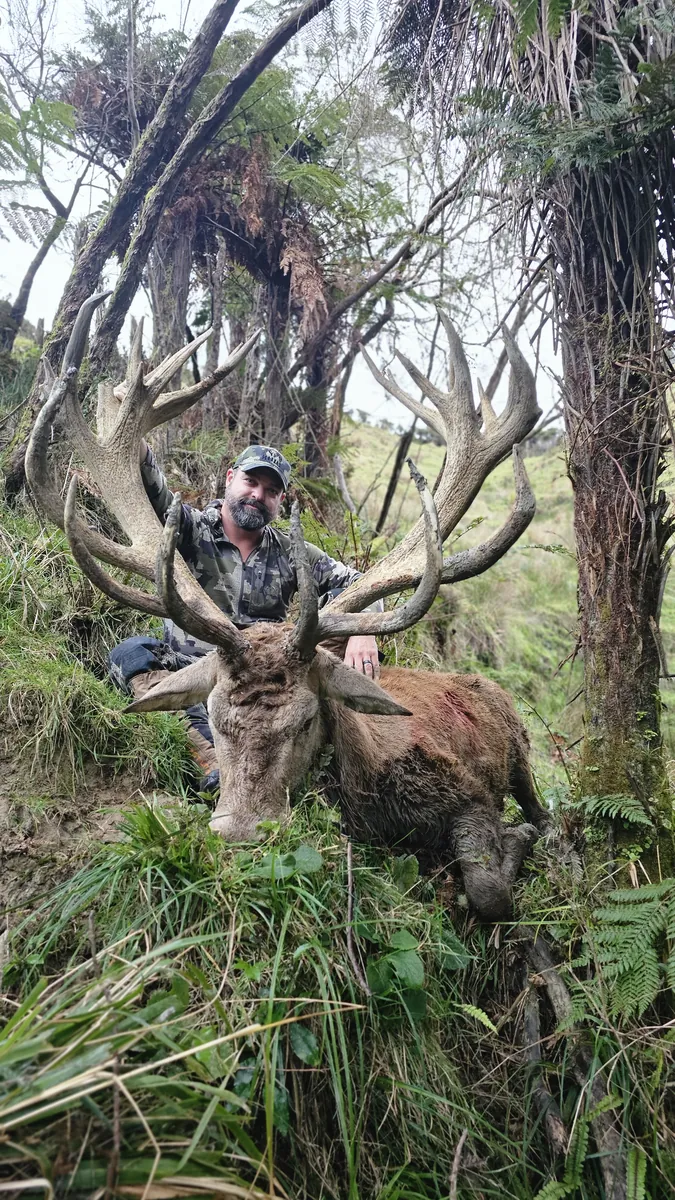
I’ve never killed a big one. I’ve killed a couple, but I just love doing it. I love the terrain they’re in and everything about it. Same thing with elk, elk is up there. I did get to go to New Zealand and do the red stag.
KURT BELDING · 56:34
What’d you think? Did you do it during the roar?
SAM McGOUGH · 56:34
I didn’t do it during the roar, so that’s one of the things I regret. But it was fun. It’s not as challenging, you’re going up and down hills a lot, and it’s slick and wet, but there’s no altitude. I was out in the middle of the North Island in some pretty steep country. They’re really cool animals, and New Zealand is just full of animals. They’re everywhere.
KURT BELDING · 57:18
It’s a very pretty, cool place to hunt. I did the South Island for tahr, and it was super cool. New Zealand’s awesome, man, and the barrier of entry is actually not that hard once you understand it. There’s just that long flight to get there, but a do-it-yourself hunt on the South Island is not impossible. You can pull it off.
SAM McGOUGH · 57:18
I bet. We didn’t hunt the South Island, but we visited and did a helicopter tour and saw all the places. If I ever go back to New Zealand, I would just go to the South Island. It’s beautiful there. Well, man, I really enjoyed getting to know you a little bit on this podcast. If people wanna connect with you and learn more about your businesses, where can they find you?
KURT BELDING · 57:59
Everything’s on the website, westernobsessionstv.com. You can find all the episodes, all our trip listings, and see our team. To see more of what I do day to day, the more personal stuff, that would be Instagram and Facebook. Search Western Obsessions or Kurt Belding, either one.
SAM McGOUGH · 58:42
Very cool. Well, thank you again, Kurt. I really appreciate it, and hopefully we’ll see you and talk soon.
KURT BELDING · 58:42
Yeah, thanks, Sam. Appreciate being on, man.