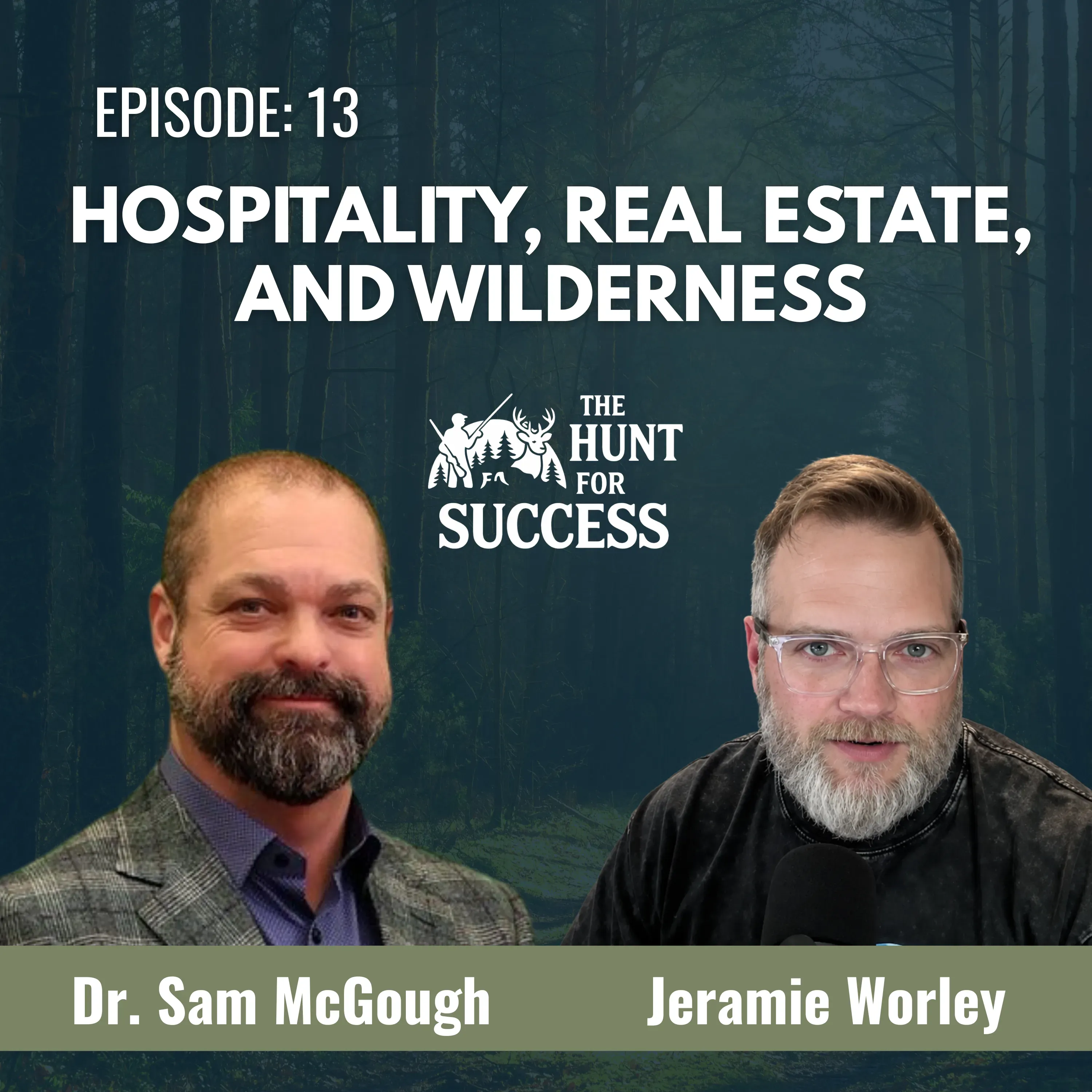
Episode 13 with Jeramie Worley. Automatically generated and lightly edited for readability.
SAM McGOUGH · 00:40
Thanks for tuning into the Hunt for Success podcast. Today I’ve got a special guest — Jeramie Worley. He’s been in real estate, and he’s got a property called Lake Longbow where he hosts executives, gives them a retreat, lets them do a little hunting, sit by a fire, all of that. Jeramie, welcome to the show.
JERAMIE WORLEY · 01:00
Thank you for having me. It’s quite an honor, because this is one of my favorite topics ever.
SAM McGOUGH · 01:20
Tell us about your history, and then about Lake Longbow.
JERAMIE WORLEY · 01:35
I’ve been in hospitality and real estate a long time — specifically Airbnb-type properties. I wrote one of the first books on investing in Airbnbs, published it in 2016. My wife and I started acquiring and operating short-term rentals in 2006, before Airbnb was even invented. So we got to watch short-term rentals break out through the worst real estate economy in history. And I didn’t realize how much I loved hospitality. Hospitality means I’ve thought of you before you’ve arrived. Kelly and I care deeply about people recharging and having margin in their lives — partly because we’ve had margin forced into ours, with medical issues with our kid. You don’t get a choice about making time for that. So I’m passionate about connecting with executive guys who are burnt out, overrun, with relationships they want to fix. There’s no better place to start than getting in the woods, getting recharged, and coming back out the man you’re supposed to be.
SAM McGOUGH · 03:05
I grew up hunting, and a lot of the guys I talk to did too. Are you going after people who’ve never been out in the woods?
JERAMIE WORLEY · 03:20
Not exclusively, but I love challenging those people when I find them. As the rental business grew I started going to masterminds to connect with other regional operators and CEOs. And in those one-on-one conversations I realized I was the unique one. A redneck from the Ozarks. People would say, “What do you mean you like to roll around in a Razor and get muddy? What do you mean you actually like to hunt? What do you mean you want to take ten days off in the middle of November and not talk to anybody?”
SAM McGOUGH · 04:40
So how did you find the property?
JERAMIE WORLEY · 04:55
COVID created a vacation renaissance — the minute things opened back up, recreation spiked like crazy. Around my birthday in 2020, Kelly and I and our best friends rented a cabin on a massive private hunting retreat. That place had red stag on it. Watching a herd of red stag run across the road was a watershed moment for me. Private lake, amazing fireplaces, acreage you could hunt. I was hooked. So I started looking, and everything was two million bucks, two million, one million. Then this one came on the market — about 30 minutes farther out than we wanted. I called my business partners, Lisa and Matt, and said, “Let’s make an offer.” We made it before we’d even seen it.
SAM McGOUGH · 07:05
Wow.
JERAMIE WORLEY · 07:20
We drove out and toured it. Eighty acres with a ten-acre private lake, and the most incredible sunsets. I’m getting choked up saying it. We said, we’ve got to do this. That was a couple years ago, and since then it’s been remodeling, cutting trails, wildlife management, working with the Missouri Department of Conservation on a plan to manage the land properly.
SAM McGOUGH · 08:30
With landowners I talk to, the pride moves past the hunting into the management — this thing you’ve made flourish.
JERAMIE WORLEY · 09:00
Without a doubt. And the pride comes from using your hands. We’re executives — we work with our brains, we’re strategy guys. Now apply that brain to an emergency, because there’s always one on the ranch. First big one: water over the road, couldn’t reach the property. Turned out the culverts were completely jammed and hadn’t been maintained. Early spring, warm enough to be snake season, and we’re waist deep in waders pulling logs out of culverts. You could see a tiny whirlpool start where it began to drain — and we just drained the swamp. The road is dry now. There’s nothing that makes me want to attack my to-do list like being exhausted from working with my hands.
SAM McGOUGH · 11:46
Walk us through the property. We turn in the gate — what do we see?
JERAMIE WORLEY · 12:00
Coming up the gravel road you see the lake open up on your left, and you drive its whole length. We cleared out the old cabins, so it’s all grass now, gentle down to the water — locals can walk up and buy a daily fishing package. It’s stocked with black bass, crappie, bluegill. Canada geese part of the year, and this past winter I had six swans out there. You turn in and go down a gentle hill, and the road branches. Right takes you to a five-acre hay field we call the OM, because it sits down inside a bowl. Best stargazing you’ll find — no light pollution. We see meteor showers out there, and on overcast summer nights the fireflies come up in the trees. I feel more connected to God right there than almost anywhere, because it’s quiet enough to hear Him. Straight on takes you to the cabin — honestly a double-wide on a permanent foundation that we remodeled into something lodge-y. Sleeps sixteen, big covered deck so you can be outside in the rain, offset smoker for briskets and pork butts and spatchcock turkeys.
JERAMIE WORLEY · 14:51
Here’s the thing — I never really hunted until I was about 40. My dad didn’t, my grandpa didn’t. And frankly I didn’t love being cold, sleeping in a pop-up camper on public land, dragging a deer out. I want to get up a little before six, put coffee in a thermos, walk up the hill to my stand, and watch the world wake up one animal at a time — crows first, then squirrels, then the deer start walking by. Then you take one and bring the four-wheeler up. I didn’t realize it, but I wanted a luxury hunting experience. So I thought, I’ve got to offer this to people. Base price is fifteen hundred, with premium levels depending on the room, or a bunk room. Fishing package, hunting package, and what we call the VIP Whitetail Weekend. We pick you up at the airport, put you up at my place in Branson the first night with a mixer so you meet people from my circle. Next morning we test firearms — every man has to hit a dinner plate at a hundred yards. That’s the qualification, and it exists because we want a humane kill. Then breakfast, and we drive out. I watch these guys lose phone signal on the way, put their phones down, and fall asleep.
SAM McGOUGH · 18:00
When you get guys together like that, you don’t need an agenda. They’ll talk about what’s working and what isn’t. And the more they relate, the more they trust — it’s hard for high earners to be vulnerable, but you can out there.
JERAMIE WORLEY · 18:40
Here’s the thing. You take these high achievers and you cut their legs out from under them. You force them to take off their black belt and put on a white belt. I’ve got a good buddy — head of a very large organization, a man’s man, tons of business experience, has to be on all the time — who had never hunted. I loaned him my gun and watched him take his first deer on my land. We want everybody to have the chance to field dress it, but he didn’t want to, and that’s fine — we don’t force it, and there’s a guide at every station. So I was going to do it for him, and then I paused and said, “I want you to have the opportunity to harvest the heart.” He didn’t want to. He used every one of his professional social skills on one of our guides — “I would be honored if you would do this for me.” And this redneck guide just stared at him and said, “My nine-year-old daughter did this yesterday.” That executive grabbed the knife out of my hand and harvested the heart himself. We toasted that night. You prepare it like a filet mignon. He told me later he’d never felt like a man like that. Two months on we shipped him a cooler of processed venison to feed his family.
SAM McGOUGH · 21:00
I love heart. I was elk hunting a couple years ago with a guide who went on to win a season of Alone — survived a hundred days in the tundra. I’d walked past his room and he was sleeping on the floor. I asked why, and he said, “I spend so much time outdoors, I don’t want to get soft.” So we’re in the middle of nowhere, I kill an elk, he reaches in, grabs the heart, takes a bite, and hands it to me. What am I supposed to do? I took a big bite, blood running down my beard.
JERAMIE WORLEY · 22:10
What did it do for you?
SAM McGOUGH · 22:15
There’s a transfer. A rush. Something mental happens, and I understand why people did it back in the day. He said you’re taking on the energy of the animal. I’ve done it more than once now.
JERAMIE WORLEY · 22:40
I believe in it. Nose-to-tail eating is extremely healthy — the vitamins are in the organs, not the lean meat. Watch any carnivore. A wolf, a coyote, a bear — the organs go first. I did the same with my first deer. I prayed beforehand that God would provide the best of the land. Second time I’d ever been out, a big buck came through chasing a doe and stopped between two trees. I cheated toward the tree, figured if I missed I’d hit wood, and dropped him. I waited the appropriate time, walked up, and put my hand on him. Still warm. I’d never killed an animal in my life. I called him brother and said, “Your life will not go to waste. Your life force will transfer to me and my family, and I promise I’ll make it worth it.”
SAM McGOUGH · 24:20
Most hunters have more respect for that animal than the person eating a cheeseburger.
JERAMIE WORLEY · 24:40
I like poking at that. People say they don’t like hunting — fine, everyone’s entitled. But left unmanaged, the herd overpopulates and gets chronic wasting disease. We are the apex predator. And I’ll ask, “Do you eat hamburger? Have you ever killed a cow and skinned it?” You’re participating, you just don’t want to see it. Anybody who eats meat should have the chance to process an animal once.
SAM McGOUGH · 25:40
You mentioned faith earlier. There’s so much noise now, and everyone who hunts goes back to that quiet — the time they can actually listen. Are the guys you bring out having that?
JERAMIE WORLEY · 26:00
They are, and I keep it non-judgmental and unprogrammed. There are Christian guys out there and guys who aren’t. No requirement. But when somebody gets comfortable, things come out. Last time I had a pilot who flew Apaches — a missile went up through his rotor blades and didn’t hit him, four minutes from death. Guys get into those stories around a campfire and realize there’s more to life. Some want to give their hearts to the Lord, great. Some want a few too many drinks, that’s okay too. We had two brothers come out who hadn’t really seen each other, and the most fulfilling part for them was sitting in a stand together. We like when that happens.
SAM McGOUGH · 28:00
Shifting gears — you’ve had a lot of success in business. What are the key strategies people listening should take?
JERAMIE WORLEY · 28:20
We’re still in the middle of figuring it out, going into year five. But number one: it takes more time and money than you thought. Tony Robbins says most people overestimate what they can do in a year and underestimate what they can do in a decade. This is a legacy property — something I’ll pass to my family for generations — so I’m going to enjoy it while I build it. Number two, I’d have connected sooner with more people who need retreat-type experiences. A yoga group that wants paddleboard yoga. Groups of guys looking for a destination. Because our background was Airbnb, we just put it on Airbnb.
SAM McGOUGH · 30:00
And that didn’t work the way you expected.
JERAMIE WORLEY · 30:10
For an Airbnb to succeed you need proximity to amenities — a Branson, where eleven million people show up and you succeed falling off a log. I can’t tell you Airbnb made the numbers cash flow like crazy. Some years the property pays for itself, some years we subsidize it. But now I own my own private resort, and instead of spending $80,000 a year to own it I spend twenty or thirty. And we keep finding improvements. Opening the gentle side of the lake to the local community for fishing was a great one. There’s essentially no hospitality in rural Missouri — one motel and no Airbnbs — so we get real bookings. We hosted a utility crew running fiber for two months and they loved it, way better than a hotel.
SAM McGOUGH · 34:00
What about the hard parts?
JERAMIE WORLEY · 34:30
Let me tell you a horror story — or at least a real estate development story. We tore down the old cabins and put in four RV pads. Not stacked on top of each other like an RV park — pad, gap, pad, room to stretch out, right on the waterfront. Walk out your door and you can spit in the water, fish for your breakfast. Fire pits, all the sewer, all the water lines. We took a $70,000 home equity loan to do it. And then we had trouble with the well. It’s old, the casing had already been repaired, every remedy had already been tried. Looks like we have to replace it — probably twenty to forty grand more than we planned, depending on how deep we go. After that we’re fully operational, and we already have a great book of business to build on. But I can’t take this and sell it as a profitable syndication. It’s a retreat. It has appreciated almost a quarter million since we bought it, and that’s before the improvements.
SAM McGOUGH · 37:00
So how do you scale it?
JERAMIE WORLEY · 37:18
We could find one guy to buy a third. But I want more people to have ownership. So we’re looking at creating an LLC, selling a third of Lake Longbow in $50,000 increments, raising half a million, and giving those people rights to the property — your family can use it within reason, automatic invitation to the Whitetail Weekend. Culturally we have to align. I’ve got two and a half acres on the south coast of Kodiak, Alaska, that needs to become a fishing retreat, so if we get the right people we start at Lake Longbow and grow from there. But I’m going to interview everybody. You have to come spend a weekend with me, and I’ve got to know you’re not a jerk.
SAM McGOUGH · 43:00
Coming from hospitality is your edge. In the hunting world people are guides, not hospitality operators — they don’t always have that thought process.
JERAMIE WORLEY · 41:30
Here’s how you do it. When someone books the Whitetail Weekend, you send a great questionnaire. Any food allergies? My son and my wife both have serious ones. A guy came last year and said he’d never felt more cared for, because we prepared separate meals for him. That takes real effort, but because that margin was forced into our lives, it’s easy for us. We also ask, what’s your favorite snack? Favorite drink, alcoholic or not? And we provide it. There’s a box of good cigars, a full bar. We don’t want people drunk — we want abundance, so a guy can pour a Glenlivet over a couple rocks, sit by the fire, and tell funny stories.
SAM McGOUGH · 43:47
This isn’t your full-time gig. How does the rest of your business allow this much freedom?
JERAMIE WORLEY · 44:00
The stakes were high for me, so I prioritized it. I grew up at a cabin on Lake of the Ozarks — my parents went in with my grandparents on it. We were lake people. I’ve got memories I’ll never forget, and I wanted that for my kids. I’ve got slow-motion video of them running off the dock that shows up in my phone all the time. And professionally, I’m in real estate development anyway — I’ve got a 60-unit short-term rental syndication on Table Rock Lake right now, an $81 million project. So working on a half-million-dollar project is just fun. I get in the track loader and operate it myself instead of paying somebody. That’s therapy. I don’t need it to be super profitable, so the fear isn’t there.
SAM McGOUGH · 46:30
It sounds like you had to be intentional or the big projects would swallow it.
JERAMIE WORLEY · 46:50
I need time away from those projects. If I can get out there and rake and shovel and wear myself out, I love that Monday morning. We’re going for Easter, four-day weekend. My assistant already knows the top five things we’re tackling Tuesday. I can go wear myself out, show up sore to the nine a.m. meeting, and hit it hard. And the guys I’ve assembled out there — we’re doing multi-million-dollar deals together, and that was never the intention. The intention was to sit by a campfire and hunt. But the trust you build transcends everything you’d spend meeting people at masterminds.
SAM McGOUGH · 51:20
Any words of wisdom before we go?
JERAMIE WORLEY · 51:40
Go for it. The best advice I’ve taken from the Y Combinator world is that if you’re not embarrassed by your first product, you haven’t launched fast enough. And don’t be afraid to turn the water on. When you’re plumbing a new property, turn it on — if it leaks you’ll know in seconds where and how to fix it. If you try to perfect the plumbing before you turn the water on, you’ll spend forever. I took a video before we closed on this place. I’m a little younger in it, a little less gray, my partners and my wife in the background, and I’m filming one of the old cabins saying, “I hope I have the courage to buy this place someday. I hope in ten years I can watch this and say I had the courage not to pass.” One of the best books I’ve read is Undaunted Courage by Stephen Ambrose, about Lewis and Clark. They were light on resources, didn’t know what to expect, and didn’t find what they hoped — but they brought back knowledge for everyone else. Nobody remembers the names of pioneers. They just build the highway everyone else drives on. By the time Lake Longbow is popular and commercialized I’ll be on to the next ten projects. It takes pioneers willing to get their hands dirty.
SAM McGOUGH · 55:07
Last thing — top three things you never leave behind when you go out there.
JERAMIE WORLEY · 55:20
My 9mm Hellcat by Springfield Armory. I carry concealed, and out there I get real practice — holstering, drawing, all of it. I’ve actually had to put a deer down with it that a poacher wounded. That’s a story for another time. Second, good fire starter and one small section of kiln-dried wood, so no matter how much rain there’s been I can always get the first fire going. And third, a journal, or my Bible — something that isn’t my phone and lets God speak to me. A lot of people pray out there and ask for things, but if you don’t sit and listen afterward you’re missing it. Sometimes He gives me direction, sometimes He tells me He’s proud of me. I keep a copy of Walden out there too, and my favorite line is in the first paragraph: “At present, I am a sojourner in civilized life.” That’s exactly how I feel, Sam. Like I’m meant to be out there — and when I come back to civilization, I’m putting on a costume.
SAM McGOUGH · 57:30
Man, that hit. Thanks again, Jeramie. We’ll have you back, and we’ll definitely get some hunting in. Thanks, everybody, for tuning in to The Hunt for Success. Until next time, this is Sam McGough signing off.