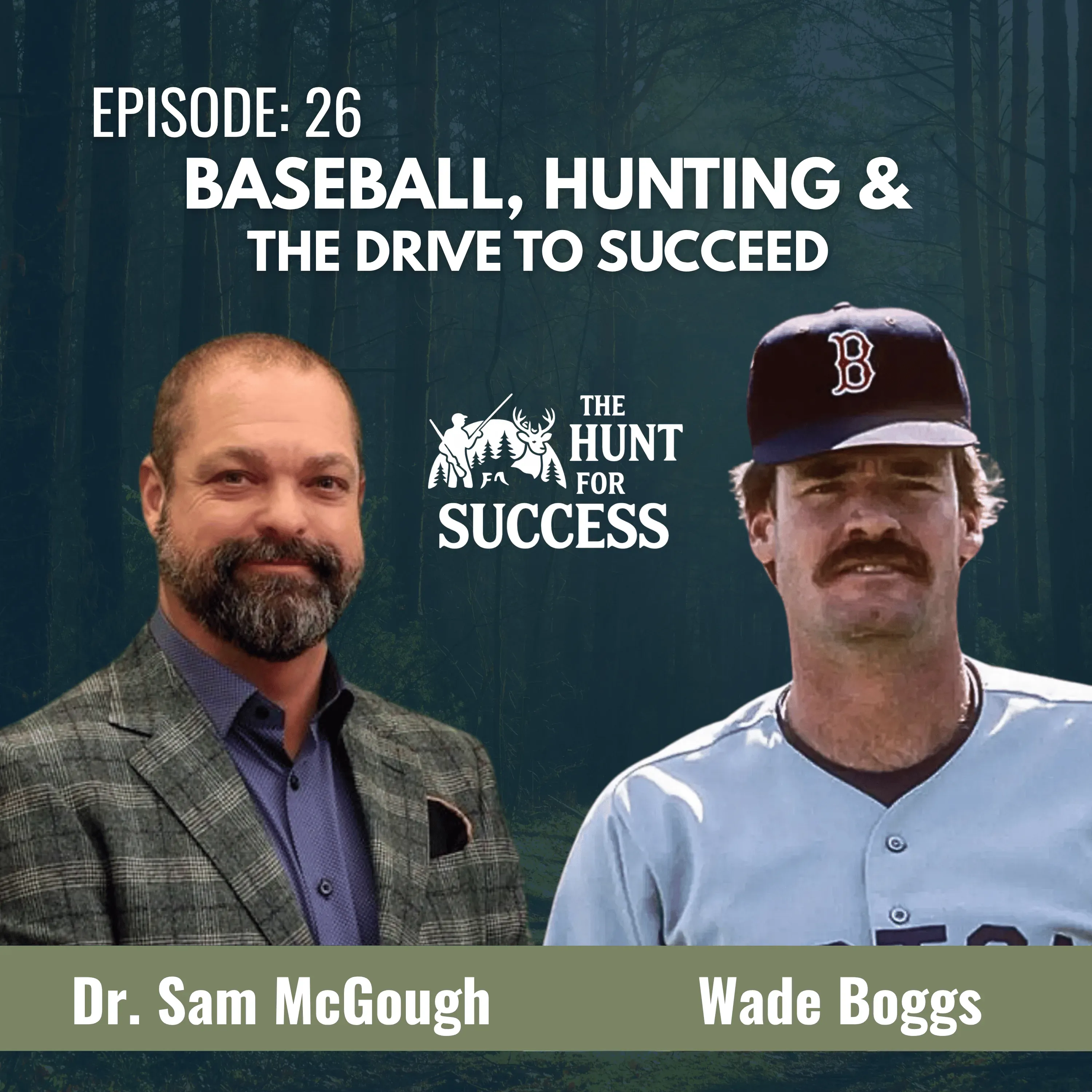
Episode 26 with Wade Boggs. An automatically generated, edited condensation of the conversation, not a verbatim transcript. Timestamps are approximate. Watch or listen above for the complete interview.
SAM McGOUGH · 0:00
All right. Thanks again, everybody. This is Sam McGough with The Hunt for Success, and I have with me Mr. Wade Boggs, a Hall of Fame third baseman. You may recognize the name Chicken Man, and he’s one of the only ball players to have over 3,000 hits in his career, so you definitely had a successful career. Thanks for coming on the show, Mr. Boggs. A lot of people may know you as a baseball player, but do you think a lot of people know you as an outdoorsman? You hunt, you fish, you do all kinds of things like that.
WADE BOGGS · 0:44
Well, I had a show on Pursuit Channel, Hitting the Outdoors with Wade Boggs, and I’ve co-hosted a lot of shows. Woods and Water in the Northeast, and Fin Chasers, chasing world records and various things like that. So I’ve had quite a lot of exposure to the outdoor industry, and met a lot of great people in it. Number one guy’s gotta be Ted Nugent. He’s number one on the list, if you know what I mean. But the outdoors, you know, that’s sort of the stress relief that you get to have, whether you’re sitting in a tree stand or on a boat fishing. That’s where I got my relief in the off-season.
SAM McGOUGH · 1:24
Exactly. We interview a lot of business owners and entrepreneurs too, and they kind of say the same thing. They’re so busy and focused on their job, and it’s the only time they can truly get away and let their brain relax a little bit. So that’s big. Have you always been an outdoorsman, even when you were younger? When did you start getting into the outdoors?
WADE BOGGS · 2:07
Well, I think the earliest memory that I have is fishing with my grandfather when I was three. But I was my dad’s bird dog. We’d go on dove hunts and quail hunts, and he’d shoot the bird and I’d run after it and get it. Then when I was probably 15 or 16, I was able to shoot the gun. I didn’t get into big game hunting until probably 1984, so I would’ve been 26 years old, and that was in Alabama with Buckmasters, Jackie Bushman and all those guys, just outside of Selma. That was my first indoctrination into big game hunting. After that, naturally, you don’t have a lot of time in the off-season, so it’s mainly elk or possibly whitetail or something along those lines. I really didn’t get into the super big game, like the Big Five and the Dangerous Seven from Africa, until I retired. And now I hunt sheep, and I’ve got the grand slam of North American sheep. Sheep hunting is late August and September, and normally during those times I’m hopefully still playing baseball and going to the World Series or something.
SAM McGOUGH · 3:31
So I was doing a little research about you, and I realized you had a very stringent training program when you were playing, in how you ate and how you trained and things like that. Do you think that helped your success, versus some of the guys who came and went, and helped you have such a long career?
WADE BOGGS · 4:17
Well, there’s 278, 280 players in the Baseball Hall of Fame, and I’m the only one with “superstitious” on his plaque. So that tells you a lot about where my success lied, in having a bunch of superstitions, and one of them was the chicken. I had to eat chicken before every game. But I probably had 75, 80 rituals that I went through during the course of a day preparing for a game, and a lot of those carried over into the game. That was sort of the peace of mind. I grew up in a military family, and you eat breakfast at the same time, you get on the school bus at the same time, you eat dinner at the same time, you wake up at the same time. So I was pretty regimented as a young child, and it carried over into my baseball career, because I would set times for when I was gonna do something. I had everything spaced out during the course of a day, and nothing really snuck up on me. That was the mental factor that sort of took over with all the superstitions. It put me in a different frame of mind where I’m not gonna worry about facing so and so. Those thoughts never really crossed my mind: oh my gosh, am I gonna make an error today, am I gonna lose the game. The superstitions just put you into a positive frame of mind. I don’t think if I’d missed five or six of them it would’ve affected my game, but we’ll never know.
SAM McGOUGH · 5:44
So using these superstitions, or rituals, allowed you not to focus on… because a lot of guys get in their heads about who they’re facing, or the other team, or whatever.
WADE BOGGS · 6:31
Oh, absolutely. That’s why a lot of guys don’t have success in the big leagues. The pressure, number one, to perform in front of 40, 45,000, 50,000 people. They don’t really have that in the minor leagues. You’re gonna have large crowds to a certain extent, but the main focus young players have nowadays is to make the big leagues, and once you get there, the tough part’s staying there. But with a lot of guys hitting .210 in the big leagues nowadays, I don’t think they send too many guys down anymore.
SAM McGOUGH · 7:12
Now, you spent a few years in the minors. Did that change you, or make you work harder to get there? Because a lot of guys kind of stall out in the minors.
WADE BOGGS · 7:12
Yeah, I spent five and a half years in the minor leagues, and my last year in Pawtucket I led the league in hitting in 1981 and didn’t get called up to the big leagues. That was kind of eye-opening, to the fact of, what do you have to do to get to the big leagues? Ten days later I’m in Puerto Rico at winter ball. I played down there, then finally got put on the 40-man roster and made the club out of spring training in 1982. But I was playing a game I grew up all my life playing, and I enjoyed it. It really wasn’t up to me if I was gonna make the big leagues. I was doing everything I could. I hit .300 five years in a row in the minor leagues, won a batting title in 1981, finished second a couple other years. I just thought, “Hey, the ball’s in their court,” and I continued to perform. That was the direction I went in.
SAM McGOUGH · 8:42
Did you have some of those rituals in the minors that allowed you to focus on the process, as I’d call it?
WADE BOGGS · 8:42
Actually, not to that extent. Probably the Chai sign that I drew in the batter’s box before I got in, wishing myself good luck. But the chicken didn’t come until 1983, 1984.
SAM McGOUGH · 8:42
Did you just have a good game and think, “I’m gonna stick with this”? I know you had more processes. Was there some sort of criteria you had to meet to put one on or take it off?
WADE BOGGS · 9:24
Well, in actuality, my wife is gonna write a cookbook with my mother and grandmother, a chicken cookbook, and we called it Fowl Tips. Little play on words there. And I wound up winning a batting title in 1983, so I had chicken all the time, and it was like a monster success at eating the chicken. I think the overall number of superstitions sort of grew once I got to the big leagues. In the minor leagues it’s kind of difficult, but you try to get to the ballpark at the same time every day and eat at the same time every day. Little things you can do, like step over the line going out and step on the line coming back in. But once you get to the big leagues, that’s when the laser focus starts.
SAM McGOUGH · 10:04
So do you carry any of these superstitions over to the outdoors, to your hunting and fishing?
WADE BOGGS · 10:04
I might have a lucky hat or something like that. But thank God I dropped all the OCD. I’m not really consumed. I’ve got lucky charms, like a deer charm or a marlin charm when I go fishing, to that extent. But thank goodness I’m not very superstitious in the outdoors.
SAM McGOUGH · 10:45
Man, I am. Every time I go fishing, I have to eat a can of Vienna sausages.
WADE BOGGS · 10:45
Oh, love those. I grew up on Vienna sausage and saltine crackers.
SAM McGOUGH · 11:26
Exactly. That’s what I would do, and I’d pour the juice in the water. I don’t know why. We were striped bass fishing, I did it one day, I got into the habit, and now I do it every time. I’ve had some really good fish. Hunting, not so much. I’ve got a lucky hat, but that’s really it. I think athletes and hunters and fishermen are very superstitious in general. I know a lot of guys who have lucky underwear, something that if it gets lucky, you need to stick with it. Do you find any parallels between hunting and fishing and your playing career? I know we use hunting and fishing a lot of times as a way to get away from the pressure, but is there any parallel between playing ball and going out there and getting a deer or a stag?
WADE BOGGS · 12:14
Well, I think there’s a lot of parallels between athletics and the outdoors, because you wanna be successful in your occupation, and my occupation was baseball. When you translate that into the outdoors, like I said, I’ve got the grand slam of North American sheep. I tried to do it in one year. I always wanted that. I always wanted the Big Five, Dangerous Seven from Africa, and I’ve got the royal billfish slam of all nine billfish. These things drive me to be the best at that. I’m still looking for that 170-plus whitetail. I went to Tajikistan Marco Polo hunting and wound up getting a 59-inch Marco Polo. Especially when you’re sheep hunting, it’s so difficult. You’re on a 12 to 14-day sheep hunt, and it wears at you mentally. It breaks you down, and then it turns physical. You start struggling, because it’s very hard to train in Florida for a mountain hunt, and you’re hunting 8, 10,000 feet. In Tajikistan we were at 16,000 feet. That was kind of crazy.
SAM McGOUGH · 13:43
Wow. Did you get there early to get acclimated to the mountain?
WADE BOGGS · 14:28
No. We had 24 hours to get acclimated, and there’s not a lot of oxygen at 16,000 feet, believe me. You’ve gotta be mentally tough as well as physically tough. You’ll be five days into a sheep hunt and haven’t seen anything, and you don’t wanna get skunked, naturally. I was very blessed. Every sheep hunt I went on, I was able to take one, and a lot of guys can’t say that. They walk the mountains for 12 or 14 days and climb and put in miles and miles, carrying a 40, 50 pound pack, sleeping in a tent, with grizzlies all around. The anticipation, the excitement, all of that sort of correlates to the baseball atmosphere too. Your adrenaline’s through the roof. When I retired from baseball I was sort of an adrenaline junkie anyway, and I’m sitting on the couch going, “This is terrible.” I needed something to really float my boat, and that’s when I went to Africa. Believe me, Africa is the adrenaline capital of the world. We have Busch Gardens here in Tampa, and it’s Busch Gardens without the fences.
SAM McGOUGH · 15:22
I’m heading over there in 2027.
WADE BOGGS · 16:03
There are a lot of correlations, because getting back to baseball, like you’d just expressed with the mental part of guys who can’t handle the big leagues, you get worn down at the end of August, September. You’re just physically beat, and then you’ve gotta flip a switch and get ready for the playoffs. You’ve got three out of five here, four out of seven here, and if you’re lucky enough to go to the World Series, you’ve got four out of seven there. And you’ve already put in 35 games in spring training. So when you go all the way to the World Series and it goes to game seven, you’ve probably played close to 230 games, and it beats you down physically. But I think the mental aspect of getting to the playoffs puts you into another gear, and that’s the enjoyable part. It’s really chilly, and naturally in Boston and New York at the beginning of October it’s kind of cold, but it’s sort of a shot of adrenaline and gives you a little boost.
SAM McGOUGH · 17:29
I can’t imagine the mental side of that. The physical side you can train for, but the mental side could definitely wear you down.
WADE BOGGS · 17:29
Well, the good part about that is, after 162 and you’re going to the playoffs, your batting average is zero. Even if you had the worst year, your batting average is zero. So you can go out the first game of the playoffs, get a hit, and you’re hitting 1,000. It’ll change your attitude in a hurry.
SAM McGOUGH · 17:29
Wow. You grew up in the Tampa area, am I correct?
WADE BOGGS · 18:10
Yeah, I moved to Tampa when I was 11, in ‘69. My father had just retired from the Air Force in ‘67, and we were living in Brunswick, Georgia. He was working for a department store called JM Fields as a security supervisor, and then they gave him a promotion to cover the Southeast, and the promotion was moving to Tampa. I’ve been here ever since. Great city. I’ve seen it grow so much, not only in population but sports-wise, with our Lightning, the Tampa Bay Bucs, the Tampa Bay Rays. Now the Rays just approved their stadium, and it’s moving to Tampa. It just keeps growing, and you kind of wish it didn’t, but that’s the progress you have to deal with.
SAM McGOUGH · 19:37
It’s a great town to stay in and a great town to fish in. Now, you’ve obviously traveled all over and had incredible success on the field, but also in the field. I know you said the sheep hunts are probably the toughest, but what do you think has been the toughest hunt for you?
WADE BOGGS · 19:37
Actually, I had more problems on my first Dall sheep hunt in the Northwest Territories, with cramps and various things like that. But I would probably say my elephant hunt. We had to walk for miles and miles, tracking the herd to find the old bull. I think one day we had 27 miles and the next day we had like 33, and it’s all on foot. You’re just following footprints and following dung, and at the end of the day you still haven’t caught up to them. It’s amazing how fast the herd moves. They just go along, knock down some trees, eat a few leaves, and keep moving. When we finally came up on the herd, there were probably 300, 350 elephants, and it was an amazing sight. They look like battleships.
SAM McGOUGH · 21:08
I can imagine the adrenaline on that one.
WADE BOGGS · 21:08
But the sheep hunts are the ones that get you, because you’re up and down, up and down, and you’re in a tent. On one of the sheep hunts we were charged by a grizzly, and oh my gosh, that’ll send you through the roof. We were on a Stone sheep hunt, and all of a sudden we see him up on the ridge, and here she comes. Thank God she didn’t have cubs. I gave my gun to my guide and said, “You know when to shoot.” I’d have probably shot her at 100, 150 yards. But she’s coming like crazy, and she goes rear end over teakettle at about 20 yards, turns around, runs back up over the mountain, and we never saw her again for the next 10 days. It’s on videotape, and it’s crazy. I asked my guide, “Why didn’t you shoot her?” He says, “The minute she smells you, she takes off.” And I went, “Golly, that’s good trust.”
SAM McGOUGH · 22:32
Have you ever hunted for grizzly?
WADE BOGGS · 22:32
I’ve got a cinnamon black bear from Saskatchewan, a coastal black bear off of Vancouver Island, and a black bear from Maine. So I’ve done the black bears. I’ve had tags for grizzly, but I’ve never been successful with the grizzlies.
SAM McGOUGH · 22:32
I wanna do that. I never thought I would like hunting bear until I did hunt bear. I’m leaving Thursday for Canada, and I’ve got moose, caribou, and bear tags, so hopefully I can get a big cinnamon.
WADE BOGGS · 23:13
Oh, good deal. What part of Canada?
SAM McGOUGH · 23:13
Manitoba. We’re heading up there for about three weeks, and hopefully I’ll film something.
WADE BOGGS · 23:13
Sounds like fun.
SAM McGOUGH · 23:13
It’s gonna be a good trip. It’s the first time I’ve moose hunted or caribou hunted, so I’m excited to see how that goes. But when you’re out on a hunt, I find I can walk for days, and the whitetail hunts are the hardest for me, sitting in a stand all day. Do you ever get discouraged, where it’s hard to keep moving forward on your hunts?
WADE BOGGS · 23:55
Never. One of the most difficult is the whitetail in Saskatchewan. They pick you up at 4:30 or 5:00 in the morning, put you in a ground blind at 25, 30 below, and pick you up after dark. You sit all day. Thank goodness it’s only a five-day hunt, because I don’t think I could survive it any longer than that. It’s such a long sit, but the great thing is these deer are constantly moving through the area, so you never know when Mr. Right’s gonna show up. Because it’s so cold there’s very limited food up there, but these big alfalfa bales they put out attract them like crazy, and you’ll see deer all day long. And naturally if you’re hunting in Alabama or Georgia, you’re sitting in a tree stand, but you’re normally out of the woods at 10:30. You go back and have some lunch, and that’s when the deer move, from 11:00 to 1:00 while you’re back at the lodge. Then you go back into the woods at 2:30, 3:00 and sit till past dark. But I just love the serenity of it. It’s so relaxing for me, and especially at my age now, having taken so many animals, my enjoyment is just interacting with nature. If you go home without your tag filled, it’s fine. I probably couldn’t say that when I was 20 or in my early 30s, but nowadays I just enjoy watching deer interact, especially when you’re a trophy hunter and you’re passing up deer that a lot of people would go ahead and take. When you’re shooting mature animals that are at the end of their prime, that’s rewarding and satisfying as well.
SAM McGOUGH · 27:01
It’s getting that way with me now too, as I’ve gotten older and been able to take more. Beforehand, you would rationalize why to shoot the animal. Now you can really sit down and go, “Well, I’ve got one that size or bigger. I don’t need to kill that guy.” On my own land, I’m a lot more conservative than I was back in the day. So I understand that, and I think our ideas of success change as we age.
WADE BOGGS · 27:41
They really do. They really do.
SAM McGOUGH · 27:41
In your career, did you have an idea of what you would consider a successful career, or did that change over time?
WADE BOGGS · 27:41
Granted, my first goal was to make it to the big leagues, but I was not really a goal-oriented person. I would say it was more of a drive than a goal, because I feel like if you set goals, you’re setting a ceiling. I never wanted to sit there and say, “Okay, 200 hits are gonna be my goal.” I’d have never had 240 hits in a season if that was the goal. I sort of treat goals as setting the ceiling, and once you get to it, then it’s a letdown. There were some times I got to 200 hits and I still had two weeks to go in the season. I think you’re more apt to have team goals, which is let’s make the playoffs, let’s make the World Series, and those are more realistic than personal goals. After 10 years I had 2,000 hits, so the light at the end of the tunnel for 3,000 became more of a focus. That was the drive, that I’d have to play a little bit longer, and I wound up retiring at 41 but accomplishing the 3,000 hits. That was the one, not goal, but plateau that I wanted to get to.
SAM McGOUGH · 29:14
You talked about team goals versus personal goals, and I think about that in business. How did you help your team get to those goals? Do you remember having to rally people, or how did you lead on those teams?
WADE BOGGS · 29:54
Well, the majority of my career I led off, so I felt like if I did my job, we were gonna score runs to help the team. I was never a rah-rah guy. Probably the only speech I ever gave to a team was in the back of the plane going to Atlanta in ‘96. I stood up and got everyone’s attention and said, “Hey, I know how Atlanta feels right now, because I’ve been in their shoes.” In 1986 we were going back to Boston up 2-0, and we did not wanna go back to New York at all. We wanted to close it out in Boston. Well, that didn’t happen. So I told everybody on the plane, “Let’s go into Atlanta, take numbers, take names, get back to New York, and we’ll win this thing.” We went in, won three games, went back to New York, and won game six to win the World Series.
SAM McGOUGH · 30:51
Growing up in Alabama, I was a Braves fan, so I remember that quite well. Congratulations on that one. That one stung.
WADE BOGGS · 30:51
Yeah. You guys were up 2-0 and it looked bleak.
SAM McGOUGH · 30:51
It was a good season for us, and that’s how I have to keep remembering it. I interview people all the time who have success in their careers, and they typically start getting into hunting. Some got into it young, and some got into it as they started having success, as more of a hobby because now they can. A lot more athletes have gotten into hunting now, a lot of ballplayers. I guess what I’m trying to ask is, where do these guys find their tribe when they get off the field? Because I know a lot of guys can get into some trouble when they retire early.
WADE BOGGS · 32:31
Well, the thing about it is, a lot of these guys make so much money that they fly their own Learjets to hunting places. They don’t have to get on a regular commercial flight. They can jump on their private jet and be up in Canada before you know it. When you have 25 guys on a team, you’re probably gonna have seven, eight, nine hunters. You’re gonna have guys that have never hunted in their life, and some guys are more fishermen than hunters. Those guys sort of flock together. Maybe they sit around having an adult beverage together, and you sort of gravitate to those types of individuals. In the off-season I’ve fished and hunted with Jimmy Key and Mike Stanley and John Dopson, Steve Howe in New York, and various other players. We’d plan a trip in the off-season, whether we’re going to Costa Rica or Key West or Canada. And a lot of times we’d try to find places to fish during the season. We’d find some farm ponds in Kansas City and go catch a bunch of bass, and we’d go salmon fishing in Oakland and Seattle. We had people that would take us out, especially in Chicago. You get to know a captain or two and you get to go salmon fishing on Lake Michigan. It passes the time. A lot of guys play golf during the season, and that’s their big go-to thing.
SAM McGOUGH · 34:41
That’s good too.
WADE BOGGS · 34:41
So they’d wake up and go play golf, and we’d wake up and be in a bass boat by 7:00 in the morning, be back before lunch, and then off to the yard to play the game that night. It’s relaxing, it really is. Especially in Boston, oh my gosh, we’d striper fish and bluefish after a Sunday day game, or on an off day we’d go down to the Cape and striper fish. Those are the things where you get away from it a little bit, and it sort of rejuvenates you.
SAM McGOUGH · 35:22
You’ve had an opportunity to do just about every kind of hunting and fishing there is, it sounds like. Is there anything you’re missing?
WADE BOGGS · 35:22
I’m trying to build an ark. I’ve got about 270 animals in my house, and it’s just all passion, especially since I got out of the game. I would love to go sheep hunting in Mongolia, but the world’s a different place now. I chase big fish around more now. My last piece of the puzzle for the billfish is gonna be the thousand-pound marlin. That’s gonna be the coup de grâce for the billfish, to finally get one over a thousand pounds. A 580 black is my biggest, that I caught down in the Galapagos. I love chasing big marlin. Costa Rica is a great place for sailfish, and I’ve caught a few marlin down there, not overly big. I fished the Indian Ocean for black marlin when I was in Africa, Hawaii, Cabo San Lucas for striped marlin. For me it’s a lot easier chasing big marlin nowadays than spending 25, $30,000 on a hunt.
WADE BOGGS · 37:28
And it’s gone through the roof, it really has. I just saw the other day that an outfitter in Canada is offering a Stone sheep for $110,000. My goodness, it’s astronomical. Even the bears are in the 40 range. Yukon moose are 35, 40. So you’ve gotta be sort of independently wealthy if you wanna continue hunting as an older individual.
SAM McGOUGH · 38:51
I was just looking at a hunt in Mexico for a bighorn sheep, and it was like 50 or 60, I think.
WADE BOGGS · 38:51
That’s the low end. With the right outfitter it’ll be anywhere from 80 to 100. Fifty to 60 is probably not a lot of frills, if you know what I mean.
SAM McGOUGH · 39:34
Not a lot of frills. Likely to get cartelled. It is getting tougher, like you said. It’s a different type of world. There are a lot of places I want to travel, for hunting and just in general, that we’re having to think twice about.
WADE BOGGS · 39:34
Exactly. It’s a shame. There’s a lot of great hunting in Mexico, but the dynamics have changed so much down there that it’s just not worth it.
SAM McGOUGH · 39:34
It’s such a big money thing now, too, and that attracts the wrong kind of people. I just read an article about some guys who got hijacked and almost lost their lives. I had almost planned to hunt down in Sonora, and I just said, “Okay, maybe…”
WADE BOGGS · 40:15
That was the crazy part about going to Tajikistan. You’re right next to Afghanistan, and you’re in kind of a crazy situation. And I was tur hunting in Azerbaijan, which is right on the border of Iran, and that was kind of dicey, but the people were wonderful. They couldn’t have been nicer.
SAM McGOUGH · 40:57
That’s interesting. I missed my chance in New Zealand to do the tahr, and I want to go back and do that.
WADE BOGGS · 40:57
Well, you go, take me. The chamois and the tahr are the two that I would… I mean, even throw in a red stag, because you said you took one from New Zealand.
SAM McGOUGH · 41:39
What I missed was the South Island. I don’t know why I wasn’t thinking when I was down there. It’s a long flight, but if I go back, which may be 2027 or 2028, I’ll let you know. I took my wife on that hunt, and she loved it. She normally doesn’t go anywhere with me like that. I’ve got a farm that’s off-grid, a cabin, all this stuff for hunting, and she’s never stepped foot on that ground. My kids have all been down there to hunt. But I took her to New Zealand and she absolutely loved it, because there were wine tours and massage therapy and all this good stuff. You’ve never been to New Zealand?
WADE BOGGS · 42:21
I heard it’s wonderful. No. We were at the SHOT Show, my producer and all of us, going around to various booths, and there was one outfitter there from New Zealand who discussed chamois and tahr. He says, “Oh yeah, come, and everything’s carte blanche.” I had the opportunity, the guy was gonna throw everything in, and we were gonna film it, and then six months later they pulled the plug on the show, and so they pulled the plug on New Zealand. I went, “Oh my gosh. I should have just called the guy and said, ‘Hey, I’m coming anyway.’”
SAM McGOUGH · 43:43
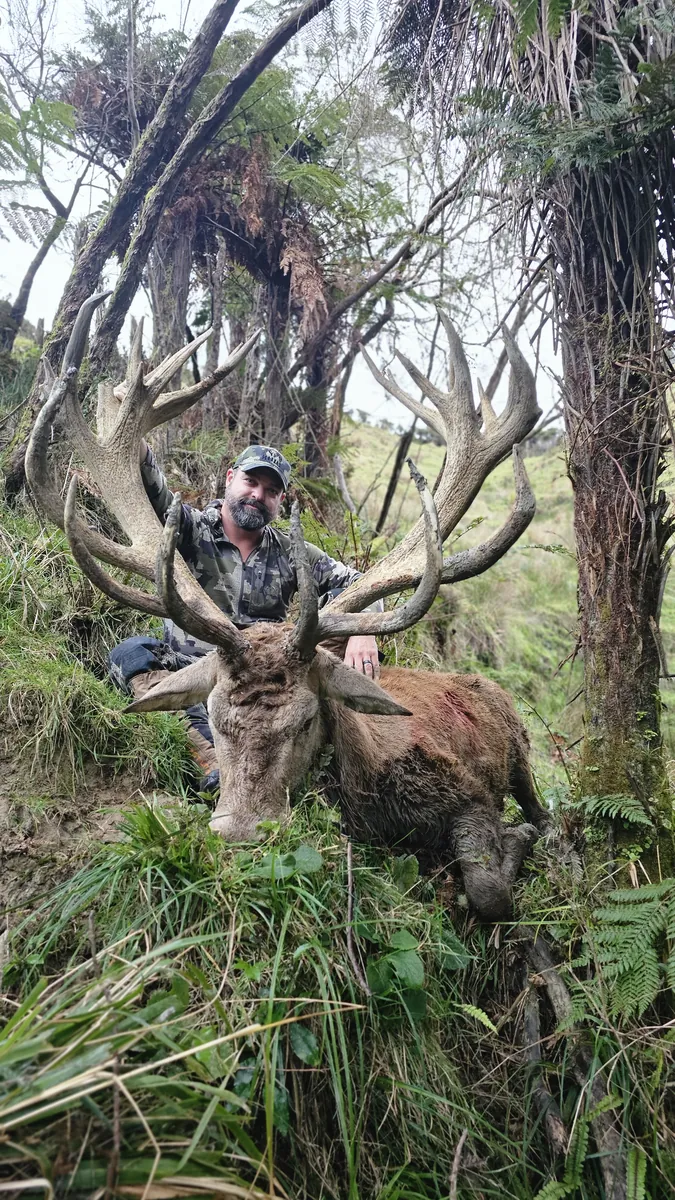
I’ve got a good outfitter down there that I love, and they’ve got so many other things on the North Island too. I killed a fallow and a stag while I was there, and then I ended up killing an elk. It’s a shooter’s paradise, because around every next hill there’s something else. Really nice stags, a really pretty big fallow, and that elk I think was 440-ish. I saw him three days in a row, and on the third day I said, “I can’t pass this guy again.” My taxidermist said, “You better make sure you put some extra stuff on the wall to hold this guy. He’s heavy.” If you’re a big game hunter, it’s a good atmosphere. I’m from the South, and the weather was about like hunting Tennessee, high 30s to low 50s, with sporadic rain but nothing bad. They have these possums you can go shoot at night, furry things so soft they take their wool and mix it with merino. They’re invasive there, so you can shoot as many as you want, and same thing with does. They said, “We’re gonna give them away to everybody, feed the dogs, feed everybody.” I think I killed seven fallow does, and I was picking them out for their hides, a chocolate one, a spotted one, a white one. I’m making throws out of them. It wasn’t bad hiking, because even though it’s up and down and pretty steep, there wasn’t much altitude. It was one of the best experiences hunting-wise I’ve ever been on, as far as the lodge and how they took care of you. What’s your plan for the rest of the year? What have you got going on?
WADE BOGGS · 47:22
Nothing. I have zip.
SAM McGOUGH · 47:22
Well, we gotta get something up our sleeve. If I can fit it in, I’m gonna take a group of guys fishing out of Tampa, nothing special, probably some time in November. I’ll invite you if you want. What’s in season down there in November?
WADE BOGGS · 48:07
Trout, snook, and redfish. We normally have a pediatric cancer tournament during that time. The big female reds come in to spawn, and depending on how cold the days get, the snook may get lockjaw. Trout are always gonna bite. But if you get some nice warm days, you’ve got a chance of catching 45, 48-inch snook. Those are monsters.
SAM McGOUGH · 48:48
Good eating too. My first experience with tarpon was snook and redfishing down in Tampa Bay. We were catching bait and ended up catching a couple of Spanish mackerel, and the guy said, “Let’s cut them up and see what happens.” We threw pieces out there, and in 10 seconds we had tarpon on, and they were jumping. It’s still my white whale. I’ve gone tarpon fishing every year for about six years, and I’ve never landed one. I’ve had them on, had them jump, had them within 10 or 15 yards of the boat, and never caught one yet. I go down there every May now, and eventually I’m gonna get one in. The last two years, we’ve caught nothing but sharks.
WADE BOGGS · 50:19
I just did a show for a guy down here, and we went tarpon fishing at the Skyway, and it was shark heaven. We couldn’t keep the sharks off the bait, and the tarpon were all around us. But with the sharks around, they get real skittish, because they know that if they get hooked, the shark’s more than likely gonna take on the tarpon.
SAM McGOUGH · 51:41
I want to hit something real quick. I know you went through a bout of prostate cancer and beat it. Are you still involved as far as advocacy?
WADE BOGGS · 52:26
Oh, absolutely, 100%. It’s something men have to take seriously. My score was only 3.3, and they really don’t start checking it until after four. In eight months it had gone from 2.3 to 3.3, and my wife, Debbie, asked our neighbor, who’s my urologist, “Is there anything to sort of ease Wade’s mind?” He said, “Well, we can have an MRI.” The MRI came back suspect, and then I went in for the biopsy and had 11 of the 14 cancerous. So I did five weeks of radiation, five days a week, and hormone therapy. And last February 7th, 2025, I was cancer-free. It’s a long process, but since then it’s been amazing how many people I’ve come in contact with who have had prostate cancer. A lot of the Hall of Famers have had it, and I just found out three of my friends have it now. It’s easily checked. You do the PSA, keep a vigilant eye on that number, and don’t let it get out of hand. Just get checked every year. It’s very curable, as long as it doesn’t metastasize. If it metastasizes into your lymph nodes or other organs, that’s where it becomes the silent killer. Ryne Sandberg and I were diagnosed at the same time, and Ryne just passed away a year ago from it. So please go out and get your prostate checked. It’ll save your life.
SAM McGOUGH · 53:51
The statistic for men is that it’s almost inevitable. If you live long enough, you’re gonna get it.
WADE BOGGS · 53:51
It’s amazing how many men do have it. Some guys say, “Well, I’m not gonna die from it, I’ll die with it.” In a lot of cases, that’s not true. If it gets out of hand and you’ve got the bad one, it’ll kill you. There are various options. You can have it removed, but I went the radiation route. It’s definitely one of those things you put on your bucket list every year when you’re having your physical, to get your prostate checked.
SAM McGOUGH · 54:34
For athletes, their health is paramount to their career, but guys in general a lot of times don’t wanna look at anything. They just hope it doesn’t happen and wait until things are too bad. Do you think athletes are getting better about keeping their health up? A lot of guys still just don’t wanna go to the doctor. They don’t wanna know.
WADE BOGGS · 55:23
Well, I have a stress test for my heart every year as part of my physical, and we do it as athletes when we play. Every spring training, all athletes go through two days of physicals and blood work and various things like that. I think the older you get, that should be more or less routine. My dad always used to say, “I’m not gonna go to the doctor,” because he might find something. Well, that’s the reason you go to the doctor, so you can catch it early, get it taken care of, and go on your way. A lot of times they’re stubborn people, and then when they do find something, it’s too late.
SAM McGOUGH · 56:54
Do you have a routine now that you follow for your general health, to keep moving and stay active?
WADE BOGGS · 56:54
Oh, yeah. I have a gym in my house, so I work out three times a week, and I walk five miles every day. Speed walk. I retired at 41 and I weighed 202, and I weighed myself the other day and I’m 197. Gotta stay in shape. You never know when that one sheep hunt might call.
SAM McGOUGH · 57:35
That’s one of the things that keeps a lot of guys out of hunting in general. I’m from the South, so people are used to sitting. I’ve been going out west for years now, and most of the guys can’t handle it. They can’t do an elk hunt.
WADE BOGGS · 57:35
Oh, I know. A lot of people don’t think elk hunting is strenuous, but you put in a ton of miles, all day. And the gray ghost will fool you every time. They’re there one second, and then they’re over the ridge. It’s amazing how big elk can run through trees, lay the antlers back on their back, and just take off.
SAM McGOUGH · 59:40
Well, Mr. Boggs, I cannot thank you enough for being on the show today.
WADE BOGGS · 59:40
Good deal, Sam. A lot of fun, I appreciate it. We’ll have to get together and do something.
SAM McGOUGH · 59:40
Yeah, I’ll be glad to. I definitely wanna do something with you. So thanks again, everybody, from The Hunt for Success. This is me and Wade Boggs saying have a good one. We’ll see you on the next show.