Episode 17 with Matt Fourie. Automatically generated and lightly edited for readability.
SAM McGOUGH · 00:40
Welcome to the Hunt for Success podcast, where the boardroom meets the outdoor lifestyle. Today we have Matt Fourie. He’s a senior enterprise leader at Siemens Digital Industries Software, where he leads the General Motors business, Siemens’ largest automotive customer and strategic partner. Thanks for being on, Matt.
MATT FOURIE · 01:00
Thanks so much for having me, Sam. It’s great to be on. We had a great conversation earlier and I’m glad we met each other. It’s funny, I was able to ask you a lot of questions about different outfitters at SCI a week ago. I appreciate the tips. Such a small industry. Everybody knows each other pretty well.
SAM McGOUGH · 01:21
So you grew up in South Africa. What was that environment like?
MATT FOURIE · 01:30
I think it’s everything that America knows and loves. A lot of outdoors. South Africa has a really good economy for those that work hard. There’s a lot of disparity in the wealth gap, but if you’re willing to work hard and exercise a little bit in the wild west, you can do really well. A great place to grow up. I grew up in the farm community, then moved to the city in my teens, and then we came to the States when I was 30. So there’s my age. Nine, ten years ago.
SAM McGOUGH · 01:57
Were you introduced to hunting early, living out that way?
MATT FOURIE · 02:05
Absolutely. My dad was a hunter. He’s hunted his whole life, and since I was a kiddo he’s taken me out of the back of the truck to different lodges. A lot of our friends had farms, and if I reference a farm, it’s a hunting safari lodge. Your farm and my farm are totally different.
SAM McGOUGH · 02:20
Like Texas. People say they have a farm. How many thousand acres do you have?
MATT FOURIE · 02:30
Similar type of thing in South Africa. Anything smaller than that we’d call a small holding or a plot. I was introduced to shooting and hunting at a really young age, and then my dad took a job as a PH, a professional hunter, and game farm manager up north near the border of Zimbabwe. We lived on that property for a year, maybe two. That’s where we really got the taste of the bushveld.
SAM McGOUGH · 03:00
And then you stopped?
MATT FOURIE · 03:05
It’s interesting. I moved away from hunting just before my teenage years. We moved to the coast and I got busy surfing, and girls and bicycles and motorbikes and all the good stuff, and hunting was the furthest thing from my mind. The gun culture in South Africa is very different to America. Guns are nearly outlawed, to the point where trying to get a hunting rifle, even a pistol, takes a tremendous amount of effort and expense. So it was just out of reach. Then moving to the States really opened my eyes to what’s possible. I could go into a store like an Academy, pick up a rifle for under three hundred dollars, find a piece of land, and go shoot a deer that would feed my family for half a year. It was just a different economy of scale.
SAM McGOUGH · 03:54
Growing up the way you did shapes you. Have you taken that experience into the boardroom?
MATT FOURIE · 04:05
There’s a resilience you get growing up in a hustle country. South Africa is very much a hustle country. If you aren’t working the hardest, it’s not that you won’t come first, it’s that you’re going to come last, and there’s no in between. So you’re either working extremely hard and just making it, or you’re working extremely hard and you’re lucky and you make something of it. That forces a work ethic. You can’t avoid the hard work.
SAM McGOUGH · 04:30
You ever read the book, if you’re not first you’re last?
MATT FOURIE · 04:35
Ricky Bobby, baby. But it’s true. There’s a lot of agility you learn when you always have to be striving to survive. I didn’t have a formal education or anything like that. I’ve been working since I was seven or earlier, and I started out selling mangoes. We had two massive mango trees in our yard, and my brother, who’s older than me, we used to pick the mangoes and the locals would come past the house in the morning and buy buckets of them. Think of half a Lowe’s bucket, and we’d sell it for the equivalent of maybe seventy-five US cents, because we didn’t know how much things were worth and they were free to us.
SAM McGOUGH · 05:20
So how did that turn into a business?
MATT FOURIE · 05:30
I’m not an early morning guy. I’ll wake up early if I’m going hunting or fishing or shooting, but I hate mornings. The ladies used to go and sell the mangoes at the train station, so they’d come around about half past five. I was sick of it. So I said to a couple of them, hey, if you knock on my window, it’s going to be a dollar for a bucket. If you knock on that window, my brother’s window, seventy-five cents. That was my first thrill of an introduction into work, and into creating a business structure, and into hustling. From there it just didn’t stop. I don’t think I’ve not worked a day in my life. South Africa will shape you. South Africa will make you do things you didn’t think you’d ever be able to do, because you have to do them to survive.
SAM McGOUGH · 06:12
Were you able to transfer that attitude when you came to the States and started working?
MATT FOURIE · 06:25
Absolutely, and if you don’t pick it up you’re doing yourself a disservice. Coming to the States was a leveling exercise for me. In South Africa I’d done really well at a young age and I’m very proud of my achievements there, and coming to the States I didn’t really know anyone. To get into business at the level I was at in South Africa was nearly impossible. I didn’t have a college degree. No network, no college degree, African experience, living in the South where if you know somebody, that’s how you get in somewhere. And I love that about it. So I had to start at the bottom again. That resilience is knowing what you’re worth, knowing you can solve problems, having the humility to wait a little bit, and then pursuing the thing you actually wanted.
SAM McGOUGH · 07:15
And how do you go after it once you’re in?
MATT FOURIE · 07:20
Siemens is awesome in that you can wild west things here. They have good boundaries, but if you want to grow and take advantage of an opportunity, they’ll back you. Think of it like a baseball card. I created my own baseball card, essentially, where I’ve got all my wins and I know my hit rate, and if I’m going to go pursue something, I’m going to present that. Because nothing in life is going to be given to you. Without that fortitude it would be very difficult. I think that’s what you see a lot of coasting in big companies.
SAM McGOUGH · 07:56
You’ve been on teams, you’ve led teams, you’ve seen high performers. What separates them from the average performers? Is it just grit?
MATT FOURIE · 08:10
There’s a few things. Grit, for sure. Being able to take it on the chin. I think how you build your life outside of work is incredibly important. What values do you have? Do you believe in yourself? Do you believe in a higher power? Everybody prays when they’re in the foxhole. The stability I have in my life is really driven through my belief system. I believe in Christ, he gives me strength, and in the crappiest times I really believe that’s pushed me in the right direction. But having faith is one thing. You need a foundation and some disciplines to be able to execute that faith.
SAM McGOUGH · 08:55
What are the disciplines?
MATT FOURIE · 09:05
I’m a big fan of being mentored and seeking out mentors. I’m a mentee. I’m going to go find a mentor, I’m not going to wait for somebody to take me under their wing. I’ll say, I recognise that you’re incredibly successful, I want a little bit of what you have. I’ve got a post-it on my desk that I wrote down and keep here. Over-deliver. Make everyone smarter around you, so there must be something you can assist somebody with. Everyone is a mentor. Be authentic, don’t pretend you’re like somebody you’re not. And ask them how to improve in every conversation. That takes a lot of humility. Humility is something that’s been beaten into me, and it’s difficult to say I’m good at humility, but I know where I’m lacking.
SAM McGOUGH · 10:00
Most people don’t do that. And mixing in a strong faith matters, in the good times as well, not just the bad. You said everybody prays in the foxhole, but not everybody prays when everything’s going really well.
MATT FOURIE · 10:14
Absolutely.
SAM McGOUGH · 10:20
So tell me about a time when something blew up in your face.
MATT FOURIE · 10:35
Just name a typical Tuesday, dealing with the dynamics of large deals and large teams. There’s always something.
SAM McGOUGH · 10:50
You’ve had deals not go through. Did that shake you at your core?
MATT FOURIE · 11:00
Funny enough, and it sounds stupid, very few haven’t gone through, because I’m very real about opportunities. My kids hate this, but I always say I’m not going to play if I don’t win. Which means if there’s an opportunity, I’ve got to set myself up for success. Where there’s friction is the speed you have to run at to do that. With a long runway it’s easier. But anything to do with sales or with creating something takes pressure, and pressure is typically time. So the most challenging part is the speed I’m pushing a team to operate at, making sure people stay engaged and afloat and see recognition. All I need is a hundred percent, and most people don’t bring a hundred percent. All I want is a hundred percent for a hundred percent of your time, and that’s a lot to ask of people.
SAM McGOUGH · 11:50
So no big collapses?
MATT FOURIE · 12:02
I’ve had a couple of blows. One that comes to mind, I was running a large electroplating company in South Africa. Before I got into software sales I was the guy running the business, doing business turnaround. Going into that opportunity, I was focusing on the money a lot. I was busy climbing. Like I said, South Africa is a make it or break it environment, and this was one of those make it opportunities. But I was young, mid-twenties, and I went into this big business as the youngest leader with a bunch of people underneath me and I was punching above my weight, big time. I’d read a lot, but I didn’t have a lot underneath my fingernails as far as the dirt for actually doing the work. That, and some sketchy financial decisions the owner had made, really turned out to be a misstep.
SAM McGOUGH · 12:55
And then what?
MATT FOURIE · 13:05
I found myself looking for a new gig with two young kids in private school and a bunch of bills to pay. South Africa is extremely difficult to get a job in. Think 2009 US recession times five. Just collapse. I sent out over five hundred resumes, to contacts, to anyone who was in recruiting, and I got nothing. I got nothing. I just remember driving around in my little red car at the time, and I was crying. I was thinking, man, I’m going to get to the end of this month, and then what.
SAM McGOUGH · 13:55
What did that teach you?
MATT FOURIE · 14:10
The first call I made was to my wife. She’s the bedrock, she’s my foundation, and she said, hey, we’ve got this, God has a plan for you. And I said, yeah, it’s pretty murky right now. What does that mean? We have faith, but there was no answer right there, and waiting for that answer was incredibly difficult. Ultimately I got a job with a guy who became one of my mentors, and I ran a part of his business, which was extremely fruitful. Probably nine months of my best work, right before I moved to the States. It was really grounding.
SAM McGOUGH · 15:00
So what’s the takeaway?
MATT FOURIE · 15:10
Going after money is one thing, but there’s always another side of the coin. Some of these deals put you over your skis and you have the self-belief that you’ll be able to do it, and that’s not always the case. It’s like pursuing a hike. You’ve got a fifty-five-pound pack. You haven’t really trained for it, but you’ve watched enough Steven Rinella to think, ah, I can do it. And then you forget you’ve got to carry a twelve-pound gun, you need to take water in, and your boots aren’t broken in. You get to mile six or seven and you go, okay, this is real. And there’s six or seven miles back. There’s no turning back. You’ve got to be ready for that type of stuff. Don’t pursue if you’re not ready. You’re going to hurt yourself or someone else.
SAM McGOUGH · 15:32
Switching to hunting. You said you like to set yourself up for success. Do you apply the same thing to hunting?
MATT FOURIE · 15:45
I’m terrible when it comes to that. I love data, I’m a pretty logical bloke, I like doing research and seeing what’s the best I can get out of something. Some people hunt to shoot and some people shoot to hunt. I hunt to shoot. I love shooting. I’ve invested. I’m a one gun kind of guy. I’ve got one hunting rifle I use for deer and big game, and one I use for pigs and varmints.
SAM McGOUGH · 16:20
What are you shooting?
MATT FOURIE · 16:25
It’s a company out of the west called Gunwerks.
SAM McGOUGH · 16:35
I’m familiar. I’ve got a build sitting in my email from them right now that I don’t want to talk about. My wife said get it, and I said, God, can I justify that.
MATT FOURIE · 16:50
What are you looking at?
SAM McGOUGH · 16:55
7 PRC, the whole setup. Like you said, the one gun. I’ve still got a 300 mag, but this way I can go out west with it and do whatever I want. They have two that come in lefty and I’m a lefty. Is it the Magnus?
MATT FOURIE · 17:20
The Magnus is probably one of their best shooting guns. I have the Nexus. Aaron, the owner, I’ve met him a couple of times. Great guy, really smart. He’s on this thing called vertical integration. He’s insourced a lot of his procedures and his processes, and I’m a manufacturing guy, so when I see what he’s done, it makes sense. Once you buy the rifle, everything’s with him. I’ve got the Nexus and the bipod, which is very good.
SAM McGOUGH · 18:00
Did you see the new one that closes up into a little box?
MATT FOURIE · 18:10
I forget what it’s called, but it’s really cool. I had my hands on one at SCI last week. I love having a good solid foundation, something repeatable. I’ve had a few different guns in the past, a Savage and a Springfield, but there isn’t much out there from the factory that compares.
SAM McGOUGH · 18:30
You’ve hunted a lot in South Africa?
MATT FOURIE · 18:40
I’ve hunted a lot in South Africa. Success is a different story. When I was a kid I was out hunting a lot. I remember one time I was out with my dad, I was probably eight or nine, and we were hunting impala. We were driving along and saw a herd shoot across the road, stopped the truck, got out, and said we’re going to go see if we can find them. We walked and walked and walked. Eventually my dad said, there they are. And I said, where. He said, right there. And I couldn’t see over the grass. I said to him, pick me up. He said, buddy, if you can’t see, then you can’t shoot them.
SAM McGOUGH · 19:25
That’s a lesson.
MATT FOURIE · 19:35
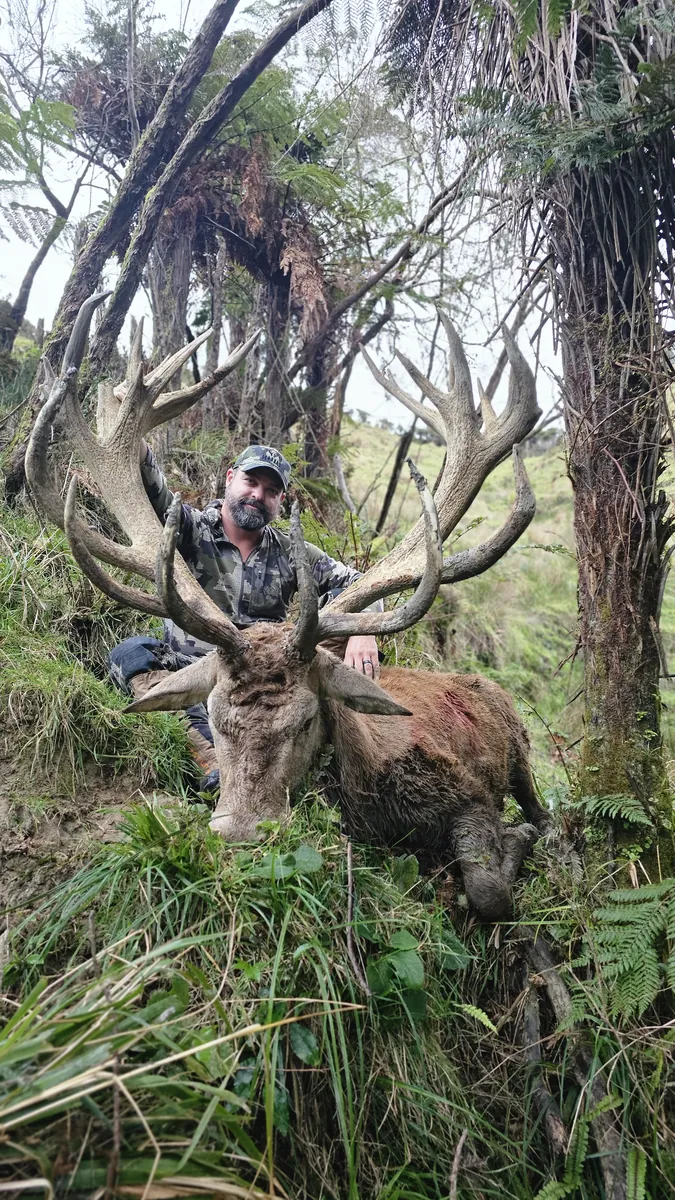
It was that forced waiting. It was terrible. I had a couple of those opportunities with kudu and things. And then I went back in 2024 to a family friend’s farm out there, a beautiful place called Greater Kuduland Safaris. He’s on 55,000 acres, been running it for decades. It’s his place, not a concession, a really special piece of property. Rekindled that friendship and had a really successful hunt. So it took a bunch of years.
SAM McGOUGH · 20:15
Sounds like something you’d bring a friend along for.
MATT FOURIE · 20:20
Absolutely. I was saying to one of my friends I’m taking in 27, I could probably do a month. I could go every single month just with people who want to go.
SAM McGOUGH · 20:35
Do you think the mindset of a hunter helps somebody be a better business leader?
MATT FOURIE · 20:50
Yeah, man. This is a conversation I have with my wife all the time. My son is not a hunter. He’s 16, and he’s in the same phase I was at 16. He loves sports and surfing and motorbikes. And there’s something I want to instil in him that I see in me and in other successful hunters. Different kinds of hunting bring different things out of different people. In the East there’s a lot of deer stand hunting, and that creates a lot of patience. I’ve never seen a more patient community. People can wait for stuff.
SAM McGOUGH · 21:25
And you can’t?
MATT FOURIE · 21:30
I hate waiting for anything. I want to go and fetch it. If I see movement in the woods I’ll bust the deer out. But pursuit is what’s drilled into you in hunting. That fortitude of saying, maybe it’s over one more hill and I’ll push a little harder. We have a couple of phrases we throw around in our hunting groups. One is don’t die, because my wife says that every time I leave. It means we’re going to pursue to the point where people say this is unreasonable. Go and be the unreasonable one. The other is hunt harder. Just hunt a little harder and you’ll be successful.
SAM McGOUGH · 22:40
And in business?
MATT FOURIE · 23:00
Same thing. When you get a no, there must be a reason for the no. It’s not the animal’s fault that it’s running away. You either winded it, or it’s seen your movement, or it’s heard you. Three things. Eyes, movement, hearing. So when you get a no in business it’s the same. Why did they say no? Are they wrong? Take a step back, think about it for a second. How was your approach? Do you have the humility to go back and tailor your approach next time? And the other thing is these animals don’t run away ten miles. You can go after them again.
SAM McGOUGH · 23:49
Being unreasonable is right. Too many people want to be reasonable and I’m like, it’s not. Most people succeed in business in time. They just last long enough and keep trying.
MATT FOURIE · 24:00
Like I said, don’t die. We see that with our largest returns in the States. The S&P is one of those things where people say you have to put it in there and outlast it.
SAM McGOUGH · 24:10
The other thing about hunting is it’s a life and death type of thing. There aren’t many places you have to make that kind of decision.
MATT FOURIE · 24:20
And making that decision over and over again, and not making it. There have been many times in the deer stand, because where I live I’m forced to do deer hunting, which is great and I’m grateful for it, where I’m not taking the shot. I just don’t want to. And I think it’s very powerful in business to be able to say no. A mentor of mine said that no is how you find your success.
SAM McGOUGH · 24:48
The dangerous game part of hunting is something I think about in business too. The thrill of the win or the loss.
MATT FOURIE · 25:00
Absolutely. Why do people go after Cape buffalo? It’s not that cool of a mount. I’ve got a gemsbok and it’s beautiful. But that animal staring down at you, that’s death, brother. They’re crazy, but you’ve got to be prepared for it. It’s not an emergency. If you’re going buffalo hunting, you’re going there with the right rifle and the right shoes that are quiet. Most guys that go to Africa don’t have the right shoes. It’s the silliest thing.
SAM McGOUGH · 25:35
What are the right shoes?
MATT FOURIE · 25:40
You want a really flat sole with no tread. Think sand. Think walking on the beach quietly. It’s very sandy out there. When I was a kid I was wearing Jesus sandals. But all that said, you’ve got to be equipped. Like I said at the beginning, I’m not going to play if I’m not going to win.
SAM McGOUGH · 26:11
And in sales?
MATT FOURIE · 26:20
There are conditions where other people make the decisions that let you win or not. I’m in sales. I still have to rely on somebody buying. The value can be awesome, just like you with the Gunwerks build in your inbox. They’ve done everything right, good marketing, good materials, good relationship, they’ll get it to you on time. You still have to buy.
SAM McGOUGH · 26:45
I don’t think people ever get sold. A salesman gets over their objections and gives them the right information.
MATT FOURIE · 27:00
Absolutely. What I do is the furthest thing from sales. I’m fortunate enough to work with some of the smartest minds in the industry. I put them, with a refined message, in front of people who have a need, and see if we can match that up. And if we can’t match it up, I’m going to pass the ball, because there’s no way I’m going to have my customer invest in a solution or an idea that’s not going to make them successful. My legacy is my name on the line. I’m going to have to fix that eventually, because I’m not just here for a flash win.
SAM McGOUGH · 27:45
If you’re really good at sales you could use it unethically. If you can talk somebody into something, but you’d be lying.
MATT FOURIE · 27:59
One of the approaches I take with each engagement and each large business decision is four qualities, and my decision has to hit all four. One is integrity. Are we operating under integrity? If I had to come in and do an audit, qualitative or quantitative, is there going to be full integrity there? Another is the highest quality. Are we delivering the highest quality product or service or promise? Sometimes we promise to do things, and we have to be able to execute that. The other is staff wellbeing, which means the people running your operations, are they being taken care of, is there an element of them being burnt out. And then cost. Are we doing this at the right cost? Because either it costs them or it costs us, and there needs to be a middle ground. We’re here not just to make friends. We’re here to make some money, and it needs to be good for both. So when I’m approaching somebody with a solution I’m thinking, what is this going to do to their revenue? If it’s not going to increase their revenue, how can we expect them to buy?
SAM McGOUGH · 29:20
How do you define success?
MATT FOURIE · 29:35
That’s a good question. Everybody has their own definition. I think it’s broken up into different areas. Success overall for me is my alignment with Christ. That’s ultimately success. If I think about success for my family, it would be their alignment there, and then our ability to have some legacy. The type of decisions that are going to be made, how they point their family to faith, the way they run their families in the future. How do we create some generational opportunities that may not just be wealth? That might be a way to instil service into our kids, so they have a serving heart. Is your wife going to love you forever? Those are some real high markers on my thoughts of success.
SAM McGOUGH · 30:55
And in business?
MATT FOURIE · 31:00
Executing with excellence. And to execute with excellence, you’ve got to know you’re going to win, and to win you’ve got to get something out of it. I don’t just want a pat on the back. We’re in a business, we’re not running an NGO. We want to win, we want to make good money, and we want to affect our customers’ outcomes at a really high level. And on hunting, I’ve got a really tight group I hunt with, and our thought is that if we go on a hunt and we see an animal, any animal, that’s a success. The rest of it is cream. If we get a shot on something, cool.
SAM McGOUGH · 31:45
I think the same. Hunting, fishing, either way, being out there is the success. After that it’s great if we win. Business, I want something on the wall and I want something in my belly too.
MATT FOURIE · 32:05
So tell me, what’s your definition of success?
SAM McGOUGH · 32:15
It’s going to be real simple, and I haven’t achieved it yet. I want to go wherever I want to, for as long as I want to, with whoever I want to, and do whatever I want to. That’s it. When I can do that, I’ll feel like I’m successful. If I want to go to Namibia for a month and take my whole family and my friends, and do it for as long as I want.
MATT FOURIE · 32:50
I love that. One of my really good mates who shaped a lot of my business outlook, and the tenacity I have, said to me, Matt, rich people have money, but wealthy people have time. And he was a wealthy man. He was working for fun. It was not fun working with him. So hard, man.
SAM McGOUGH · 33:15
What’s the next thing you want to be successful at?
MATT FOURIE · 33:25
Right now we’re working on two different exits. Actually getting that under my belt would be something else. Something to put on the wall. One in medical and one in HVAC. It’s becoming a lot more of my time and I’m thinking, what do I do here. It’s fun, but it’s a different kind of fun. Once we get that set up, that would give me a lot more time. Carving out time in my life right now is really important. Our kids are teenagers and they’re going to be going off to college soon enough, and I want the flexibility to go see them where they are.
SAM McGOUGH · 34:14
You texted me from SCI last week. What did you see there that was exciting?
MATT FOURIE · 34:25
Too many guns that I needed to buy. But I was actually really surprised how many New Zealand outfitters there were. It didn’t make sense. I didn’t think it was that big of an island, or both islands. Talking about danger, I was trying to book a Sonoran hunt. Mexico, cartels, that’s all I’d ever heard of. They were giving me the rundown of how they’d pick us up at the airport, and my buddy Jonathan, who I hunt a lot with, has his own plane and said he’d fly us down. They said, no, don’t do that. We’ll pick you up at the airport, and nobody will be asking to ransom you. And part of the appeal of that is the actual danger.
SAM McGOUGH · 35:50
What else?
MATT FOURIE · 36:00
My wife bought two furs. I was not expecting the amount of things for women there. But the thing that kept coming through my head was the sheer amount of money. These hunts are thirty thousand, sometimes fifty, sometimes more. And that’s just some random ones. If you go to Africa you’re going to pick ten animals.
SAM McGOUGH · 36:40
That’s how they get me every time. I’m already here, I’m already here. But the sheer amount of money being exchanged in that place is why I don’t believe there are any money shortages. People talk about that and I’m like, no, you’re shopping with the wrong people.
MATT FOURIE · 37:00
The crowd is incredible, and everyone is so polite. If you stopped anybody and asked their opinion they’d be so happy to give it.
SAM McGOUGH · 37:20
Even the hunting celebrities, super nice, down to earth people. But I was in line to get a drink and I heard a guy tell his friends, did you hear Jim spent two hundred and fifty thousand dollars yesterday. And he was serious.
MATT FOURIE · 38:00
Dallas Safari Club is incredible. They had it in Atlanta for the last two years. Not quite the same. The density of wealth in the East that relates to hunting is very different to Texas. I was deep into Holland & Holland and Westley Richards. They had millions of dollars sitting there in their booth.
SAM McGOUGH · 38:51
You were talking about Gunwerks. That’s nothing compared to those guys.
MATT FOURIE · 39:00
Think about it. Gunwerks is what, seven grand, and then you’re putting a decent scope on it. Depending on the scope, you’re looking at another two or three grand, put a can on it and it’s another thousand. You’re in it twelve grand already. Get into the double rifles and you’re looking at an entry point of thirty-five grand, and that’s the cheapest one. You can buy other brands, but they’re not heavy enough and you wouldn’t rely on them. If you’re going to shoot a lion or a Cape buffalo, something that can turn around and kill you, you want to make sure you can depend on that rifle.
SAM McGOUGH · 40:00
A lot of the PHs in Africa will only carry a double. Your dad was a PH. Do they frown on you if you show up with synthetic stocks?
MATT FOURIE · 40:20
They’ll never tell you. I took my Gunwerks to Africa and we did some really cool shooting. We got some long shots. Western style hunting, in Africa. They told us we weren’t going to shoot further than 120 yards, and we were shooting baboons at 800 and impala at 500, and I shot a couple of kudu between 200 and 350 yards. For them, their eyes are like, this is crazy. Now 300 yards is not far anymore. You just dial it and squeeze away. You’ve got to be able to read the wind a bit. They were really satisfied with the guns we’d brought, because we knew our equipment.
SAM McGOUGH · 41:00
So what’s next?
MATT FOURIE · 41:10
That’s my plan next year. I’ll probably look at a full .470 Nitro Express in the double, and I’m running a 6.5 PRC in my Gunwerks. It’s kind of Goldilocks in the middle there.
SAM McGOUGH · 41:29
Thanks for coming on the show. We really appreciate it. Learned so much.
MATT FOURIE · 41:40
Just a shout out to you. Thanks so much for having me on. Looking forward to seeing more of these.