Skip to content
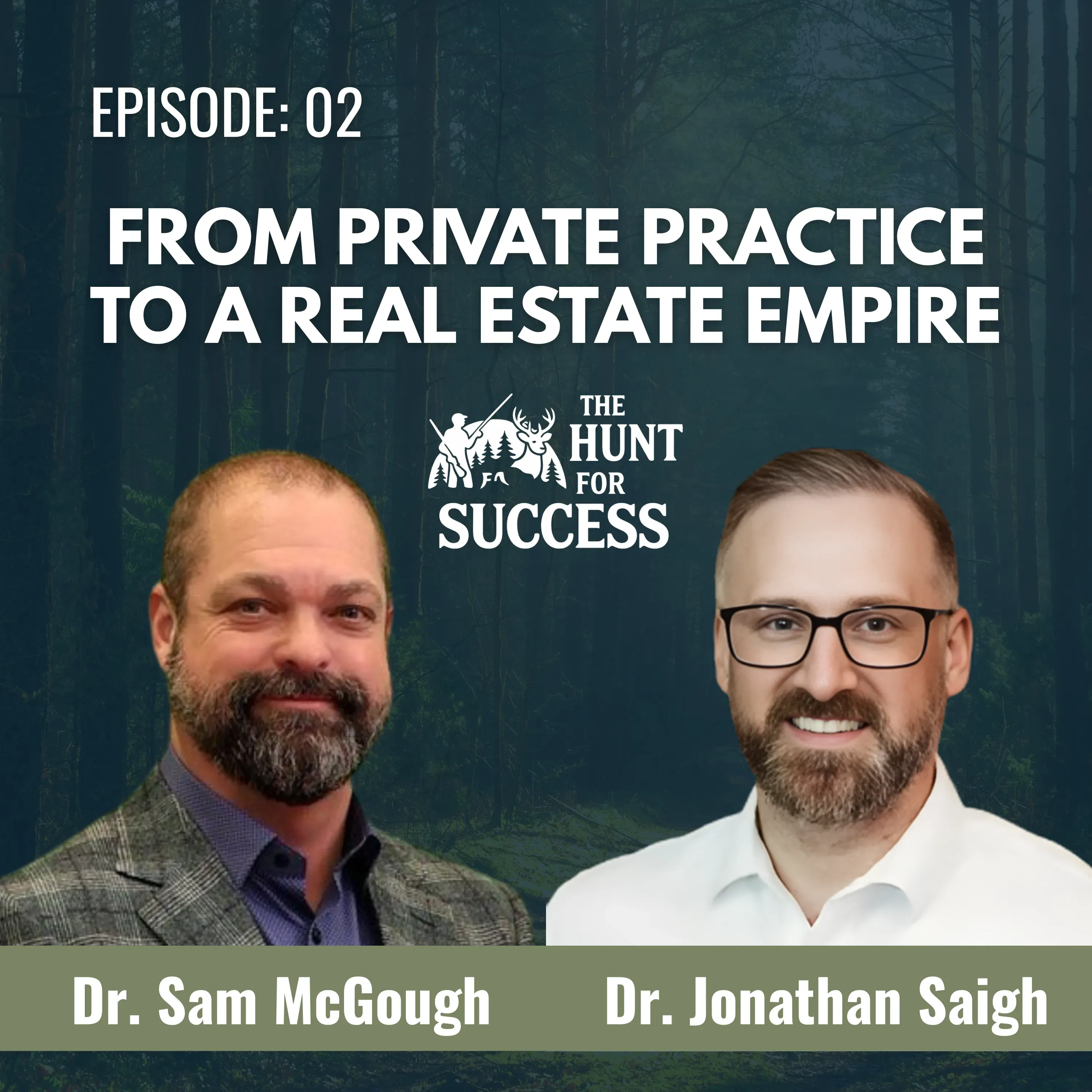
How to Scale from a Private Practice to a Real Estate Empire — Episode 02 with Dr. Jonathan Saigh
THE FIELD NOTES

Dr. Jonathan Saigh

How to Scale from a Private Practice to a Real Estate Empire

Episode 02 April 6, 2026 40 min

Sam McGough sits down with Dr. Jonathan Saigh, a chiropractor turned real estate investor who built an integrated medical practice from scratch and then scaled into a residential and commercial real estate portfolio. Jonathan shares how he transitioned from technician to true business owner, developed a management team he could trust, and earned the IRS designation of real estate professional.

LISTEN NOW
SHARE
WHAT THIS CONVERSATION IS ABOUT

Dr. Jonathan Saigh grew up in the Upper Peninsula of Michigan, played football at the University of Michigan under Lloyd Carr, and built an integrated medical practice that includes chiropractors, MDs, mid-levels, and a surgery center. But the real story isn't the clinic — it's what happened when he decided to stop being the technician and start being the owner. Living in his in-laws' basement for four years, commuting 80 miles a day, and not taking a paycheck for the first 34 months, Jonathan built a foundation that eventually allowed him to step out of the day-to-day and scale into real estate.

Now a qualified IRS-designated real estate professional, Jonathan shares the hard lessons of developing a management team, letting go of control, and treating employees as partners in success. The conversation also moves into deeply personal territory — his father's unexpected passing, hunting memories that became irreplaceable, and why experiences will always matter more than the balance in your account. This is a conversation about what it really takes to scale beyond yourself.

COVERED IN THIS EPISODE
Technician to Owner TransitionReal Estate Professional StrategyBuilding & Trusting Management TeamsIntegrated Medical PracticeVetting Mentors & CoursesUniversity of Michigan FootballUpper Peninsula Whitetail HuntingExperiences Over MoneyLeading by Example
JS
Dr. Jonathan Saigh
Chiropractor, Real Estate Investor & Consultant
Upper Peninsula whitetail hunter with roots in a family logging operation.
Full Bio ↓
DURATION 40 min
RELEASED Apr 6, 2026
KEY TAKEAWAYS
The ideas worth keeping from this conversation.

Know you're not going to be the technician forever — before you even start.

Jonathan knew before chiropractic school that he would never be the hands-on technician his entire career. Building the practice was step one; building a business around it was always the goal.

Share the upside to keep your best people.

Jonathan didn't hoard the profits. He compensated his executive team fairly from the start so they wouldn't leave for average wages at another practice. You can't scale if your best people walk.

Accept the 80% rule when delegating.

Your team will do things 80% the way you would. That's enough. Let them fail, let them learn, and train the gap. If you demand perfection, you'll never let go of the reins.

Vet mentors by asking for their unhappy clients.

If a mentor or guru won't give you contact info for someone who wasn't satisfied, that's a red flag. The ones who can admit failures have real integrity. No business makes everyone happy.

Stop trying to make every client happy — it will stall your growth.

You'll spend 99% of your time trying to satisfy the 1% who will never be satisfied. When multiple clients echo the same feedback, change. When one outlier complains, move on.

Getting your ass kicked is a feature, not a bug.

From being picked on by his brother's friends to getting humbled on a Big Ten football field, Jonathan learned early that you either level up or you're out. That conditioning carried directly into entrepreneurship.

Hunting taught patience before business ever could.

Sitting in single-digit temps in the Upper Peninsula as a kid — no insulated pad, no guarantees — taught Jonathan that you're not entitled to anything. You want the big deer? Put in the prep, the food plots, and the months of work before opening day.

A bank account doesn't define success — the whole picture does.

Jonathan has met many successful entrepreneurs on their third or fourth wife whose kids won't speak to them. If you don't have the whole package — personal, professional, financial — the commas in your account don't mean much.

FULL TRANSCRIPT
The Hunt for Success · Episode 02 · Dr. Jonathan Saigh
Automatically generated and lightly edited for readability.
SAM McGOUGH · 00:00

Hey everybody. Dr. Sam McGough back with the Hunt for Success. Today I have Dr. Jonathan Saigh. He’s a partner of mine in some other businesses, but he also does real estate, has medical clinics, and is a consultant. Thanks Jonathan for being here.

DR. JONATHAN SAIGH · 00:30

Yeah, thanks Sam. Thanks for having me. Excited for this.

SAM McGOUGH · 01:00

Can you give us a little bit of a background on yourself?

DR. JONATHAN SAIGH · 01:10

Born and raised in the Upper Peninsula of Michigan. Remote part of Michigan, a little bit colder than the rest of the Midwest. From there I went to University of Michigan, played football under Lloyd Carr. Then got into business and found chiropractic. Went to chiropractic school in St. Louis, met my wife there. Now I reside in southeast Wisconsin in Racine, just south of Milwaukee.

SAM McGOUGH · 02:00

As a chiropractor, you’re kind of a technician. When did you decide that you had to get out of the technician role and start getting into the business role?

DR. JONATHAN SAIGH · 02:20

It was actually before chiropractic school. I knew I was never gonna be the hands-on technician my entire career. My uncle is one of my business mentors — he’s a very successful dentist still practicing in his mid-seventies, but he never talked about dentistry. He only talked about business and corporation structure and taxes. I was probably 14 or 15 when I really started to understand the game of business.

DR. JONATHAN SAIGH · 04:00

The first years were hard. Living in my in-laws’ basement for four years, commuting 80 miles a day, and drove the worst car in our parking lot. Those were 70 to 80 hour weeks. But probably four or five years in, I said, okay, we’ve built a really good foundation on the medical. What else can we do?

DR. JONATHAN SAIGH · 06:00

Letting go was probably the hardest mental part — releasing this baby that you’d built for years. I treated my team fairly the whole time. I wasn’t the only one just taking the profits out of the business. I shared along the way so that they would stay. You have to realize they’ll do things 80% of the way you would have done it, and then you train the gap.

DR. JONATHAN SAIGH · 08:00

Once you make a mistake in business and there’s a financial number attached to it, you’ll never make that mistake again. And that was hard because now it was no longer me responsible for the financial mistakes — it was other people. But having communication and viewership, hopefully those mistakes aren’t too big for the business.

DR. JONATHAN SAIGH · 12:00

I’m not some Instagram guru with a one-off course. Where I learned real estate was from a few mentors, their books, and then doing the research — contacting attorneys, accountants, reading the actual tax code. I spent money on people who know it better than me and got the basic framework, then grew from there.

DR. JONATHAN SAIGH · 15:30

I’m very conservative on vetting. I want actual testimonials from clients. I’ll ask: can I get contact info for a client who wasn’t happy? Some will give it to me — I actually don’t even call them, because they gave it to me. But the ones who won’t? That’s a red flag. It was really a test of integrity.

DR. JONATHAN SAIGH · 17:30

I’m always a lead-by-example guy. I know everybody’s name, I walk through the office and say hello to everybody. We have non-negotiables like pushing your chair in when you’re done in the conference room. Those small standards go a long way. Patients don’t get that everywhere else, so they’re shocked when they get it here.

DR. JONATHAN SAIGH · 22:30

I didn’t take a paycheck for the first 34 months of being in business. Lived in my in-laws’ basement. At that 34-month mark, I wrote myself a check for $30,000 and thought, “I’ve made it.” Looking back, how naive. But that’s where it started.

SAM McGOUGH · 27:00

Your dad was a big hunter. How did that play into your life now?

DR. JONATHAN SAIGH · 28:00

Growing up, it taught me patience. A very hyper kid — we didn’t even get an insulated pad. Single digit or below zero, and we were just told, go sit in this area and only shoot if it’s an eight or better. You had to be comfortable being alone. It taught you that you are not guaranteed anything. My uncle’s side of the family had a full-blown logging operation with a sawmill and two kilns. That gave us access to land.

DR. JONATHAN SAIGH · 31:00

My dad passed away unexpectedly. I was able to create memories with him through hunting that I’ll never forget. I don’t get a lot of free time, so when I do, I have to spend it with people I want to be around. I won’t just hunt to hunt.

DR. JONATHAN SAIGH · 34:00

I know where I was with every animal on that wall. I know who I was with. I know what point in my life that was. I lost my father about a month before one of those hunts, and I was with Sam. It was a very special time. Not in a good way, but memorable. God had a plan that I was gonna go on that hunt with my best friend and I was gonna need it more than I knew.

DR. JONATHAN SAIGH · 37:30

Nobody cares how much money you have when you die. Your grandkids aren’t really gonna know you or remember you the way you think. It’s a combination — I wanna be able to go on the experiences, but you need financials to back up the higher-level experiences. It’s not about stacking cash. It’s about experiences and buying back my time with my kids. That’s why I push so hard.

SAM McGOUGH · 39:00

Each person has to define their success themselves. A full freezer is someone’s success. $1,500 in the bank account is someone’s success. We have to define it ourselves.

END OF TRANSCRIPT — EPISODE 02
Listen to the full episode above using the embedded player.
Portrait of Dr. Jonathan Saigh
ABOUT THE GUEST

Dr. Jonathan Saigh

Chiropractor, Real Estate Investor & Consultant

WHAT HE BUILT

Built an integrated medical practice from the ground up — chiropractors, two MDs, five mid-levels, an anesthesiologist, and a surgery center. Lived in his in-laws' basement for four years and didn't take a paycheck for 34 months. Now operates as a qualified IRS real estate professional with a growing residential and commercial portfolio in Wisconsin.

IN THE FIELD

Whitetail hunter from Michigan's Upper Peninsula with roots in a family logging operation and sawmill. Grew up hunting in single-digit temperatures with no insulated pad and a strict eight-point minimum. Hunts with intention — every trip is about who he's with as much as what he's after.

WHY THIS CONVERSATION

Jonathan's story is a blueprint for any practitioner who wants to become an owner. The transition from technician to operator — and eventually to investor — is one of the hardest moves in business, and he's done it with integrity, patience, and zero shortcuts.

“Nobody cares how much money you have when you die. Did you accomplish your goals — personally, professionally, and along the way?”