Every conversation. Earned perspective.
Every one of them built something worth discussing.
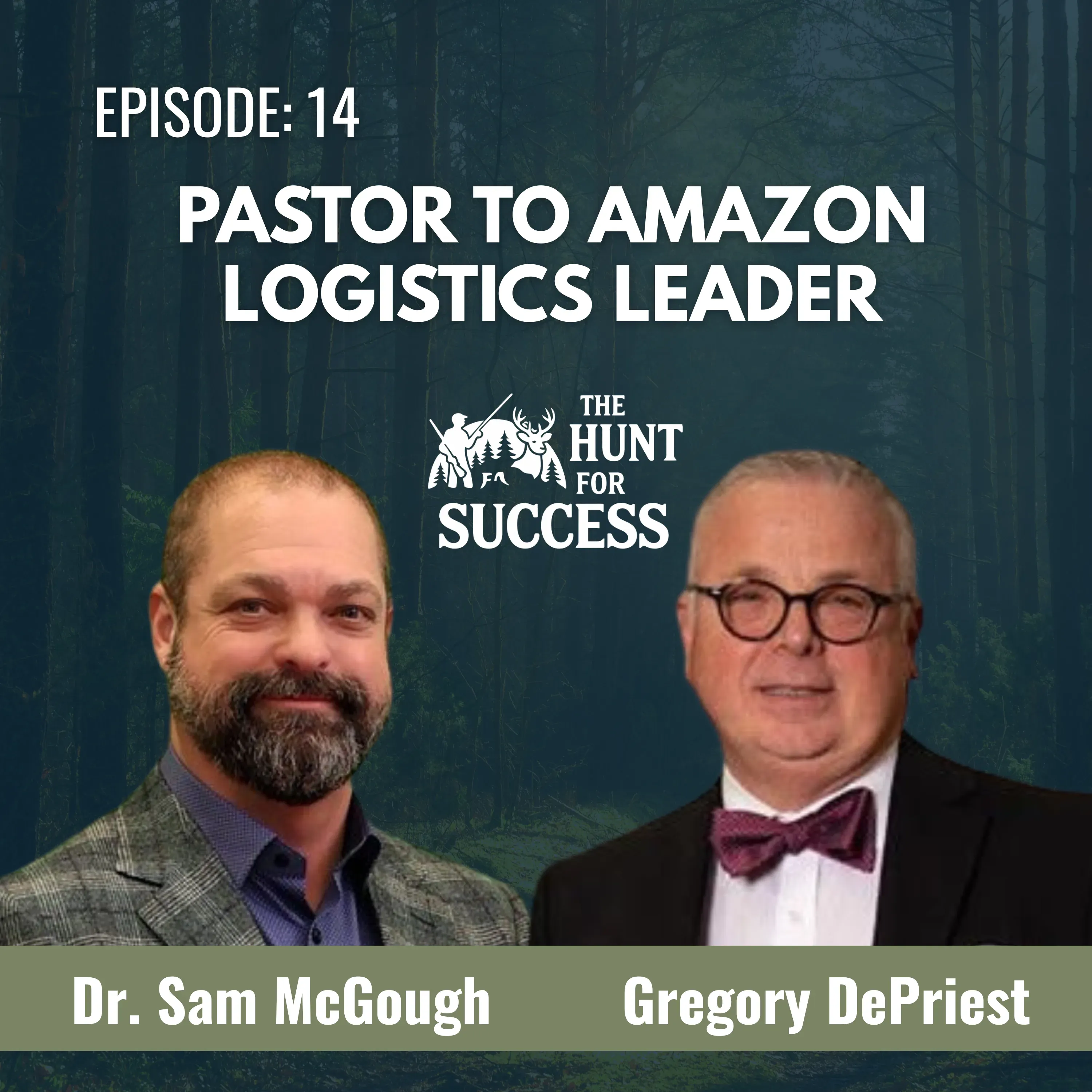
Gregory DePriest
Reinvention, Strategy, and the Thrill of the Chase
Sam McGough sits down with Gregory DePriest — one of ten kids raised by a widowed mother in Mississippi, taught to hunt and to be a man by the successful businessmen of his church's 3,000-acre hunting club. He spent his first career in auto finance, helping launch Infiniti Finance, then pivoted at 33 into ministry and spent 25 years building a 60-person East Tennessee church into the largest-attended in the Tri-Cities at 2,200 people a Sunday. At 57 — no retirement fund, no interest in pride — he walked away to start a logistics company from zero, got his CDL, and today runs an Amazon delivery business with 200-plus employees and a $600K monthly payroll. Along the way he helped raise $56.6M for an orphanage in the highest PGA-endorsed fundraiser in history, gave up an established Austin territory to rebuild in his home region, and turned a lifetime of bird hunting and fly fishing into a leadership philosophy. This is a conversation about reinvention without a safety net — why everything has a shelf life, why faith without a strategy is just a wish, why "potential" is the only curse word he won't allow, and why the men who win are the ones who found someone safe to brag to.
Reinvention, Strategy, and the Thrill of the Chase
Gregory DePriest
Sam McGough sits down with Gregory DePriest — one of ten kids raised by a widowed mother in Mississippi, taught to hunt and to be a man by the successful businessmen of his church's 3,000-acre hunting club. He spent his first career in auto finance, helping launch Infiniti Finance, then pivoted at 33 into ministry and spent 25 years building a 60-person East Tennessee church into the largest-attended in the Tri-Cities at 2,200 people a Sunday. At 57 — no retirement fund, no interest in pride — he walked away to start a logistics company from zero, got his CDL, and today runs an Amazon delivery business with 200-plus employees and a $600K monthly payroll. Along the way he helped raise $56.6M for an orphanage in the highest PGA-endorsed fundraiser in history, gave up an established Austin territory to rebuild in his home region, and turned a lifetime of bird hunting and fly fishing into a leadership philosophy. This is a conversation about reinvention without a safety net — why everything has a shelf life, why faith without a strategy is just a wish, why "potential" is the only curse word he won't allow, and why the men who win are the ones who found someone safe to brag to.
Hospitality, Real Estate, and Wilderness
Jeramie Worley
Sam McGough sits down with Jeramie Worley — a Missouri operator who was buying short-term rentals in 2006, before Airbnb existed, and wrote one of the first books on the model in 2016. Then a herd of red stag crossing a gravel road on his birthday weekend rewired what he wanted to build. He and his partners made an offer on an 80-acre Ozarks property with a 10-acre private lake before they'd ever laid eyes on it, and have spent five years cutting trails, clearing culverts, and turning it into Lake Longbow — a private retreat where burned-out executives come to hunt, fish, and work with their hands. This is not a highlight reel. Jeramie is straight about the economics: it doesn't cash flow like a syndication, some years he subsidizes it, and the well may cost another $40,000 before it's right. What it does produce is harder to put on a spreadsheet — the trust that forms when you take a man who's expert at everything, hand him a white belt, and watch him take his first deer. He lays out why hospitality beats guiding, why he's selling off a third of the property in $50K increments to people he's actually vetted, and why the operators who win are the ones who turn the water on before the plumbing is perfect.
Mastering Business and Real Estate
Chris Rood
Sam McGough sits down with his own real estate mentor, Chris Rood — a blue-collar Louisiana operator who started changing oil out of the back of his truck in college and turned it into four quick-lube shops with 33 employees, funding every expansion by flipping houses on the side. He sold the shops in 2017, went all-in on real estate, and today runs a roughly $45M portfolio of mobile home parks, vacation rentals, and ground-up neighborhoods. But this isn't a highlight reel — it's Chris cutting through the guru noise with the blunt honesty that became his trademark. He explains why luck is just calculated action over time, why you need more balls than brains but a spouse who's on board, and why this is a 20-year game you shouldn't start unless you can give it five. Then he lays out the framework that anchors everything: fast, medium, and slow money — and makes the contrarian case that rental property isn't about cash flow at all, that taking a house with no equity is a financial time bomb, and that the surest way to win is to stop over-leveraging, buy only unicorn deals, and pay it all down until you're bulletproof.
Building Wealth and Freedom
Chris Udall
Sam McGough sits down with the first venture capitalist he ever met — Chris Udall, the man who wrote him his first check. Chris manages a $15M evergreen fund through Innovate Alabama and just launched a $5M Capital Access Fund to pull outside capital into the state and keep founders from decamping to the coasts. But his road into capital is anything but conventional: it started building entrepreneurial schools for refugees in Jordan and ran through Oxford, Notre Dame, a Seattle acquisition, and a LinkedIn "easy apply" that landed him in Huntsville. The throughline of the conversation is the show's own thesis — building wealth while designing freedom. Chris explains what a VC actually does (Shark Tank, minus the rules), why he bets on founder grit over the originality of the idea, and why the only real failure is the decision to stop trying. Then he draws it straight into the backcountry: the elk hunt he prepped for obsessively and still missed four times, why hunting is the one thing that quiets his problem-solving brain, and how he once turned a Bay Area vegan into a state-record turkey hunter and a $6M investor in Alabama founders.
Designing a Life of Adventure
Eric Killen
Sam McGough sits down with one of his best friends and his go-to for adventures, Eric Killen — founder of Killen Outdoor Adventures (yes, in Killen, Alabama). Eleven years ago Eric and his wife Mary turned a hunting-and-fishing habit into a business that last year sent around 230 people across roughly 48 vetted locations worldwide, all while Eric kept his 26-year corporate sales job. The model is built on a single non-negotiable: he won't send a client anywhere he or his team hasn't personally been and photographed. This one is less a how-to than a how-he-built-the-life-he-wanted — client-first service, zero debt, a logistics operation that delivers your trophies to your wall, and the traits Eric sees in both great entrepreneurs and great hunters: patience, persistence, and the discipline to come back after you've been beaten.
How to Master the Intrapreneur Mindset
Theron Leany
Sam McGough sits down with Theron Leany — partner and operator at Action Plumbing, Heating, Air & Electric, a home-services company running across four to five states. Theron's story is the clearest case study the show has had in the intrapreneur mindset: a guy who took a pay cut to $50K to learn a business from the inside, treated it as his own from day one, made himself invaluable, and asked for the equity rather than waiting for it. He breaks down why most owners stall when they lose sight of their "why," how an eight-man walkout forced Action to stop hiring from the industry and start hiring for character, and why the techs who care the most out-sell everyone. The hunting half is its own meditation — bowhunting as the one place with no phone service, and a Kansas whitetail spot built to bring his four daughters into the field.
How to Effectively Mitigate Business Risk
Mark Baker
Sam McGough catches up with his friend Mark Baker — president and owner of ACRE Development Corp. on Prince Edward Island — for a conversation about risk that flips the usual script. Mark came up second-generation in the high-volume gas-station and convenience business, rebuilt a site from the ground up, then leased it off and went all-in on ground-up commercial land development for national and international brands. His core idea: risk is just a vague word until you immerse yourself enough to quantify it down to a finite number. He breaks down the three pillars of a real estate deal — capital, knowledge, and execution — and why capital is the one you can always go find. The outdoor half runs through PEI's world-class fisheries, and the throughline is that the 18-to-24-month patience of development feels a lot like the hunt.
Marketing for Chiropractors: Build It, Scale It, Sell It
Kendall Price
Sam McGough sits down with Dr. Kendall Price — a chiropractor who learned customer acquisition before he ever graduated, opened a practice that went from zero to 200 visits a week in 90 days, then sold it and went all-in on Elevate Marketing. Kendall lays out the lifetime-value math that sets an entire marketing budget, why most owners' "business model is broken" rather than their marketing, and why working on the business instead of in it is what made his practice sellable. The hunting half is its own story: an adult-onset bowhunter who married into 1,000 acres of central-Illinois whitetail ground and a Lake of the Woods cabin, runs a one-buck rule with a 150-inch floor, and teaches all four kids the work behind the hunt. The line that ties it together: systems create freedom.
The People-First System That Keeps Clients Coming Back
Will Bamber
Sam McGough sits down with Will Bamber — professional Lamborghini racer, software builder, and fifth-generation co-owner of his family's New Zealand hunting safari. Will unpacks how a roughly six-person core team runs like a much larger one: a cloud ERP he built himself that spits out branded proposals in seconds and invoices on a button-press, AI that strips the admin drag out of the back office, and data that says red stag is 71% of the business and the calendar is booked to 2030. Then the conversation turns to the trade-show grind, why the relationship beats the trophy, and why a humble possum out-draws a 700-inch red stag on the booth. The throughline is the culture his father Paul built — people first, fundamentals first — and why a multifaceted life lowers the pressure and raises the performance.
From the Oil Rigs to a 100-Pool Construction Business
Ryan Seekatz
Sam McGough sits down with Ryan Seekatz — a Fairbanks-raised Alaskan who spent a decade on the North Slope oil rigs before burning the ships to build for himself. Ryan walks through the exact 4th-of-July moment the filet mignon "tasted like ash," the business acquisition that landed him a Florida pool company building 100 pools a year, and the key-person risk that got him the deal and nearly buried him. The hunting half runs from shooting his first caribou at seven to dropping 1,800-pound moose in three feet of swamp — and why he's proudly a "lazy hunter." The throughline both halves share: discipline, never taking your foot off the gas, and the mentorship that shortened every curve.
The Land & Farm Niche: How Hunting an 800-Deal Real Estate
Lynn Jared
Sam McGough sits down with Lynn Jared — Cookeville, Tennessee broker, two- year turkey grand slam holder, and host of the Long Beard Legends YouTube channel. Lynn built a brokerage that scaled from 500 to over 800 transactions in three years and is now pacing 57% ahead in 2026, all out of a small Upper Cumberland market. They cover the daily morning huddles, the fall-through metric his team is currently dialing down, the under- capitalized-by-18-months mistake that kills new agents, and the lead-gen team Lynn personally pulled out of the red. The hunting half tracks a Merriam shot in May snow an eighth of a mile from Mount Rushmore, why Alabama Easterns are the hardest birds in North America, and the run-and- gun ethic Lynn carries into both turkey woods and a 90-agent brokerage.
Building a Vertically Integrated Multifamily Empire
Erik Nordstrom
Sam McGough sits down with Erik Nordstrom of Iron Ridge Capital — a Texas multifamily firm with a 24% annual return over 18 years and two downturns. Erik unpacks how vertical integration, a three-year buying hiatus, and disciplined lender relationships set them up to buy foreclosed deals at 60% of comp value while competitors were licking their wounds. They close on the AI-proof Tennessee ranch and wedding venue Erik is engineering for his family's next chapter.
How to Scale from a Private Practice to a Real Estate Empire
Dr. Jonathan Saigh
Sam McGough sits down with Dr. Jonathan Saigh, a chiropractor turned real estate investor who built an integrated medical practice from scratch and then scaled into a residential and commercial real estate portfolio. Jonathan shares how he transitioned from technician to true business owner, developed a management team he could trust, and earned the IRS designation of real estate professional.
Redneck Economics: Mining for Success and the Power of Radical Tenacity
Aaron Chapman
Sam McGough sits down with Aaron Chapman, author of Redneck Economics and one of the top mortgage originators in the country. From running cattle and breaking rock in underground mines to picking up coins in a parking lot just to buy diapers, Aaron's path to the top 1% of investment lending was paved with radical tenacity, faith, and a refusal to stay down.
No episodes found.
Try a different search or clear the filter.