Episode 05 with Ryan Seekatz. Automatically generated and lightly edited for readability.
SAM McGOUGH · 00:00
Welcome back to the Hunt for Success podcast. I’m Dr. Sam McGough — every week I interview entrepreneurs and business people who also like to hunt and fish. Tonight I’ve got Ryan Seekatz, an old friend of mine who got into business acquisitions and now runs a pool construction company in Florida. He’s from Alaska, so of course he hunts and fishes. Ryan, welcome to the show — introduce yourself.
RYAN SEEKATZ · 00:38
Thanks, Sam, appreciate it. I’m from Alaska — most of us hunt and fish up there; people live for the weekend so they can get out of town. I ran a couple of small businesses up there over ten or fifteen years — a couple crashed and burned, a couple did pretty good. Then I got into acquisitions, which is where you and I met. It took a few years of hunting down the right business, the right seller, the right books, but we landed one in the construction industry. We just launched our renovation branch — sold eight or nine renovations last month. Lower ticket, but a great addition to revenue. The core is a pool construction company on the east coast of Florida. We do about a hundred pools a year, and we try to stick to the more affluent communities.
SAM McGOUGH · 02:00
Real pools, right? You’re not putting up the little blow-up ones.
RYAN SEEKATZ · 02:10
No. Every once in a while a lead slips through for an above-ground pool, but we don’t do those. That’s the long and the short of it — that’s where I’m at and what we’re doing.
SAM McGOUGH · 02:25
I know you worked W2 jobs — you were in the oil rig business and things like that. How did you make the transition from a normal job into working for yourself and running businesses?
RYAN SEEKATZ · 02:45
Working the rigs, my heart was never in it. I didn’t realize it at the time, but I was always an entrepreneur — back in high school I had my own little construction business doing side jobs. I worked the North Slope — Prudhoe Bay, Kuparuk, all those areas — for companies like BP and ConocoPhillips. Started at nineteen, got out in my late twenties. I spent too many of my kids’ birthdays up there. You’d come back to the airport after two months and the kids wouldn’t even recognize you — beard down, looking way different. They’d run right past you looking for Dad. After about ten years of that, it wore on me.
RYAN SEEKATZ · 06:00
I remember the exact day. It was the 4th of July, the end of my hitch. They flew in surf and turf — filet mignon and lobster, world-class food. And I swear, Sam, it tasted like ash in my mouth. I was so excited to see my family I couldn’t even finish it. I told myself, I’ll never be up here again. I hadn’t even quit yet — they didn’t know — but in my mind it was done.
SAM McGOUGH · 06:50
That’s what a lot of people don’t do — they don’t make up their mind. You burned the ships. Whatever happens, there’s no going back.
RYAN SEEKATZ · 07:10
Transitioning into construction was a natural thing — I’d been picking up side work for years. I started picking up jobs, and the rest is history.
SAM McGOUGH · 09:00
I’ve been proud to watch your journey since Chris introduced us. You bought this pool business — tell me about that.
RYAN SEEKATZ · 09:10
We just celebrated our one-year anniversary. Full disclosure — it’s tough. New place, new industry, new clients. The old owner was supposed to help me through the transition, but around month four or five he got cancer and just dropped off. It was “here’s everything, figure it out.” That key-person risk is partly why we got such a good deal — we underpaid for the revenue, because so much of the business lived in his head.
SAM McGOUGH · 16:00
Let’s switch gears and talk about hunting and fishing. Growing up in Alaska, you probably started before you were old enough to walk. What are your first memories?
RYAN SEEKATZ · 16:20
Honestly, I was killing before I can remember. I carried around a little .410 Harrington & Richardson break-action forever — we did small game with that. We hunted before school. My dad would get me up at four in the morning and we’d hunt ptarmigan, grouse, and rabbits out on Rosie Creek Road outside Fairbanks. We’d clean them trailside, bag them, throw them in the cooler, and he’d drop me at daycare and head to work. My mom still says the only thing that ever got me out of bed at four was hunting. I shot my first caribou at seven.
SAM McGOUGH · 17:30
You’re building the business in Florida now — are you getting into the fishing culture down there? It’s a big thing.
RYAN SEEKATZ · 17:50
It is, but I haven’t, because we bought this business and I’ve been grinding. A couple of my employees keep boats down in the Keys. We’re in our boom season right now, so I’m trying to keep the business on course — but I’m strongly considering cutting out for a few days to go fish with them. I hear there are some big fish out here.
SAM McGOUGH · 18:30
We talk a lot about the balance between work and life. I had probably a decade where I barely hunted — there were bigger priorities. When you’re in the middle of it, it’s tough.
RYAN SEEKATZ · 18:50
I tell my kids: “Once you get this thing going, Dad, you can take your foot off the gas.” Here’s the problem with that. It’s like working real hard at the gym to get fit and strong, and then saying, “I’ve arrived, I’m gonna stop.” You’ve built the discipline, the pattern, the strength. To back off now is to let it all slide.
RYAN SEEKATZ · 13:00
I changed my life big time after my dad passed. He died three weeks before his first grandson was born, and it left a big impact on the family. He was a close friend of mine — and he’d let his foot off the gas. “Been there, done that, don’t want to learn anything.” He died in a remote cabin; the Alaska State Troopers found him on a wellness check. It took a truck, snow machines, and a hike to get to him. If you stop contributing, stop respecting life, it’ll be taken from you. Guys like us who built disciplined lives — we can’t ever back off.
SAM McGOUGH · 15:30
Most of us are looking for freedom, but we keep finding ways not to be free.
RYAN SEEKATZ · 16:00
My bank account looks better than ever, but now I’m mentally tied into this business. My wife asks when we’re going to go somewhere special. I’ve got millions of Amex points and miles — and yet I keep finding reasons to knock out one more Saturday. In reality I should take every tenth or twelfth Saturday off, even if it’s just Orlando.
SAM McGOUGH · 17:30
I’m a believer in celebrating wins — I’m still not great at it, because every time you hit one you’re already looking at the next step. A guy I interviewed told me, “We’re only left with our experiences and the stories they’ll tell about us.” That hit me hard. My son killed his first deer this year.
RYAN SEEKATZ · 18:00
That’s the truth. When I was a little guy I shot my first caribou at seven — I’ve got the picture somewhere, I’ll send it to you.
SAM McGOUGH · 18:30
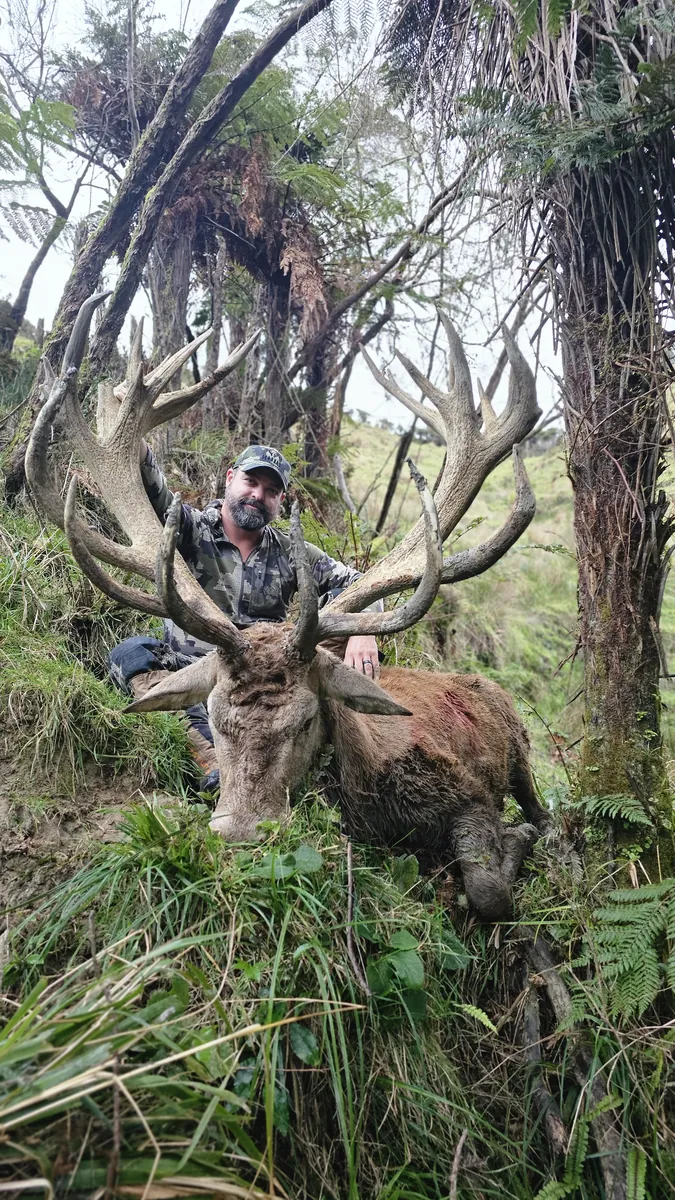
I’ve got a Canadian hunt this fall — caribou and moose, two weeks, float-plane access. And New Zealand last year was incredible. It’s a hunter’s paradise — you’re not really hunting, you’re shooting. There’s so much game; when the Europeans introduced deer to an island with no predators, they thrived.
RYAN SEEKATZ · 21:30
I’m kind of a lazy hunter — I’ll own that. Most of my hunting has been from a truck or a four-wheeler: drop it in low gear, cruise into a valley, climb a small ridge — five-minute hike, max — then glass the area and wait for movement. I’ve never hunted from a tree stand in my life.
RYAN SEEKATZ · 26:00
Alaska’s not easy — it’s simple. You drop an 1,800-pound moose and then realize it’s standing in three feet of swamp, and when it lays down you’re trying to figure out how to get something that big five miles back to the truck before sundown. There isn’t a four-wheeler in the world that’ll yank a bull moose. A caribou I can field-dress in under an hour, quartered and into game bags. We used to run a guide business and process all our own meat — summer sausage, jerky, the whole thing.
SAM McGOUGH · 29:00
My business partner has a King Air turboprop, and it makes life simple. You walk into the FBO, there’s no line, you walk right out to the plane and you’re gone. We went San Antonio to northern Michigan in three hours and were back for dinner.
RYAN SEEKATZ · 31:00
That’s something I’ve lusted after. I’m looking at the fractional timeshares — for a couple hundred thousand a year you buy your hours, no pilot to pay, no storage, you just book your time. “Defer, defer, defer, and then die.” The maintenance eats you alive, but it’s part of the game. We need to set a goal to get to Alaska together — I know some places.
SAM McGOUGH · 33:00
Out of all the things you’ve learned, what do you think has been the biggest key to getting where you’re at today?
RYAN SEEKATZ · 33:20
Without even thinking — it’s mentorship. I spent a lot of years not developing my skillset. I was born to be an entrepreneur, but I signed up for a W2 because it was easy — it was almost a cop-out for me. Inside those tight confinements, it erodes my soul. The more freedom and ownership I got, the better I did. “Be here six to four, clock out for lunch, no personal calls during work hours” — I’m just not built for that.
SAM McGOUGH · 35:00
On the flip side, we need each kind of person. People like you and me will take the call at 7 or 8 PM and work the longer hours. You’re trading one freedom for another — the freedom to clock out at five versus the freedom to eventually clock in and out whenever you want.
RYAN SEEKATZ · 35:30
If I opened my sent folder right now, there’s an email I sent at 11 last night and one that went out by 7 this morning.
SAM McGOUGH · 35:50
I was a terrible employee — always “I can do this better” or “I don’t like the way you’re doing it.” That’s a key factor for some people: they just can’t fit into the box.
RYAN SEEKATZ · 36:10
Always interested in learning, man.
SAM McGOUGH · 36:30
Ryan, I appreciate you coming on. We learned so much, we love what you’re doing, and we’re looking forward to watching you grow. Everybody, this is Dr. Sam McGough signing out for the Hunt for Success podcast. Tune in next time.