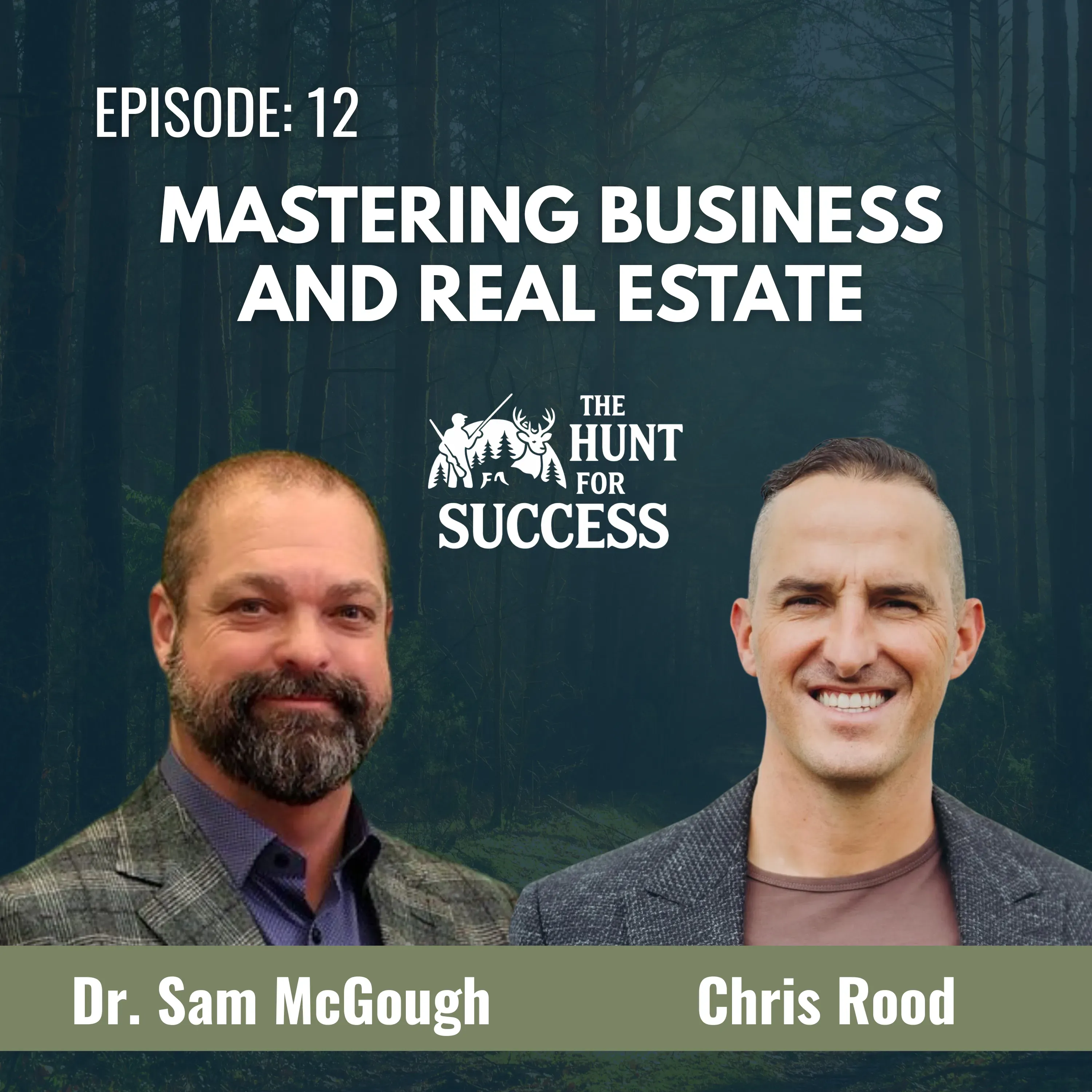
Episode 12 with Chris Rood. Automatically generated and lightly edited for readability.
SAM McGOUGH · 00:40
Thanks for tuning in to the Hunt for Success podcast. Today I’ve got one of my mentors on — Chris Rood. He’s a real estate professional, a home-service blue-collar guy, and a great business coach. He taught me about real estate and about how to pace myself in it. Welcome, Chris.
CHRIS ROOD · 00:52
Sam, it’s a pleasure and an honor to come chop it up with you.
SAM McGOUGH · 01:00
Tell us a little about your history. You were in the quick-lube world first and then transitioned into real estate. How did that go?
CHRIS ROOD · 01:15
I started my first business as a junior in college. I was changing oil out of the back of my truck between classes at UL — the Ragin’ Cajuns — down here in Lafayette, just to make some extra money. By my senior year I’d built up a real book of business — fleet accounts for oilfield companies with 30, 40, 70 trucks — and I’d diversified into auto glass, windshield repair and replacement, detailing, wax. I think I made $112,000 in 2005. That was a lot of money for a senior in college.
SAM McGOUGH · 02:20
As a senior? That’s double what a good corporate job paid back then.
CHRIS ROOD · 02:35
Right. My buddies were going to get $40,000-a-year jobs, and I said, “I’m just gonna stick with this.” I ran it about a year after college — two trucks and trailers on the road, making around $250,000 — then hit a roadblock because I couldn’t scale it. I didn’t want to keep buying trucks chasing jobs. So I went hunting for a physical location, found a motivated landlord whose tenant wasn’t paying, and got my first quick-lube shop. Doubled my income immediately and saw how much more profitable a storefront was.
SAM McGOUGH · 03:30
And that’s where real estate came in.
CHRIS ROOD · 03:45
It’s how I funded everything. My second shop, I found an owner who was distressed — behind on his taxes, not paying his employees — and I got a $860,000 shop on an SBA loan at 25. I needed about $119,000 down and didn’t have it. This is 2006, right before the crash, and everybody was getting top dollar for their house. I told my wife, “We don’t have the money, but everything’s selling — let’s sell our house.” We sold it, made almost exactly the down payment, and bought the shop. Then I bought a foreclosure to live in, flipped it 18 months later, and kept using real estate to buy more physical locations. Got up to four shops, 33 employees.
SAM McGOUGH · 05:40
And that’s when it started costing you at home.
CHRIS ROOD · 05:55
I was having more babies, never home, stressed out, working weekends. My wife said, “You’re killing me — you need to do something.” So I reflected: what got me here? Real estate. I started watching YouTube videos at the shop and came across wholesaling — putting a property under contract and flipping the contract without ever owning it. I said, “I could do that.” Did a couple deals off YouTube, made $2,500 on the first one, and thought, “This is real.” Hired coaches and mentors and took off — I had six-figure months, $80,000 a month. You know how many oil changes and brake jobs I’d have to do for that?
SAM McGOUGH · 07:00
A lot. And a lot less to break.
CHRIS ROOD · 07:15
Exactly. So I put all my shops up for sale. Express Oil — the largest lube-and-mechanic chain in the country — bought a couple locations, I sold one to an independent, and I kept one that I still lease out today. I went full-time into real estate and never looked back. That was 2017. Over about twelve years we’ve bought 19 mobile home parks, 11 short-term vacation rentals, built four neighborhoods — three of the four are under contract right now. Then I vertically integrated: started an HVAC company because it was my biggest line item, a junk-removal business for unit clean-outs, and Allies Wholesale Depot, a mobile-home dealership where we sell to investors at wholesale and flip land-home packages. That’s the 50,000-foot view.
SAM McGOUGH · 09:30
When I hear your story, I hear a few things. You’ve got to have the guts to take the leap. You’ve got to pick a good spouse — because a lot of times that’s the person saying “I need you home” or “you’re about to spend all our money.” And you’ve got to do your math and your due diligence. I know you say you got lucky, but the harder you work, the luckier you get.
CHRIS ROOD · 10:00
No doubt. The more intentional, calculated action you take, the luckier you get. Luck is not random — it’s intentional, applied, calculated action over time. It generates a lot of wins. You’ll take some losses; I have. But as long as you win most of the time and don’t quit, you win long term. And I don’t want to bullshit you — you can’t be a dummy doing this, and you’ve got to have more balls than brains. Some people have so much brains they forget the balls part. They’re smarter than most people on the planet, but they get analysis paralysis, chicken out, and stay at a job their whole life.
SAM McGOUGH · 11:00
And your wife was on board.
CHRIS ROOD · 11:15
She’s not scared of a calculated risk, and she’s been a huge part of it. She wasn’t as entrepreneurial in the beginning — she developed it over time, through personal development and coming to masterminds with me. But it takes a village. We had five kids. It takes a team, skill, and definitely some balls. And you’ve got to be a cyclical player — plan it out for 20 years. If you’re not willing to give it at least a five-year minimum, don’t even try. You’re going to fail in the first five years. It’ll take ten to get the right mental maps figured out, and another ten before you look back and say, “Holy shit, I built something.” Don’t bullshit yourself that this is a five-year deal.
SAM McGOUGH · 12:30
Something that stuck with me when I first found you was your ability to cut through the bullshit. Going from a W-2 to something like this, there’s so much crap out there. You were telling me the bad stuff, not just the good stuff. How long did it take you to discern between the guy who knows what he’s talking about and the guy who’s all bullshit?
CHRIS ROOD · 13:15
Great question — my wife and I talk about it all the time. I’m naturally a truth teller, and that came from my childhood. My stepdad was really hard on me and always told me I was full of shit when I did something stupid. He was a good entrepreneur, and that brutal honesty carried over — always telling the truth no matter how hard it is. When I got into the coaching space I thought everybody was honest. Then I started speaking at other people’s events and realized how much people over-exaggerate and over-fluff. It took about five years for me to realize 95% of them are lying — they’ve done almost nothing and they’re just trying to sell courses.
SAM McGOUGH · 15:30
You’ve got to be a proven operator first.
CHRIS ROOD · 15:45
Right. I had an exit — I built up the shops, started at 22, worked six days a week, 65 hours. I was a true blue-collar guy. When I got into real estate I didn’t realize most of these guys had never really done much; they were throwing out big numbers to sell courses. I believed them at first because I thought everyone tells the truth. Then my bullshit meter dialed in and I stopped listening, because what they said was so exaggerated it only worked on Instagram, not in reality. So I stopped listening to people and started reflecting on my own 20 years of experience — and came up with my own philosophy: fast, medium, and slow money.
SAM McGOUGH · 17:10
There’s a guy you’ve roasted online. I met him before I found you, and I remember thinking, “This can’t be real — people just give me their house, let me take over payments with no equity, and I become a billionaire?”
CHRIS ROOD · 17:40
First, those are diamond-in-the-rough deals. Second, taking over property with no equity violates the most basic principle of real estate: you make money when you buy. If you have no equity, it’s a financial time bomb going off when the market pulls back, like it did recently. There’s nothing wrong with subject-to if there’s equity — by all means, buy it. But telling people equity doesn’t matter, that it’s only cash flow — maybe $200 to $500 if everything goes right and nothing breaks — that’s terrible advice that hurt a lot of people.
SAM McGOUGH · 18:45
And then it turns into raising capital off other people.
CHRIS ROOD · 19:00
Right — they become capital raisers, and that’s where the Ponzi-scheme dynamic starts creeping in. I’m fine with using other people’s money, but not like that.
CHRIS ROOD · 19:20
So I coined fast, medium, and slow money. Fast money is your active income — a W-2, small business income, wholesaling, a broker or realtor fee — anything that transacts in 30 days or less. That’s your lifeblood; it pays your bills. Medium money is a three-to-six-month play: a flip, a small development, a land-home package, or work as a GC. Bigger payouts, bigger rips. Then you take your fast and medium money and roll it into slow money — buy-and-hold rental property. As you start making bigger profits, you’ll get taxed heavily, so you roll it into rentals: you keep the best properties from your direct-to-seller and wholesaling business and flip the rest.
SAM McGOUGH · 20:30
And rentals aren’t really about cash flow.
CHRIS ROOD · 20:45
I argue with people about this all the time, especially in 2026 with insurance, maintenance, labor, and interest rates. It’s so hard to make things cash flow. You have to look at rental property, in order of importance: one, appreciation — a store of value against the money printing in Washington. Two, depreciation — the tax offsets, 1031 exchanges, cost-segregation studies. Three, principal paydown over five or ten years. And only then, four, cash flow. That’s not because I say so — that’s what my P&L showed. If I make my cash flow from fast and medium money but shelter that income by buying and holding, that’s the most logical way to build wealth.
SAM McGOUGH · 21:50
You’re playing the tax game too. My rate’s 42%. If I keep 42% of my money in an asset instead of sending it to the IRS, it doesn’t even have to appreciate to win.
CHRIS ROOD · 22:20
Exactly. You get a huge raise just by not paying taxes — and then the appreciation, depreciation, and principal paydown together far outweigh the monthly cash flow.
SAM McGOUGH · 22:45
I see a lot of guys get burned on the BRRRR method — they refinance too much, or don’t have enough equity to begin with.
CHRIS ROOD · 23:05
They made refinancing their fast money, and when they ran out of properties to buy and rehab, the game stopped — which it did in 2022. Tons of guys got in trouble and had to sell at a loss because they pulled 80% loan-to-value and took the cash to live on. That’s the biggest mistake. If you do a cash-out refinance, it should not be to live on. It should go into savings as capital — it’s tax-free, you can pull it all out at 0% — or roll into a better property. You don’t live off your slow money; you live off your fast and medium money. All the positive cash flow from our mobile home parks, we just reinvest to make them nicer. We don’t buy Lambos with it.
SAM McGOUGH · 24:20
And you believe in having an endpoint, not endless leverage.
CHRIS ROOD · 24:35
I don’t think endless leverage is a good strategy. You have to have an end goal. I’m 45 with a $45M portfolio, and I told my wife we don’t need to over-leverage anymore — we just buy unicorn deals, pay down what we’ve got, and in the next ten years everything’s free and clear. By then the portfolio might be worth $100 million, but with no debt — how can you lose? You can take it easy, sell off your fast and medium businesses, do a line of credit against the assets as a safety net without touching it, self-manage, and live off the cash flow. That’s the surefire way to retire and not blow yourself up in real estate.
SAM McGOUGH · 25:40
That’s great advice. Thanks for coming on, Chris — and thanks, everybody, for tuning in to another week of the Hunt for Success, where we teach you how to hunt for the life you want.