Episode 21 with Brian McNally. Automatically generated and lightly edited for readability.
SAM McGOUGH · 0:00
All right, everybody, today I have a good friend of mine, Brian McNally, on the Hunt for Success podcast. Brian has exited his business, and now he is starting another coaching business where he is helping people get better and live a better lifestyle and create more abundance. From my understanding, it is not so much a business thing, it is more personal and lifestyle coaching, some of the transformations that you made and you are helping other people do the same thing. He kind of kicked my butt. I do not know if you know this, but I have a trainer now who kicks my butt a couple days a week. Anyway, Brian is a good friend. Welcome to the show, Brian.
BRIAN MCNALLY · 0:43
Thank you. Thanks for having me. I’m excited to be here.
SAM McGOUGH · 0:43
I always like to start off with, just tell us where it all started and kind of bring us up to speed.
BRIAN MCNALLY · 0:43
Well, the life journey for me kind of informs my mission today. I come from a working class family in Philadelphia. My dad’s a longshoreman, union guy. We made ends meet. It’s interesting, having gone through an exit now, to live this life and find things to complain about all the time, and I don’t remember complaining a lot back then. You didn’t have a lot, but we were just happier, and you’re content with what you have. I’ve heard Gary Vee call it an immigrant mindset. I don’t know if I’d call it immigrant, I just think it’s a working class survival mindset. You do what you have to do because that’s what needs to get done, and if it doesn’t get done, then it’s going to be a cold winter and we’re going to be a little hungrier. You’ve got to work. You don’t get to let off the gas and just relax.
SAM McGOUGH · 1:27
Wow.
BRIAN MCNALLY · 2:08
When you come up in that world, hard work is table stakes. It’s just a requirement. You don’t complain about it, you just do it. And when you get off of work, you’re enjoying your life, you find joy in the little things. But looking around me, there weren’t a lot of aspirational mindsets. It’s just work, get to retirement, hopefully Medicare and Social Security kick in, and hopefully you can ride it out. That’s the mentality, and I rejected that from a pretty early age. In high school I was like, this isn’t going to be for me. I’ve got to find a way out.
SAM McGOUGH · 2:50
I did the same, just in a rural area. I remember hearing people say, “I’m on a fixed income,” and one day it hit me that this person is just trying to not spend money because they’re afraid they’re going to die before their money runs out. They almost start looking forward to the day of death. I remember thinking, that’s the wrong way, I don’t want to live like that.
BRIAN MCNALLY · 3:31
I don’t want to do some job I hate every day for the rest of my life just so I can have enough time to do some things with my kids, which are normally impeded by the work I hate doing anyway. You’re always living for the next generation and everyone else, and I respect my family for that. Every generation that came before me made it a little bit easier for me to do what I needed to do. But in a way, their lives were given to sacrifice for us. While I’m certainly going to help my kids, I don’t want to feel like I wasted my life completely in service so that they can have the next step up. Someone has to break us out of this, otherwise it’s just going to keep repeating. That was a big motivator for me, somewhat subconsciously. I was just a rebellious kid. I don’t like being told what to do.
SAM McGOUGH · 4:12
I grew up that way, and I remember as a young kid you kind of feel bad because you think that way. You’re like, I deserve better than this, or I want more than this, and everybody’s like, “You don’t. Shut up and go to work.” You felt like a jerk because you wanted more out of life. Did you have something similar happen?
BRIAN MCNALLY · 4:54
A little bit. I wasn’t so vocal about it. I was a dichotomy. I was a really good student, good kid, captain of all the sports teams, but in high school, with this idea of wanting more, I was already working two jobs, and then I also went out and was selling drugs. I wanted to make an extra buck. So that motivation, not correctly deployed, can lead to problems. I never really verbalized it that much, it was something I suffered with internally. I would just look around and think, this doesn’t make me happy, I’m not doing this. I didn’t know what I was going to do, I just knew I wanted something different, and I knew more money would be a vehicle to get me there.
SAM McGOUGH · 5:36
Money was one thing for me too. This is weird, but Men’s Health magazine, I remember buying those things, and they’d have a page with a watch and a bike, and I remember thinking, how do people afford this crap? Two hundred dollars for a pair of jeans. But I knew I wanted it. I remember thinking, I can’t do that making the kind of money I grew up around. My parents would be like, “Two hundred dollars for a pair of jeans? Are you crazy?”
BRIAN MCNALLY · 6:18
We had a fifty dollar shoe minimum. My mom was like, “Fifty dollars.” And this is the time Air Jordans are coming out, Nike Air Maxes are coming out, kids are looking sick at the basketball courts with nice sneakers, and I’m at Payless. And she’s like, “Do you want nicer shoes? I’ll give you the money I would give you for shoes, you come up with the rest. Buy whatever you want with the money you earn.” I was 11 or 12 when she first told me that. Go earn money, I don’t care, go do whatever you have to do. So me and my brother used to collect cans and turn them in at the recycling place. I lived in an apartment complex, and being smart, industrious entrepreneurs, we’d wait for the day before recycling pickup and raid all the big bins, because that’s bulk. We’d empty them out and go. We did it for a little while, then we got told to stop.
SAM McGOUGH · 7:07
I did the same, but I would raid my dad’s and his buddies’ beer cans. I bought my first gun with beer can money. There were probably some soft drink cans in there too, but it was a lot of his and his buddies’ beer cans.
BRIAN MCNALLY · 7:07
That’s awesome. Yeah, that’s how I came up, shoveling snow, all that kind of stuff, just whatever I had to do.
SAM McGOUGH · 7:49
So you were able to build a business that was sellable, and this is something I talk about a lot with people on my side in healthcare. There’s a big difference between having a company and having a sellable company. What are the things you did to build a company like that? Everybody wants to sell their company, but I don’t know if you’ve ever bought one. I have, and I’ve looked at buying companies, and 99 percent of them you couldn’t sell, couldn’t give them away.
BRIAN MCNALLY · 8:30
I’ve got a pretty specific methodology for this. I call it my founder operating system. And like you touched on, I want to work with people as individuals too, because in these smaller, founder led businesses, the founder needs to change first in order to create a culture that really buys in. I ended up working for a bureaucratic large organization and it was making me crazy. Me and the guy I ended up starting the business with would sit there at night and stew over it. It’s broken, the leadership is a failure, the strategy is terrible. We all know what’s broken around here, but nobody wants to do the hard work to fix it because we’re protecting some leader’s ego or the bottom line. So when we started our company, we looked at the landscape, saw some competitors dabbling in the space we were in, and we saw an opportunity in healthcare in the revenue cycle, where the clinical side overlaps with the reimbursement side. We focused specifically in that area, we thought it would be a burgeoning area, and we risked it and jumped into it. The thing that made the business sellable is that we created an asset to be sold from the start. We were frustrated employees, but we weren’t so absentminded of strategy that we said, we’re just going to go do our thing. That’s what I see so much from founders. “I just want to do my own thing, I was so frustrated.” I understand that, but all you end up doing is creating an even more frustrating job, and you don’t have the freedom you think you’re creating, you actually take less freedom. Anyone who’s ever run a company knows it’s even worse. So a foundational element I teach people is design with the end in mind. You’re creating an asset, not a job. Before we even started the company we said we wanted to be a 20 million dollar company in five to seven years. That was our North Star. Once you get aligned on that, and you know you want to sell it, you have to design it in a way where you’re not integral to the operation at some point. Obviously in the beginning you have to be, but the quicker you can bring people in to help replace you, the better. And make smart decisions on buy versus build. We didn’t build a lot of things internally. We were sales, delivery, a little bit of operations, because we already knew the target market we wanted to sell the business to. We wanted a nice clean asset we could package up and sell to them, not a bunch of departments they don’t need or want or that are going to be duplicative in the next phase anyway.
SAM McGOUGH · 10:46
I think you’re right about the founder mentality, that they start their next job and go do all the things, because “I can do it better.” I was trying to buy an HVAC company within the last month, and the guy’s been doing it for 40 something years. There are two problems. He’s still 70 percent of the business, he’s still that involved, and the other part is unrealistic value. That’s another one I come across all the time. Most people never create systems, and then most businesses, the only reason they want to sell is because they want out.
BRIAN MCNALLY · 11:32
They wait until they’re frustrated and then they decide they want to get out.
SAM McGOUGH · 12:14
“I want out,” or “I’m old,” or “I need to get out.” So when you guys did it, you had a really great exit. What are the things you’re learning now that you wish you would have known before the big exit?
BRIAN MCNALLY · 12:14
Oof. Definitely tax strategies. I thought I gave myself enough time. It was that final year, nine months or so, and I started to build relationships with advisors and different people, but I really only got to that first level of strategy. You could do some charitable stuff, you could do this, and we did a lot of that, but there are a lot of really complex tax strategies out there that, had I known in advance, would have saved me millions on the back end. We did pretty good with some leveraged tax strategy and charitable giving, but there’s a whole other world out there that we could have entered into even while we were running the business, to be frank. That would have benefited us extremely, and that was definitely one where we learned a tough lesson.
SAM McGOUGH · 12:59
Do you know the Puerto Rico strategy? You have to move there before you sell, 12 months before you sell.
BRIAN MCNALLY · 12:59
I’m a big fan of simplicity too. There’s a line where I’m like, I don’t know, man, it gets a little complex. I’m a big fan of speed, and throughout growing that business, because I knew where I was going, that’s the benefit I had. There were times where we wanted to do some complex thing to maybe save a couple dollars in profitability, and we would shoot it down because we wanted more, faster. We knew we were being a little less profitable, but it was a conscious decision because we were going to grow faster and make our money on the exit. That’s why it’s so important to be aligned on where you’re going. When you’re just existing, it’s like running a race and not knowing where the finish line is. You don’t know how hard to run, for how long, or when your next water break is.
SAM McGOUGH · 13:46
I agree, and I think most people are just running. That’s a good analogy, because they’re running with no end in mind, and they also don’t know where they are in the game or in the marathon, like you said, where’s the next water break. So when you talk about designing your life and designing your exit, what are the factors you took into consideration when you did that?
BRIAN MCNALLY · 14:35
The book I’m writing right now is called Fuck Average: A Tactical Guide to Reclaiming Your Life. That and the operating system I created are all based off of my life and looking back and seeing what worked and what didn’t. One of the things that worked really well for us is just being aligned on what’s important in life, knowing what success is and determining it for myself. We had the opportunity to stay in the business and keep going. I could still be there today and it’d probably be a 150 million dollar company. It wasn’t the plan. We wanted freedom. So knowing that freedom was my goal, not just financial wealth, financial wealth in terms of freedom, I knew what my enough number was for that stage in my life. I don’t think people take the time to really look at that. Right now, man, I’m so fulfilled it’s crazy. I’m in the pocket of fulfillment and happiness. I’m not the richest guy in the world, but I have enough to where I have the freedom to do the things I want to do with the people I love most, and I get to do epic stuff with those people. I’ve got deep relationships with my family and the people that matter. My health is amazing because I have time for it every day. I’m not religious but I’m very spiritual. I get time outside in nature and I meditate every day and have that peace that there’s something greater than me driving the ship a little bit. I think that’s true wealth.
SAM McGOUGH · 16:00
I do too, and I think people really need to sit with that and ask themselves the tough questions. Every once in a while I get a chance to talk to people in a mentoring type way, and everybody needs to define success for themselves. Someone asked me that one time, and it was, to be able to go wherever I want to go with whoever I want to go with for as long as I want to go. In my mind that is the ultimate wealth and success. If I want to spend two weeks at the beach, I’ll spend two weeks at the beach. We had this yesterday. We were going somewhere and I could take a right and go back home or a left and we could go to the beach. I said, “I wish we could just take a left and go to the beach.” And my wife’s like, “Well, the kids have to go to school, this, that.” I know, but I wish I had that. We haven’t gotten there yet, but we’re getting there.
BRIAN MCNALLY · 17:25
I’ve got a little problem with the competitive cheer. My daughter’s in competitive cheer, so this is a running joke in my life. I’ve got all the freedom in the world to do what I want, like you’re saying, and I’m like, “Why don’t we just go here?” And she’s like, “Well, we’ve got cheer, we’ve got soccer practice.” But it’s awesome. I’m going to coach soccer this year and we still find our time as a family. There’ll come plenty of time to do all those other things, but having the choice, the ability to choose, is awesome. Chasing more money to satisfy some societal expectation of what’s important, instead of doing it on our own terms, would have been a real mistake. My business partner, his dad immigrated from Italy and died still not an American citizen, when my partner was young. He’s been spending all his time after the exit traveling back and forth to Italy, trying to reclaim his family’s home, learning Italian. He’s meeting his old family. He’s over there all the time, and he’s having the best time doing it. He’s just on this exploration.
SAM McGOUGH · 18:11
That would be really cool. I love Italy. When we left Italy, I told my wife, “We have to leave,” because I would drink too much. You start drinking wine at lunch. I said, “I don’t know how people live over here, I would be an alcoholic.” But I think designing your life like that is the thing, and so many people are chasing these magic numbers. It takes money, but it doesn’t take hundreds of millions of dollars to live a good life.
BRIAN MCNALLY · 18:51
No, and you can determine that for your own. I want complete and total freedom. That doesn’t have to be the decision for everybody. My brother’s a really great example. He’s a single guy, he’s an artist, he doesn’t want to work that hard. He sees me, back when I was running the business, and goes, “I want nothing to do with that.” But he works 35 hours a week, has a really good job where he makes good money that more than supports his lifestyle. He can go out for dinner and not worry about paying the bill. He can go to the beach in the morning and do his yoga, whatever his artist lifestyle is. He’s found this area of, I know I’m good, I don’t need a ton more money, I have what I need, I like my job, I like doing it 35 hours a week. He comes over and plays uncle with the kids, and he’s like, “I’m pretty content.” I think it’s just the idea that people need to decide for themselves what’s important and be conscious about it. For me it’s about being very intentional.
SAM McGOUGH · 19:35
Well, that’s the thing. The name of this is Hunt for Success, and it depends on what you’re hunting for. What exactly are you really hunting for? That’s how you determine success. So let’s fast forward. You’ve exited the business, you’re writing this book. What’s important to you now? How do you get to live your life now?
BRIAN MCNALLY · 20:16
It’s interesting. When I first set out I was like, total freedom, I just want to gallivant around. While growing the business, I kind of became someone different. My intentions, honestly, were very selfish in the beginning. I just want freedom for me and my family, I don’t care who gets in my way, they’re all just a bunch of widgets on the board. I’ll run you over, I’ll move you, I’ll throw you off the ship, I don’t care. Either get on or get out of my way. A few years in you realize that’s not getting you where you need to be. I had to evolve as a person. Became a parent, became more empathetic, evolved as a leader, and really started to see, oh my gosh, I’ve got this crazy vision and mission, but it’s changing lives along the way. We have people come into the business who say, “I want to be able to pay for my kid’s college,” or “I want to buy a new home,” or “I want to start a family.” They’re able to do that from the opportunity we created here. Their hard work has to deliver on it, but that’s really important. On the back end of that, some of the stories when I talk to the people who worked for me, hearing their feedback about working in that environment and what it did for their lives, dude, that’s the best feeling in the world. Through entrepreneurship we can have a real impact. And through my own personal development, we have to become someone new, and that’s why I have that whole process. Get honest, own the gap, become the proof. We all know what’s wrong in our lives and our businesses and in society, but we’re not being honest about it, and no one’s really owning the responsibility for doing what’s necessary to improve any of those areas. So that’s where I’m at now. I can’t work with everybody one on one, so I’m going to do a little bit of coaching, a handful of companies where I can come in as an equity partner, a little bit of pure consulting here and there. But I want to teach this model to people, that through entrepreneurship we can have an impact on people’s lives, and if we do enough of that, we can have an impact on society. That’s my mission moving forward.
SAM McGOUGH · 22:27
Nice. Now, I know that you made a drastic change in life yourself. Where were you in the business when you started making those changes?
BRIAN MCNALLY · 22:27
Everyone always asks what the thing was. If you see the picture of me when I’m 30 and I’m puffy and completely out of shape, a totally different person, people ask, “What was the catalyst?” It wasn’t one single thing. It was just years of trying. You’d lose some weight, get in a little better shape, then you gain it back. It’s like the stock market. You’ve got your ups and downs, but you’re slowly moving up and to the right. The biggest change happened in 2020. We were about five years in. We’d just done 10 million in 2019, we were 281 on the Inc. 500 list, and in 2020 we were set to double. In March we were already at run rate to do 20 million. We had the whole team behind it, we had a campaign in the company, 20 in ‘20. Then COVID hit, and we’re in healthcare. I’ve got 300 people deployed all over the country in hospitals. I’m paying for apartments, rental cars, all the travel, and typically the hospital would reimburse us through the bill rate. We were responsible for managing all that. We lost 50 percent of the business in six weeks. I had just gotten to a point where I was pretty optimized, really dialed in, we were killing it. And I fell back. I fell completely out of rhythm. I’m watching society collapse, I’m watching our freedoms get eroded every day, and then I’m watching my business fail, everything I worked for, and I spiraled. Went back to drinking heavily, eating pizza, not working out, just being angry and pissed off all the time.
SAM McGOUGH · 24:42
Yeah.
BRIAN MCNALLY · 24:42
I did about three months of that, just existing and going the wrong way. And something inside me was like, you get two choices. You can either accept failure and that this is the way it is, or you can fight. And I’m a fighter. So I deleted social media from my phone because I was swirling in all that nonsense, downloaded Audible, started listening to books to replace that time, and one of the first books I listened to was David Goggins’ Can’t Hurt Me.
SAM McGOUGH · 25:24
Oh, yeah.
BRIAN MCNALLY · 25:24
And I was just like, “You are being a total bitch. Get your shit together.” That’s when I went the other way. I’d get up at 5:00 AM and work out. Then I started getting up at 4:00 AM. That’s when I started doing jujitsu, just before my 40th birthday. I’d never done a martial art in my life. I was challenging myself to go even harder. I took all the idle time out of my life. I maximized everything and made these commitments. Work, my health, and family. Those were my top three. And it was weird, family? Yeah, they had to come after, because I had to get the physical and mental capacity to do what I needed to do, and the work had to come first because it was going to flow to everything else. Social time I did here and there, but only if I got everything else done. That’s when I became a total machine. The crazy part is you’d think you’d be exhausted, and it reinvigorated me. I had so much more energy. I’d get up at 4:00 AM, work out, be at my desk by 6:30 or 7:00, and do 12 hours at a standing desk, eating standing up, the whole nine, and just crank. Then go home, help my wife with the kids, come back for half an hour, clean up my desk just to make sure I could start fresh the next day. Rinse, repeat, five days a week. Saturdays and Sundays I’d wake up, do a couple hours of work, get a workout in. I’d still get up early on a Saturday, like 6:00 AM, so that by 9:00 I could spend time with my family. The whole day would be theirs. People say you can’t do it all at once. Yeah, you can. You just have to get really, really rigid.
SAM McGOUGH · 26:49
You have to dial it in and get rigid, because there are so many wasteful moments and wasted time in the day.
BRIAN MCNALLY · 26:49
But that’s the beauty of knowing where you were going, Sam. I knew I was on a sprint. Could I keep that rhythm the rest of my life not knowing? No, I would have burned out, there’s no way. But I knew I had three years left. I can do this. And that helped when those dark times came, because even in that rhythm you feel really good, but there’s times where you’re like, oof.
BRIAN MCNALLY · 27:33
When that alarm goes off at 4:00 AM, you’ve got to answer the call. So much of the book is about earning your own self-trust, learning to honor the commitments you make to yourself. You master that and there’s nothing you can’t do.
SAM McGOUGH · 27:33
That’s something important I want to highlight for a second, because I’ve heard this before. Every time you make a deal with yourself and you break that commitment, it gets easier every time you break it. And then it’s a spiral effect in the rest of your life, because if you can’t be held accountable for your own commitments, how can you be held accountable for all the other stuff?
BRIAN MCNALLY · 28:13
Right, and that’s what I teach in the Fix the Founder stuff. The first phase, if I’m working with a company, I don’t want to see your P&L. I don’t want to hear anything. I want to talk to you. What do you do all day? What do you look like? The second I see you I go, okay, you’re obviously not dieting, I know what’s up there. You look tired, you’re probably not sleeping. How’s your family? Do you spend time with your wife? “Well, it’s kind of strained.” Got it. No wonder nobody’s following you. No wonder your business looks like it does. What do you say about yourself? I don’t think people think enough about that. People follow leaders, they follow people at the end of the day, and you need to be someone worth following.
SAM McGOUGH · 28:54
That’s a good one. I kind of go back and forth on some of these things. You listen to the Andy Elliotts of the world, and Dan Martell talks a lot about getting in shape. I think there’s something to it, but I don’t want to say happy medium, because I don’t believe in happy mediums, I’m 100 percent either way. I just think there’s more to it than having a six-pack and being successful.
BRIAN MCNALLY · 28:54
Yeah, I think there’s a level where it crosses over into vanity. For me, I talk about it in terms of capacity. I’m going to be coaching soccer this year again for my kids. There’s not a kid on that team who can run faster than me or longer than me. It’s a value I have as a leader. I don’t ask people to do something I can’t do. So if I’m going to ask my team to work 12 hours a day and bust their ass, I better at least be capable and have done it before. I’ve got to know what it’s like if I’m asking someone else to do it.
SAM McGOUGH · 29:34
Right.
BRIAN MCNALLY · 30:15
We were just in Switzerland with my kids, and I’m watching dads not be able to hoof it up the mountain with their kid, having to say no to doing things, or being too heavy to go paragliding. A guy couldn’t go paragliding, he was too heavy. I got to do it with my kid. Or I’ve been at the amusement park in line with a parent and their kid, and we go to get on the ride and they’re like, “Excuse me, sir, we’ve got to make sure you can fit. Sorry, you can’t ride the ride today.” That’s what I’m talking about. Sure, Andy Elliott’s talking about wanting to be the proof of human performance, which I respect. But I also like wine and pasta dinners, so 8 percent body fat is probably not realistic for me. There’s a vanity perspective, other than when I was getting in the cage for the fight.
SAM McGOUGH · 30:55
You were ripped, I remember.
BRIAN MCNALLY · 30:55
I was shredded. But everyone keeps asking, “Do you want to do another fight?” I would love to do a fight, I’d do a fight tomorrow, I just don’t want to have to live the lifestyle required to do it at a high level. It’s determining success for yourself even in your health and your fitness. You know when you look in the mirror at night if you’re unhappy with how you look, and if that’s the case, then you need to do something about it. You’re the arbiter of what that looks like to you.
SAM McGOUGH · 31:36
I love what you said about the capacity to do the things, and then the crossover into vanity. I’m like you, I don’t care about having a six-pack. I would like to have a glass of wine. What I care about is being healthy enough to do all the functions, the capacity, like you said.
BRIAN MCNALLY · 31:36
Does my wife find me attractive? That’s the kind of question we should be asking.
SAM McGOUGH · 32:23
Like I said, I want the strength and the capacity to do the things I want to do. Could not care less about a six-pack. But if I can go run, or pick this up and tote it from here to there, or work 12 or 14 hours a day without blowing my brains out, then yeah.
BRIAN MCNALLY · 32:23
Well, think about it from a hunting capacity. My dad’s older now, and he didn’t do the best job of keeping in good shape. He never got to do a big elk hunt. He always wanted to do one. I finally got in a position to take him on an elk hunt, and I call the outfitters and they’re like, “No, man. We’ve got this thing we do for people who are handicapped. He can maybe do that, we’ll drive him around.” He can see some elk, but he can’t do it. He can’t hoof it out there. And how many guys, even younger men, probably want to do these things and think in their mind they can, but if they had to strap a pack on and go hiking up a mountain, there’s no way they’re doing it.
SAM McGOUGH · 33:05
No way. They say legs are the biggest killer of elk hunts. I remember my first elk hunt, we walked 60 miles. I had one of those trackers on. We started at 9,000 feet every day and went up to 10 or 11. It was no easy hike. Even coming down sucked, I remember I slid going down. I’m going to Canada in a couple weeks, and the thought process of hoofing out the animal, that’s a lot of work. You cut up an animal in the middle of nowhere, and a moose is several thousand pounds of meat. But that’s a challenge. My wife and I have been training. I have this trainer, and it was really cool, we started training together, so now that’s our dates. We do two dates a week where we train together. She wants some of her body back, and I just want to be able to carry an elk or a moose. The biggest reason people quit hunting right now is they physically can’t do it anymore. Does your dad still want to go on an elk hunt?
BRIAN MCNALLY · 35:12
I mean, he’d love just to get out and see elk at this point.
SAM McGOUGH · 35:12
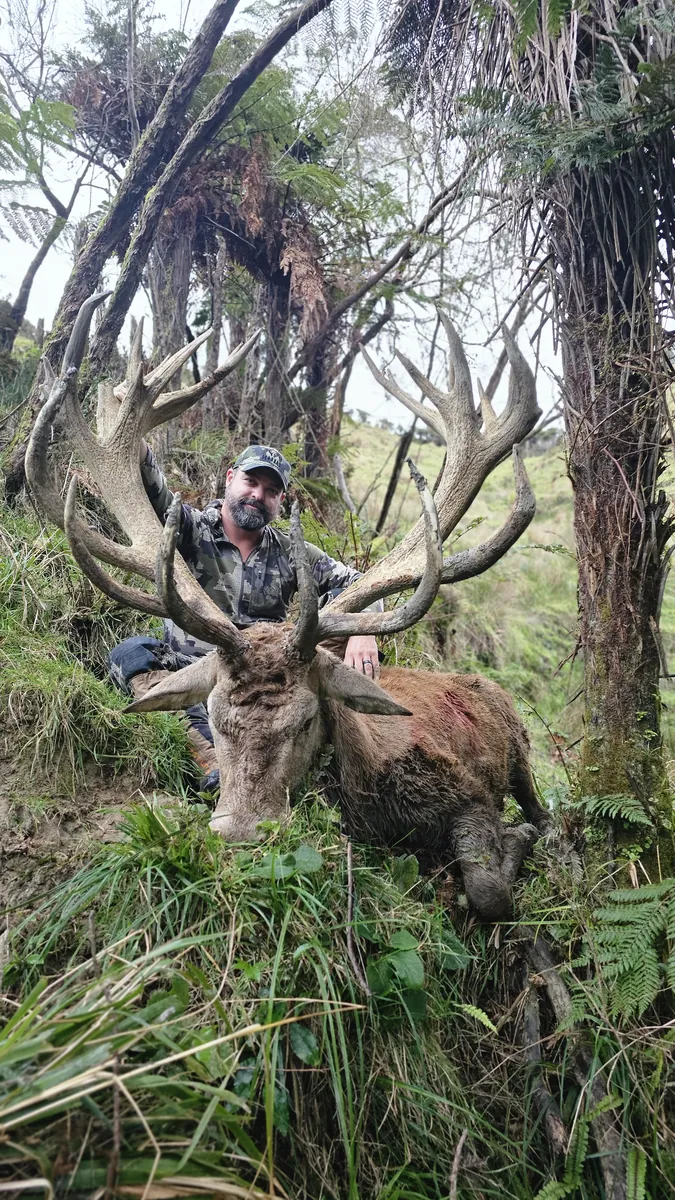
If you ever want to make a trip that’s very easy on someone but it’s a long trip, New Zealand. They’ve got all kinds of stuff, and you can literally drive around in a side by side and there’ll be animals hanging out everywhere. It’s a heck of a ride on the plane, but I did it a couple years ago and it was a very easy hunt compared to elk hunting in Colorado. That’s what I told Jonathan. I’m going to Canada this time, then I’m going to Alaska, and someone asked me to go to Africa, and I said I can do that when I’m old. I can do that when I’m really old, because you just drive around in Jeeps and walk 100 yards. Right now I’ve got to do the hunts that are physically challenging, and honestly I enjoy that. My wife thinks it’s weird, but that’s a guy thing, isn’t it? I enjoy being fatigued. I enjoy the pain, the hard work.
BRIAN MCNALLY · 35:58
That’s part of why I trained for the fight and decided to do it, this idea that I needed to know what I was made of. And it wasn’t just in the cage, although in the cage to a degree, because that door’s locked. That’s some primal stuff. You don’t get an opportunity to let that loose as a man in a controlled environment without going to jail.
SAM McGOUGH · 36:41
I’m sure you grew up kind of like this, at our age and in that timeframe, boys just fought for no reason. I remember having fights with your friends, “Nah, you can’t take me.” “I can take you.” And we’d fight for no reason, or that’s just how we solved things. And then when you got older, maybe a few drunken brawls in college or in a bar, and after that you never have that opportunity again. When you decided to do that, what did your family think? How old were you when you started?
BRIAN MCNALLY · 36:41
I was about 40 when I decided to start pursuing it, and 43, almost 44, when I fought. They know me well enough that nobody tries to stop me from doing anything, because then it’s just going to make me want to do it more. They saw me put in the work. It didn’t make anyone feel comfortable. We did a little mini documentary and they interviewed my family, my mom, even my brother. It was crazy because I got hurt a lot. I tore a calf muscle, sprained my MCL twice, my ACL, separated my shoulder. Even a month before I was supposed to fight one time, I had an emergency appendectomy out of the blue. I’m finally healthy, I’m ready to go, and my appendix bursts. That’s why it took almost four years for me to finally get in the cage. Everyone kept saying, “Dude, is it worth it?” And I’m like, for you guys, probably not. For anyone else, probably not. But I’ve set my mind to this. I’ve sacrificed so much. There’s no way I’m not doing this. I think my family saw that. That same effort I was talking about putting into business, I put that into training. I’d get up at 4:00 AM and train, two or three hours a day at different times. I’d do a morning workout, come home, eat, do some recovery, go train again, train in the evening, five or six days a week. Massage, cold, I trained like a professional athlete for a year and a half, almost two years straight, and it was awesome. When they see that level of commitment, it’s hard for anyone to be totally worried. My son said it best in the documentary. He goes, “Well, even if he gets knocked out, he’s not going to die or anything.” I think that’s generally the feeling everyone had. I’d come home with black eyes all the time, so nothing new.
SAM McGOUGH · 39:28
You’re not training right now to fight, but when we were at the UFC fight a couple weeks ago I heard you talking about a fight you want and you would do, and I think it’s awesome. You want to fight Mark Zuckerberg?
BRIAN MCNALLY · 39:28
Zuckerberg, yeah. Everyone who hears it goes, “Oh yeah, kick his ass.” I’m like, dude, it ain’t like that. I don’t want to fight Mark Zuckerberg because he’s this anti whatever. It’s not like that at all. I respect the fact that at 40-some years old he decided to pursue this, and he’s been doing jujitsu tournaments. One of the things that was hard for me was finding a good fight at my age. I ended up having to fight a guy almost 10 years younger than me, because there’s no one our age doing it. The reality is I could have found a fight sooner with a 20-year-old kid, division one, and I would have gotten destroyed. I’m not crazy, there’s reality here too. My whole book is about rejecting the notion of regret and pursuing these things. He had a knee injury around the same time as one of my MCLs, and he said he was training for an MMA fight, and I was like, man, I totally get the journey he’s on. That’s the path I was walking. And size, age, skill level, we’re very evenly matched, believe it or not.
SAM McGOUGH · 40:55
When you describe it like that it makes a lot of sense, and I get it from his side, because who wants to step in the ring with him in a public setting?
BRIAN MCNALLY · 40:55
Nobody wants to do that. Or if they do, they want to be really better than him just to mess him up. And I’m like, no man, for the purest of MMA reasons, let’s go in there and throw hands and see who wins in a fight. Test yourself. Because if he never does it, I think he’ll regret it, having gotten that close to wanting to do it and then moving on from it. We can do it in the backyard, we can do it wherever, I don’t care, as long as it’s a cage and we’ve got a referee and it’s a real fight. The world doesn’t have to see it. I don’t even need a photo, bro. I just need to be able to talk about it, tell the story at a bar. That’s it.
SAM McGOUGH · 42:18
That would be cool. So you’ve got the book coming out. When is that coming out, and what’s next for you?
BRIAN MCNALLY · 42:18
I’m hoping November. We’re tightening up some things and trying to get it pushed out to the right audience. Then it’s the mission. Impact through entrepreneurship is really the key for me. In order to have the impact I want to have in the world, I need to grow my wealth and grow my influence. Doing podcasts, writing a book, all of that is in service to this goal. Listen, I don’t think I’m going to change the world, but I’m going to try. I’m going to do the best I can, because I think I’ve built a capacity as a leader, and I’ve learned some things, and I’m living the life that I’m aligned with. I’ve chosen what I want. Family first, my health first. A lot of things that coaches sell, I’m going to give away in a digital environment, because I want to respect my time. I don’t want to be creating a big coaching business. I’m only going to work with a handful of companies where I have real equity, and then deploy my operating system to help them grow, scale, and exit. That’ll be the wealth creation, but the rest of it I just want to give away and teach, and maybe use some low ticket digital products to help fund my charitable work.
SAM McGOUGH · 43:40
Let’s talk about your charitable work. It was really cool what you were doing.
BRIAN MCNALLY · 43:40
I’m trying to build it out more. It’s more of a vision at this point, but I’ve got a charitable fund. What I’ve been doing to date is helping out community centers. There’s one back home in Philly, it’s a boxing gym. Anything with that intersection of physical health, financial literacy education, health and nutrition for kids, personal development for kids, because I feel like they learn how to be trained robots in school, but no one’s teaching them how to live and take care of themselves. So I do a lot of motivational speaking and donations to those groups, and one of the things I noticed is they don’t have a good operating system. Their hearts are in the right place, they want to pull kids off the street and help them, but there’s no framework. So I’ve been putting my entrepreneurial brain to how we have real impact at scale. What I’m trying to build now is an operating system based on performance, which aligns with what I teach businesses. If you’re not aligning compensation with the goals of the business, you’re going to fail. I’m applying that same methodology to society and kids. We give money to these charities, but what are we tracking? Are we even aligning the results? Nobody’s really looking at that. So I want to create an operating system where, based on how the kids are doing, we can drive more funds to your charity.
SAM McGOUGH · 45:06
That’s awesome. You got any big trips, hunts, fishing, anything coming up?
BRIAN MCNALLY · 45:06
I finally built the dock. I live on a lake now, so we’ve been fishing out back, catching some bass. My son’s been pulling 20-inch mud suckers out of the mud every day, which has been great. I don’t have anything planned, but I want to get out. I’m on Tampa, the Gulf Coast, so we’re talking about getting out and doing some deep sea.
SAM McGOUGH · 45:49
I tell you what, late November I’m going to come down to that area and we’re just going to do a charter, get several guys together. There’s a bunch of guys that live down there, and I’ve got a couple good guides. We’ll charter a boat and do some good fishing.
BRIAN MCNALLY · 45:49
Let’s do it. That’d be great. That, and I want to get back into archery. I did a lot of archery as a kid and I just got out of it. I grew up in Pennsylvania, in Philly, but we weren’t far from the Poconos and all that, and we’d go out and do archery all the time. I miss it. I miss the quiet, even just target shooting.
SAM McGOUGH · 46:36
My oldest girl just got into archery and I’m loving it, because I’m getting back into it myself. She played softball and stuff, and she said, “I just want to do something that’s just me. Whether I fail or succeed, it’s only me.” And I was like, yes. I’ve got her all this gear, and a bunch of arrows came in yesterday. Every day I get home she’ll be out in the backyard shooting a bow by herself, and she says it’s meditative. This is right up my alley. Maybe we can do some stuff. Definitely doing archery.
BRIAN MCNALLY · 46:36
I’d love to just get out more. Nature is one of my foundational things. Whenever I’m not in a good mental spot, I get out into some quiet woods, some wilderness somewhere, and just hike or be by myself in the woods. I think as men we were meant to be there. We’ve slowly gotten away from it, and I think when we get back there, that’s why we always feel good, because it’s where we’re meant to be.
SAM McGOUGH · 47:17
Of course there’s the primal side and all the things that go with being in nature, being self-reliant, harvesting an animal. There’s something to me about eating something you took yourself. You hunted it, you killed it, and everything tastes better. And you get this testosterone boost or something. I’ve never measured the levels, but you feel every fiber of your being, the rush and all that. That’s my favorite thing, and so is being in the woods and having that quiet time.
BRIAN MCNALLY · 48:01
But the success part of it, that’s the intersection with business. We are wired that way, and it used to be if you brought home a meal. That’s why we get that feeling. Now when we succeed in business we get that same kind of thing. But at the end of the day, we’re built to be providers and protectors.
SAM McGOUGH · 48:01
I agree with that, and that’s where I’m trying to bring people on hunts, take people who have never done it. I’m taking a guy hunting this year who’s never been before, just to let him feel that. Like you said, there’s a big intersection between success and what we do here and getting out there and giving your brain a little bit of a vacation, and then using those same types of strategies to find and kill something. I’ll leave you with this. The first time I killed an elk, I was in Colorado, and the guy I was with was Roland Welker, who won season seven of Alone. This guy’s the real deal. He lives in Alaska, hunts moose and grizzly bear. We get up to the elk after I’ve shot it, we start gutting it, and he pulls the heart out, and it’s still warm. He takes a bite and then hands me the end of it. There’s nothing I can do besides take it and take a big bite. Blood running down, everything. And now I do it every time I kill something, because it’s transferring the heart of the animal, all that energy. I like a rare steak anyway. I tell that story and my wife’s like, “Oh my God.” But now it’s a tradition.
BRIAN MCNALLY · 50:49
People have been doing that for millennia. I give my kids a hard time because they’re a little detached from it now. When they say something, I go, “Where do you think it came from? Let’s get real.”
SAM McGOUGH · 50:49
They need to get acquainted with the reality of it if they’re going to eat meat. If they want to be a vegetarian, great, I like that, but if you’re going to eat meat, you should know something had to die for that meat. My kids are well acquainted with it now. There’s always some dead animal in our freezer. Well, man, if people want to know more about you, if they want to get in touch about their business or do some work with you, how do they get in touch with you?
BRIAN MCNALLY · 51:36
Brianmcnally.com, and Instagram is thebrianmcnally. You can find me there, and there’s a link to sign up for the wait list for the book on my Instagram. All my stuff’s there. I’d greatly appreciate anyone signing up and getting made aware of when it comes out. The book is Fuck Average: A Tactical Guide to Reclaiming Your Life.
SAM McGOUGH · 51:36
Nice. I love it. I’ll be signing up. Well, thanks again for being on the show. We really appreciate it.