Episode 09 with Theron Leany. Automatically generated and lightly edited for readability.
THERON LEANY · 00:00
A lot of people, when you’re first starting out, the dream is: I want to provide the best service to my customers, or I want my employees to make six figures. Whatever the original thought was — I’m not going to work for anybody else, I’m going to go into this on my own. People forget over the years because they get beat down a little bit. You lose sight of why we started this. And if we focus on the why, the structure of what we need to do gets really clear.
SAM McGOUGH · 01:15
My name is Dr. Sam McGough, and I’m here with Theron Leany. We’re here for The Hunt for Success. Theron works with Action Plumbing, Heating, Air & Electric — they do a little bit of everything, and they’re one of our mentors in our HVAC company. Theron, welcome to the show.
THERON LEANY · 01:50
Thank you, Sam.
SAM McGOUGH · 02:00
You have some ownership in your company, but you’re also kind of an intrapreneur versus an entrepreneur. How did you get started with Action? I know you’ve done several acquisitions.
THERON LEANY · 02:20
I grew up doing appliance repair in Salt Lake — my business partner Ben is actually family; his family is big in appliance repair. I served a mission for my church and got into a pretty nasty car accident that damaged my spine, so I couldn’t really do appliance repair anymore. I transitioned into sales — finance, inside sales, auto sales. Ben had started a plumbing company, and I approached him and said I’d like to spend some time and learn this. I actually took a pay cut to come work for him — I was making 50 grand a year. My view as an employee was always to provide as much value as I could, so I spent every ounce of energy trying to improve stuff. When the opportunity came to buy into the business, Ben presented it because — those were his words — I made myself invaluable to the company. It required that entrepreneur mindset of: I’m going to take it as if it’s my own. Extreme ownership. And I’ve continued running that same play ever since.
SAM McGOUGH · 04:30
A lot of employees never see that. And a lot more owners would welcome giving away a piece of the company to let somebody use their energy to build it. How did that opportunity come about — did you ask, or did Ben present it?
THERON LEANY · 05:00
I actually went to him and asked. I knew we had an acquisition coming up, and he was secretly holding some equity — he’d set some aside for me and was just waiting for me to ask. When I said, “Hey man, I want to be a part of it,” he said, “I knew we were going to have this conversation.” He was just waiting. A lot of people say they want something and then they don’t open their mouth. I think he would have let me just not take it if I’d done nothing — but it requires that drive.
SAM McGOUGH · 05:45
A lot of people are waiting for the other person to make the move. You’ve got to make your move.
THERON LEANY · 06:00
It’s better to ask and get told no than to not ask at all. I had this conversation with an employee of mine an hour ago — if you make yourself invaluable, if you’re always working to improve, you’ll always have a job or an opportunity. It doesn’t matter if it’s here or somewhere else. But if you’re just doing the bare minimum, you’ll never go anywhere.
SAM McGOUGH · 06:45
Where do you think you got that mentality?
THERON LEANY · 07:00
Probably from my mom. I come from a decent-sized family — eight kids, I’m the second oldest. My dad ran a small construction and drywall company, so he was gone early, and I’d do projects around the house with my mom. That’s where I found the joy in working. It started with chickens — we raised them, I poured concrete, installed lights, kept it clean, because it was mine. I liked the pride of that. The chickens turned into a little side business selling eggs. That feeling of accomplishment carried with me as I grew up.
SAM McGOUGH · 07:45
So you and Ben have translated your success into coaching and helping other people. What do you find is holding most people back?
THERON LEANY · 08:15
At the core, a lot of people don’t have any structure. And the lack of structure comes from forgetting why they got into business. When you’re first starting out, the dream is the best service, or the happiest employees, or employees making six figures. People forget over the years because they get beat down — you’re trying to get leads and you lose sight of why you started. If we focus on the why, the structure gets really clear. If I want my employees to succeed, what I have to do is simple. If I want to provide the best service, what I need to do is simple.
SAM McGOUGH · 09:00
Where did you learn most of these steps? Did you go through a lot of education?
THERON LEANY · 09:20
Not formally — I went to college and never graduated. Most of the education I’ve acquired has been through sweat equity. I’ve always cared deeply about the people we serve and work with, and it required me to be innovative, to put myself in uncomfortable situations because they needed to happen. I’d learn it as quick as I could and look for people who’d been there to teach me — that’s a shortcut. We pay for our education one way or the other: through mistakes, or by paying somebody who’s been there. Something we do that’s unique is we stay open to learning. Our systems are never set in stone — a startup is very different from a $40-50 million company, and it seems like every five million, the company takes on a new identity. If you stay stuck, you cannot grow.
SAM McGOUGH · 11:00
Every five or so years in my business, you have to change a lot of things. I remember when Facebook was easy to get leads, when Google was king, when the Yellow Pages were marketing. Things change — and so does your business structure.
SAM McGOUGH · 16:20
You’re a big company now — four or five states. Can you talk about some of the pains you went through to get there?
THERON LEANY · 16:35
We’ve made pretty much every mistake you can make. We tried to build teams based on money — and you lose those people, because there’s always somebody who’ll pay more. We’ve had bad culture. Years ago, when we were just one location, I had eight guys walk out at one time — we were actually out hunting. That left me two people on my sales force. We got back, reassessed, and started building a culture for success — refocusing on people as the solution. It’s easy to start seeing employees as the problem, because managing people is hard. We’d put managers in place who shouldn’t have been there — people we liked. That was a hard lesson.
SAM McGOUGH · 17:45
When you build culture, what are you trying to accomplish?
THERON LEANY · 18:50
In the moment, the thought wasn’t “let’s build an amazing culture” — it was “we want to bring on people who actually provide good service.” We stopped hiring people just looking to make money, because they don’t always provide the greatest service. There’s a joke in the trades, at least in Utah, that plumbers are like beach balls at a concert — they bounce from place to place chasing the highest pay, and that short-term mindset causes toxic traits. So we started hiring high-character people from outside the industry, trained them up, got them their licenses, and let them provide high-quality service. What we found is the guys who actually sell the best are the guys who care the most. They won’t let a customer go to a worse competitor. It’s a beautiful culmination: we want our techs to succeed and care about customers, and that leads to good sales.
SAM McGOUGH · 21:00
You’re teaching other people now, which is admirable — even competitors.
THERON LEANY · 21:15
Our view is, let’s elevate the entire industry. I’ll tell you exactly what we do. Because if you care more and provide higher-quality service, I’m forced to elevate what I do. That’s the spirit of entrepreneurship. The lowball guy always destroys things — but the most expensive guy in town is usually doing the best job, which is why he requires that price.
THERON LEANY · 22:15
An interesting lesson: I have a brother in the industry, and I tried for years to give him our information for free. It never clicked. Then one day he asked, “How much to teach me?” I gave him a number, he said let’s do it — and he blew up. His company’s growing fast. It was so odd, because I’d been giving him the same information for years. It’s the old saying: if you don’t pay, you don’t pay attention. People only respect what they pay for — it’s the same with employees and company vehicles. One in a million treats your truck or tools like their own.
SAM McGOUGH · 24:30
How do you monitor that across so many moving parts? I know a clean, organized truck is part of your process.
THERON LEANY · 24:45
It comes back to our foundation — look good, feel good, play good. If you get into a dirty truck in the morning, looking for parts and tools, it looks bad to the customer and puts you in a bad headspace. We teach the guys to see the return is worth the time. We do have fleet managers checking in for accountability, but everything is presented as benefit versus cost. Show them a clean vehicle leads to higher sales, let them try it for a week, and once it proves out, they’re bought in without a bunch of oversight.
SAM McGOUGH · 26:15
You’ve had hundreds of employees now. How rewarding is it watching these guys win?
THERON LEANY · 26:30
It’s some of the most rewarding stuff we do. Years ago we kept a list — at company parties we’d bring up the guys who made six figures and we were so proud. One of our first guys came from a temp agency making $8 an hour; now he’s at multiple six figures. He started on install, digging holes and breaking concrete with no skills, then got his journeyman plumbing license, learned to sell and communicate. Nobody in his family had gone to college, owned a home, or made more than 40 grand — and now he owns his house and vehicles, everything paid off, and started a family. That brings us a great deal of joy. We’re in business because we want to help as many people as we can, and you do that by having the greatest team.
SAM McGOUGH · 11:15
Let’s shift gears. When did you start hunting, and where did you learn it?
THERON LEANY · 11:30
My dad wasn’t a big hunter. I remember going elk hunting with him once in Utah when I was about 10 — snow up to my waist, and he was hiking so fast I couldn’t keep up. We never got one. Funny story: when I was little, my mom took me to see Santa, and when he asked what I wanted for Christmas, I said I wanted one of his reindeer so I could shoot it. A lot of it came from my uncles — they always hunted, and I loved the idea of being outdoors and being self-sufficient.
SAM McGOUGH · 12:50
You’re a big-time bowhunter. Do you ever gun hunt?
THERON LEANY · 13:00
I do rifle hunt, but I got into bowhunting because of my in-laws. Hunting for them is like a family reunion — they have a spot in Utah where everybody spends two weeks. Early in my marriage I wanted to spend time with my wife and her family, but after a year or so I said, “I’ve got to go hunting.” I bought a bow and started shooting. There’s something like meditation in it. As a business owner, the hunting trips are the only real time I go places with no phone service. My phone goes off all day — there’s so much moving and shaking — so when we go hunting, it’s an awesome time to unplug and focus on something simple and beautiful.
SAM McGOUGH · 14:40
Where’s your favorite place to hunt?
THERON LEANY · 14:55
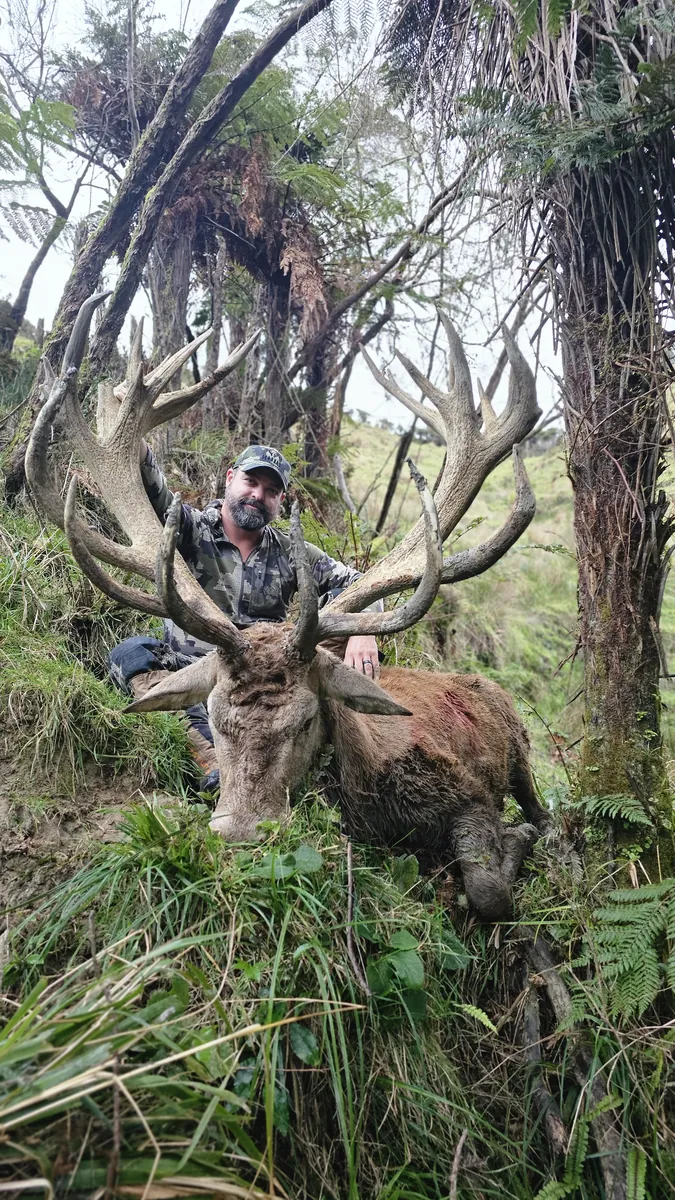
I just hunted New Mexico for the first time this past year, and that probably takes it. I love bowhunting in Utah — it’s beautiful, you’ve got to pursue the animals up close. But New Mexico is a different world. There were so many elk, but they’re so far away. I was bear hunting in the Gila and a massive six-by-six walked by at 30 yards and just looked at me like I’m nothing — I had no tag. I probably saw six or seven more within 100 yards. They were everywhere.
SAM McGOUGH · 15:45
I agree — New Mexico is one of my favorite places to hunt. In Utah you’ve got it made with the mule deer.
THERON LEANY · 16:00
Your experience with the elk in New Mexico is my experience with mule deer. I’ll take an elk tag on my bow hunt and get beautiful bucks 15, 20 yards away with no tag. That’s how it works. It’s a lot of failure — and that goes back to business. One thing hunters do really well is learn how to fail a lot and still enjoy what they do.
SAM McGOUGH · 31:15
What’s your favorite animal to hunt?
THERON LEANY · 31:30
Elk. I love the taste, they’re majestic, and the hunt is very difficult with a bow. I have four daughters; my oldest is eight, and I’m really excited for her to hunt. We picked up property in Kansas and just put food plots in to start getting some big bucks coming through. Whitetail might become my new favorite, because that might be where I take my kids. It’s a smaller barrier to entry than elk — you can put them in a stand instead of hiking seven miles. It’s hard to get kids to focus for an hour these days, but I think getting them out in nature is huge.
SAM McGOUGH · 33:30
There’s a message in the Bible about teaching them the way you want them to live when they’re young. Hunting is one of those things — there are so many parables: patience, failure, hard work. And by processing your own meat, they learn where meat comes from.
THERON LEANY · 33:45
Society getting away from hunting and gardening has been harmful to the youth, because it takes responsibility. When I took my daughter out, I gave her a little backpack — water, gloves, hand warmers — and told her not to touch anything wet. Of course she did, and got wet hands, and had to work through the problem. She started solving it herself. Those lessons are powerful. I think it builds stronger character — the kind you need to be an entrepreneur, where you get kicked in the teeth regularly and have to come back with a new plan.
SAM McGOUGH · 34:45
For anyone in the home-service industry looking for help, where do they find you?
THERON LEANY · 35:00
The quickest way is Ben Jordan’s Instagram — Ben is my cousin and the one who established our structure and foundation. Or our website, theactiongroup.co, where we do our consulting. We’re here to help. Our thing is always action. In football, the rah-rah huddle never did anything for me — I respond to a coach telling me specifically what to do. There’s a place for the feel-good, especially in sales, but the industry is lacking specifics. You don’t rah-rah a business into functioning. You have to have actionable, tactical steps — that’s what we want to share.
SAM McGOUGH · 37:00
I can’t speak highly enough of you guys — how accessible and willing to give you’ve been. This is The Hunt for Success. I’m Sam McGough with Theron Leany, signing off. Talk to you guys next time.