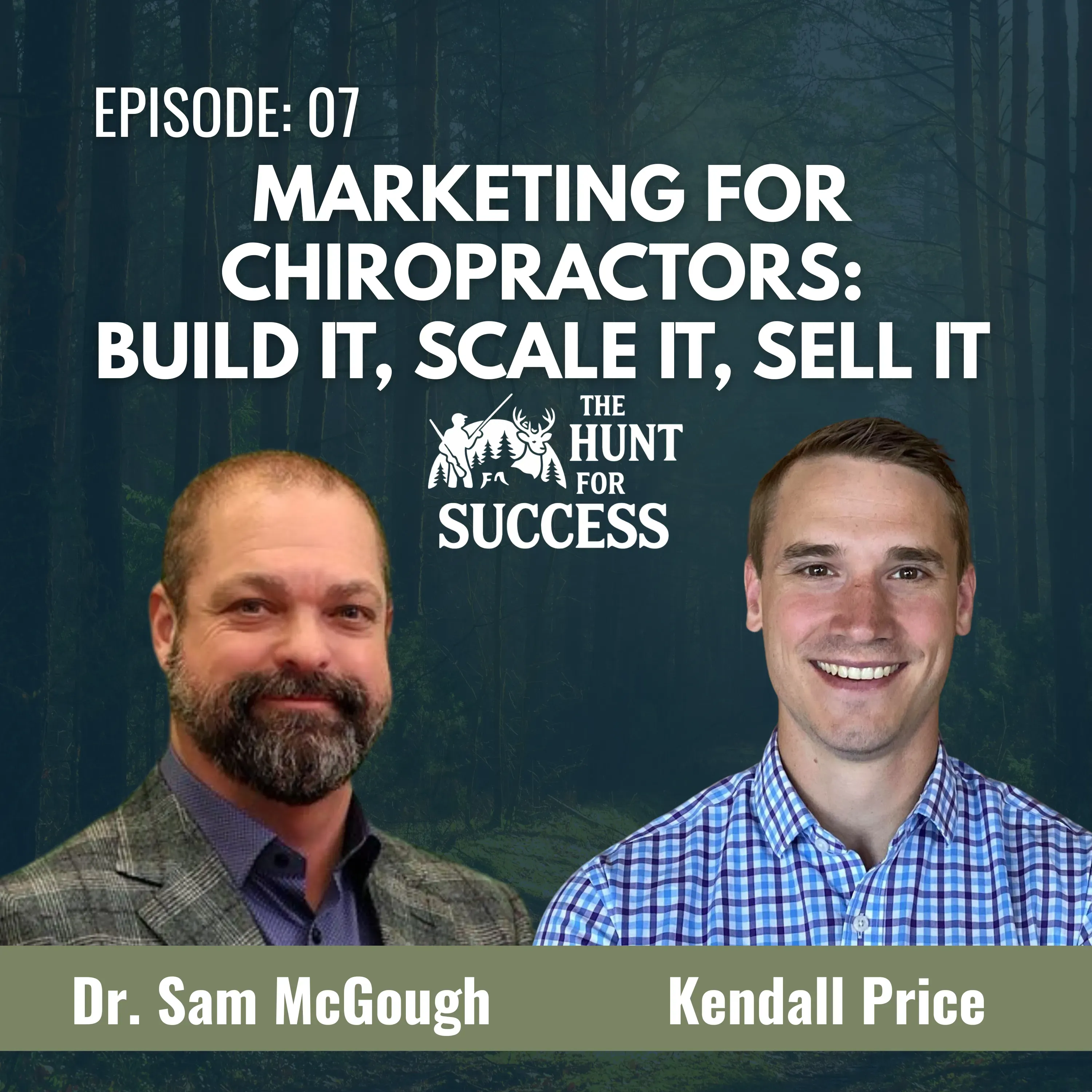
Episode 07 with Kendall Price. Automatically generated and lightly edited for readability.
SAM McGOUGH · 00:00
Welcome back to the Hunt for Success. Today we have Dr. Kendall Price — a former chiropractor turned marketer who founded Elevate Marketing, helping chiropractors produce consistent new patients and scale their companies. We bonded the first time we talked, over hunting and fishing — and on this show we talk business, hunting, and fishing. Kendall, thanks for being on.
KENDALL PRICE · 00:40
Thanks for having me.
SAM McGOUGH · 00:55
When did you decide to get really good at marketing — before or after you became a chiropractor?
KENDALL PRICE · 01:15
Honestly it started in school. I have two brothers who are chiropractors, and both associated under other doctors when they came out. I saw what that did to them and I didn’t want it. So I asked: how can I learn to run a business — and the most important thing in any business, getting new customers — before I ever go into practice? I joined groups, shadowed doctors, did screenings and health talks. I learned the guerrilla, boots-on-the-ground marketing while I was still in school. When I came out, I opened my practice six months after graduating, and we went from zero to 200 visits a week in 90 days. My first weekend I had 80 new patients — most people won’t see 80 new patients in a month, ever.
SAM McGOUGH · 02:50
That’s not easy, and it’s not typical.
KENDALL PRICE · 03:05
I figured out fast that getting new patients in the door is the ticket. But there was always a disjointedness between what I wanted and what the coaching companies provided. The genesis of Elevate was realizing I could make a bigger impact on the profession by helping other chiropractors succeed — teaching them not just advertising, but the systems behind marketing. That’s what’s vastly lacking, and not just in chiropractic. Most businesses don’t have systems to consistently acquire new customers.
SAM McGOUGH · 04:10
Sales cures everything.
KENDALL PRICE · 04:30
It does. Running the business is about process and people. Get process and people right, then market and sell — to me that’s the same department — and then do things to increase how long a client stays with us. If we can increase lifetime value across the board, the numbers grow exponentially; very small tweaks make a big difference. The problem I see is owners working too much in their business and not on it.
SAM McGOUGH · 05:15
You brought up LTV. If you know the lifetime value of a customer, your whole budget changes.
KENDALL PRICE · 05:30
Exactly. If lifetime value is $20,000 for a client, even if it costs me $2,000 to acquire them, it doesn’t matter — I’m going to make money along the way. So when my team says ad spend is $40,000 this month, I know that’s about 20 people and roughly $400,000. The numbers make sense if you understand the numbers.
SAM McGOUGH · 06:45
You got mentored — you didn’t just figure this out. How much time and effort does a business owner need to put into learning this?
KENDALL PRICE · 07:30
It took me three to four years to break a million in my practice. I’m a constant learner. At first I knew how to get new patients but didn’t understand all my numbers — what it cost to provide a visit versus what I charged. My brain works in spreadsheets, so I built them out over time, and the numbers pointed me at the problem. You can learn it all on your own, but paying people shortens the timeframe. I probably spent $150,000 to $200,000 on education — we don’t learn this stuff in school. My wife’s cousin’s husband has a Harvard MBA; we talk business when we fish in Canada, and it’s the same education. They just pay a lot of money — for the network, which is worth it.
SAM McGOUGH · 09:50
You transitioned out of practice and sold it, and bought out your partner in the marketing company — all close together?
KENDALL PRICE · 10:10
I bought out my partner in December of ‘23 and sold my practice in January of ‘24 — but I hadn’t been in my practice for seven months. It was running by itself, so when we got to the banking part it was easy for my associate to say, “I’ve been running this for seven months, here’s what the numbers look like.”
SAM McGOUGH · 10:45
That’s a tip most owners don’t get — how much more your business is worth if you’re not the one doing it. I’m doing acquisitions right now, and it’s heartbreaking: someone puts 30 years in, and it’s barely worth anything because there are no processes and no trained people. It’s just assets.
KENDALL PRICE · 11:30
Right — it’s a high-paying job. We make great money in practice, but the multiples on a practice, even with me removed, aren’t what they are on an HVAC or a marketing company, where someone else can be inserted to run it.
SAM McGOUGH · 13:30
Let’s shift to hunting. When did you start, and how old were you?
KENDALL PRICE · 13:50
I grew up fishing along the Mississippi — bass fishing was my thing. I actually didn’t start hunting until I was an adult. My father-in-law is a big pheasant and quail hunter, my brother-in-law a big deer hunter. They took me bird hunting in 2017 and 2018 and it hooked me. I bought a Brittany the next year, trained her up, and the following year my brother-in-law took me deer hunting. I killed a little basket-rack eight-pointer in gun season and that was it — I picked up a bow that summer and started shooting.
SAM McGOUGH · 15:15
Once you get a dog, you’re not really a hunter anymore — you’re a dog handler. The fun is watching her work.
KENDALL PRICE · 15:40
Exactly. I could go out without a shotgun and just let her work — that’s so much fun. She’s getting older now, good for about four hours, so sometimes I rent her out to my father-in-law or brother-in-law. But I do a lot of bow hunting now. I’m really blessed — I joke that I married my wife for love but stayed for the benefits. I married into a family with a thousand acres of farm ground in central Illinois, big deer country, and a place up on Lake of the Woods in Ontario.
SAM McGOUGH · 17:30
It’s amazing this woman was single when you met her.
KENDALL PRICE · 17:45
And she’s beautiful, so I don’t understand it either. When we’d been dating about 90 days she invited me up to the family cabin in Ontario. I thought, even if this doesn’t work out, this is a free fishing trip in Canada. It’s my happy place — I’ve got a trip planned in a few weeks for two weeks. Our first date was actually fishing; everybody else backed out. I figured I’d have to teach her to cast and bait a hook, and she said, “No, I’ve got this, I fish all the time with my dad.” That’s when I thought: this is the one.
SAM McGOUGH · 20:30
Kids are becoming a big part of these conversations. How much emphasis do you put on teaching your kids — business and the outdoors?
KENDALL PRICE · 21:00
We homeschool our four kids, so they get the reading and math, but I put it in context — why a math problem matters, using it as a tool. On the hunting side it’s all about making it fun while teaching the work. This past weekend my father-in-law and I cleared stand access — I explain to them, if a deer sees you, it runs, and then we can’t harvest it. Then we went and did a controlled burn on his 50 acres of CRP for quail and pheasant. What six-year-old isn’t going to love watching a field burn? I put him on the back of the four-wheeler with the spray nozzle and he’s yelling, “I’m Marshall from Paw Patrol.” Making it fun, but teaching the little things.
SAM McGOUGH · 25:30
Running a chainsaw or a tractor on the weekend — it’s exercise and stress relief. There’s so much going on in your mind running a business, and you have to focus so hard it clears everything else.
KENDALL PRICE · 26:00
My happy place is the farm or the cabin. I’ll get to the stand an hour before legal light, put my earbuds in, turn on my Bible app, listen to a sermon, and reflect. Then I start hunting. I always bring a notebook in the bin of my harness, because I get these mental flashes — ideas come to me even in the woods, and it frees me up to think about the problems I’m dealing with. Same on a tractor or running a chainsaw: brain off, but I almost get more done on the business side than anywhere else.
SAM McGOUGH · 27:40
You’ve got some nice deer.
KENDALL PRICE · 28:00
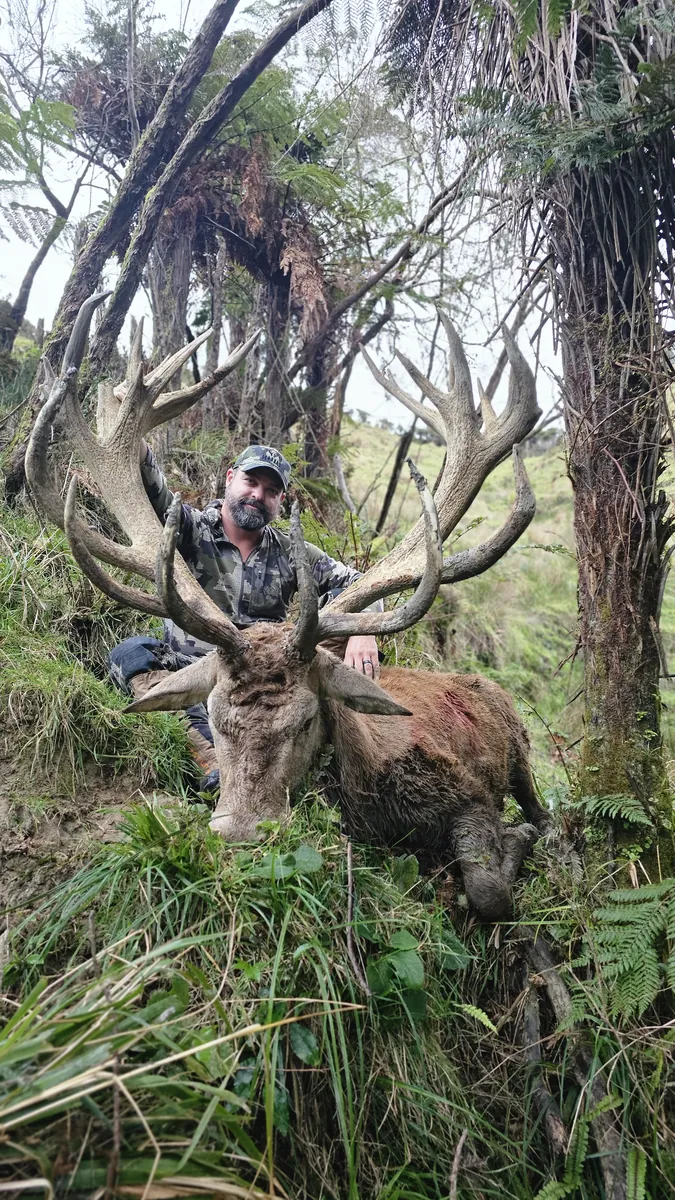
We’ve had a good run. A blue tongue came through in 2012 and really hurt the herd, but it’s come back. The last three years we’ve had four bucks come off the property — I killed a 165 a couple years ago, another guy killed a 170, and this past year a 165 and a 169 came off. I’m on all the hunting pages, and I know it’s not all about antlers — to me it’s about being in the woods. We harvest does for meat; my wife actually prefers doe meat. But we do trophy hunt, because we can — I recorded a 130-inch eight-pointer at 13 yards last year and never picked up my bow. That’s just not the caliber I’m looking for.
SAM McGOUGH · 32:00
I keep tying business and hunting together because of the work you put into the land. I had this same conversation with my HVAC company and a medical clinic this week — there’s a certain dollar amount that’s non-negotiable, we can’t do anything below it. It’s the same in hunting: we’re letting these deer get this big, period.
KENDALL PRICE · 32:40
We run a one-buck rule and roughly a 150-inch floor for the experienced guys — though a first-timer can shoot whatever they want. We’ve got 30 trail cameras on the main property and a dozen-plus shooters over 150, so you’ll pass a 140 because you never know what’s 40 yards behind it. Where I run into the broken-math problem most isn’t my team, it’s clients. Someone comes in collecting $20,000 a month, only does pay-per-visit, almost wears it as a badge of honor. I ask how many visits the average patient comes for — 12 — and what they charge — $50. So the lifetime value is $600. I can’t make that work if it costs $150 to acquire at a 30% margin. That’s not a marketing problem; the business model is broken. You either need more visits or to charge more.
SAM McGOUGH · 36:00
It’s the same for the technician — they have to know their number. We did this exercise with the HVAC company: you didn’t factor in cost per lead, the gas, the insurance, the van payment sitting there churning money every day. So when do you want to do this $150 job? You just did it for free.
KENDALL PRICE · 37:30
And the customer-service side justifies the price. When you give somebody a real level of service, people are willing to pay — it’s also how you communicate it. If someone doesn’t see your value, you don’t need to come down to their level and let them dictate it.
SAM McGOUGH · 44:00
The room is more important than what’s ever taught. That was the premise of our mastermind — just getting together and learning from each other.
KENDALL PRICE · 45:00
I do a mastermind every year with guys from chiropractic school doing two or three million a year. It’s like the hallway conversations at a conference, or the ones over a beer at the bar — you take more notes there than in the session you paid for. Entrepreneurship is lonely. All my high-school friends are cops, firefighters, working at John Deere — good jobs, but you can’t have these same conversations. It’s why getting in rooms like that matters.
SAM McGOUGH · 46:30
Any last words — one key to success?
KENDALL PRICE · 47:00
Systems create freedom. That’s your process — and putting the right people in the right seats to execute those systems and processes will create more freedom and more life than anything else.
SAM McGOUGH · 47:30
That’s what it’s all about. Kendall, thanks again for being on the Hunt for Success. Until next time, talk to you soon, bud.