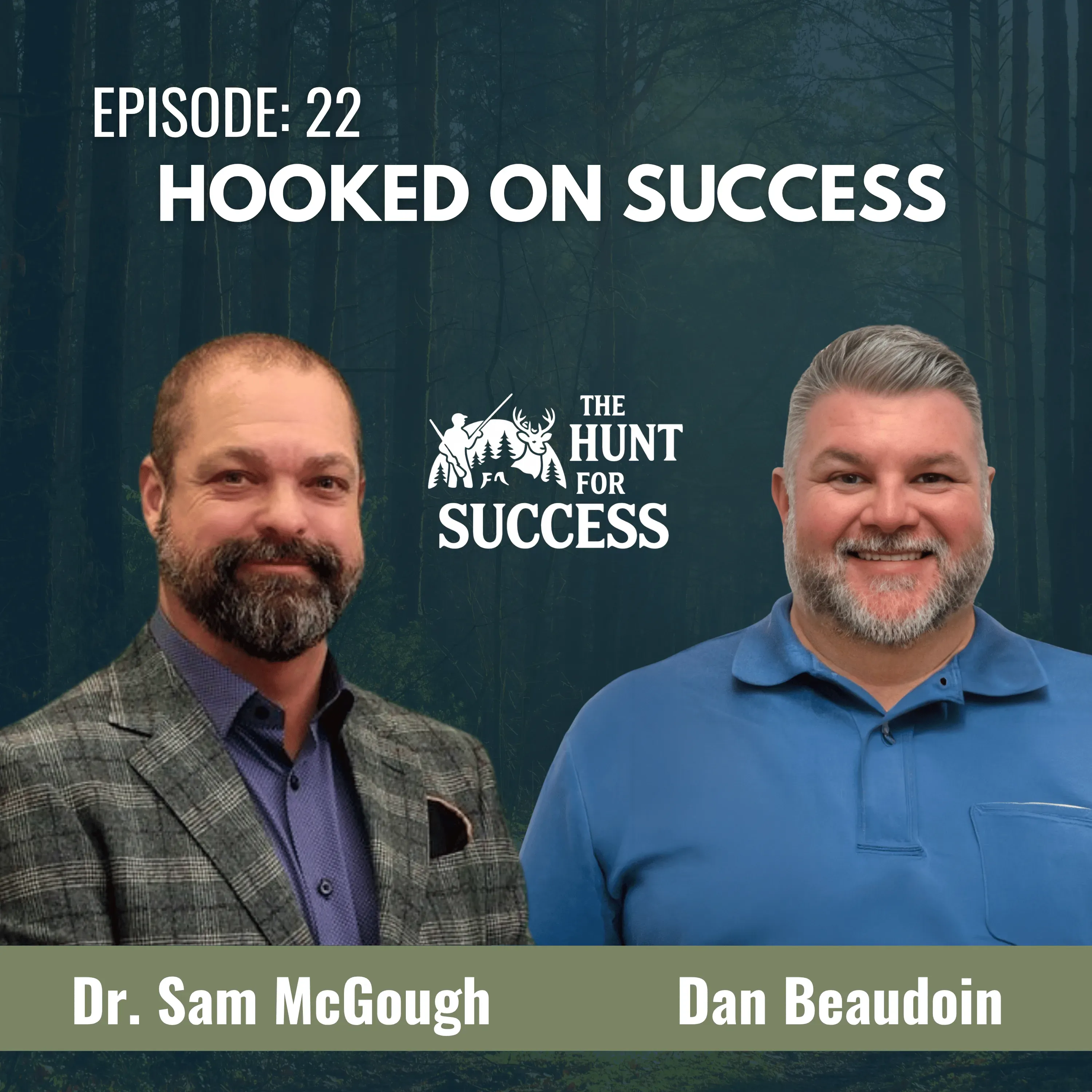
Episode 22 with Dan Beaudoin. An automatically generated, edited condensation of the conversation, not a verbatim transcript. Timestamps are approximate. Watch or listen above for the complete interview.
SAM McGOUGH · 0:00
Welcome back to The Hunt for Success. Today I have a really fun one for you guys. I have Mr. Dan Beaudoin, the president and CEO of DMF Bait Company. You have probably used this if you have gone fishing in America at some point. I know we have all had some worms at one point. You have live bait in 12,000 stores nationwide. Is that correct?
DAN BEAUDOIN · 0:43
That is correct.
SAM McGOUGH · 0:43
DMF has been in business for 49 years, and you have been at the head of it for 29. Your products are in Bass Pro, Walmart, most anglers have used your product at some point. How did you come up with this?
DAN BEAUDOIN · 1:31
I am second generation, so I did not come up with it. I have had the vision of where this company could go over time, but a little bit of backstory. My dad and his twin brother and their good friend at the time, he is no longer with us, were basically high school teachers here in Michigan, and we get the summer off. Back in the ’70s they did not have year round income. They only got paid during the school year, so they were perpetually looking for summer income, something to fill that gap and fill their time. They sided homes, they did landscaping, they did a lot of odd jobs.
DAN BEAUDOIN · 2:15
Then Fred had a family member in the farming industry who said, “Hey, there is this really cool thing where you can raise worms and make a lot of money.” So they invested into it, and it turned out to be a form of red worm that is used for composting. Now flash back to 1977. How many people do you know that had considered composting anything in the ’70s?
SAM McGOUGH · 2:15
Not a lot.
DAN BEAUDOIN · 2:15
None. And guess what? Composting worms multiply pretty quickly and easily. So it was a scheme. It was a scam. They bought into a pyramid scheme, raised these worms, rented a building out, and then lo and behold, the company that is supposed to buy back the inventory is long gone, and they were probably 80 percent over what the value of the worm was.
DAN BEAUDOIN · 3:10
They give you 100,000 red worms that are worth maybe $5,000 back then and tell you it is going to be worth 500,000 once you get them to a million, and then they skipped town. So at that point they were stuck with all these worms. What do you do with a million worms? Nobody knows. So they started trying to take them to bait shops, and gardening worms, compost worms, are stringy and long and useless for fishing. You can hardly put them on a hook.
DAN BEAUDOIN · 3:51
Then everyone is saying, “Man, if you had night crawlers, we would buy those.” And they said, “Sweet. We know how to do worms, so we are going to start doing night crawlers.” Little did they realize that a compost red worm is much easier to take care of. They reproduce rapidly. Night crawlers require cool, dark spaces, and they do not reproduce in captivity.
DAN BEAUDOIN · 4:34
Mother Nature assists. They just do not do it. And night crawlers take a long time to reach maturity. Red worms will reach maturity in six to nine months. A night crawler, the ones you are fishing with, are probably five, six, seven years old. So they discovered a market for night crawlers and felt like, “Hey, this is going to be easy to do, we have already done it.” Then they realized it is not easy to do and we did not really already do it. I always tell people it is like saying, “I have a hamster, how much different can a dog be?” They are both pets, they both have hair and fur, but they are not the same.
DAN BEAUDOIN · 5:19
There was nobody there to teach them, nobody there to educate them. Through tenacity and stubbornness and a lot of Old Grand-Dad, they persevered and they got through it. Now we are very fortunate for where the company has been able to go.
SAM McGOUGH · 5:19
I think I have heard that similar story with a lot of businesses, where you got into something not knowing exactly what you were getting into, and then it went bad, and then out of pure not quitting, you made it.
DAN BEAUDOIN · 6:02
They are the true American success story of what it means to work hard, not give up, and just dive in. When they were growing and they finally realized they had something here, banks would not loan them money, because who is going to loan money to a worm wholesaler? We were not a traditional bait shop. They were revolutionizing the industry without even knowing they were doing it, and everyone was like, “You guys are crazy, you are going to lose everything.” They were on that doorstep. They did have a day in 1982 or ‘83, I forget the exact year, where they were literally sitting down to divide up the business and said, “We have had enough.”
DAN BEAUDOIN · 6:45
Kmart headquarters is about 20 minutes from our house, and my Uncle Mike said, “You know what? I am going to call Kmart and see if we cannot get in there. If we can get into a stable account like that rather than peddling to random people, maybe we can do something.” They told him, “You are wasting a dime, do not even bother with the phone call.” It was a Saturday morning, and sure enough somebody answered and said, “Yeah, sounds great, come on in, let’s talk.” That was the moment they finally had the belief that this could go somewhere else.
DAN BEAUDOIN · 7:28
Kmart was a big bully back in the day, but they got 50 stores, and in that summer of ‘83 those 50 stores, it was the number one item in the sporting goods department overnight. Then in ‘84 it expanded.
DAN BEAUDOIN · 8:10
Then in 1988 there was a drought. Like I told you, Mother Nature takes care of the night crawlers, so there are crews that literally go out at night and pick worms off the ground. An ideal night is no moon, no wind, good moisture, mild temperatures, so early to mid spring. When we get into this time of year, worm picking is not very good, it is too hot. So it becomes a commodity. You can usually produce worms when fishing sucks. When fishing is great, nobody is producing worms, so you have to have holding power.
DAN BEAUDOIN · 8:56
In 1988, once Kmart caught on to how successful it was, they started setting up other bait vendors throughout the country, and we had a massive drought, could not get worms, it was a bidding war. Here you have these three former school teachers that do not know business practice. They are buying worms for double what they are selling them for, but they are terrified to call and say, “We need some financial help.” So they shipped at a loss for the majority of the year, and the buyer would call and say, “Hey, can you do this store? Can you do that store?” And they were killing themselves doing it, but they did it.
DAN BEAUDOIN · 9:37
At the end of that year the buyer called and said, “None of the other vendors supported us like you. We are getting rid of everybody, and you now have the whole chain.” That was probably 750, maybe 1,000 stores back then that had crawlers. That was the turning point. Now they have volume, they are sustainable, they can make money. Those were really the two turning points, making that phone call, and then obviously not doing what normal business practice would do. Like we just went through with tariffs, everybody got a tariff and said, “I need a price increase.” These guys were so afraid that they never asked for a price increase. They probably would have got it, because obviously the other guys got it.
DAN BEAUDOIN · 10:19
The other thing I need to tell you is that all the night crawlers come from Ontario, Canada. Ontario is the night crawler mecca of the world. They service probably 90 percent of the world’s night crawlers. So us being nearby, they could get up there pretty quick and get their hands into things where somebody in Oklahoma or Montana or Texas cannot. That led to a lot of their success story, and from there we branched out in the ’90s, Bass Pro, Walmart, Cabela’s, they were separate at the time, and we started to get into more hardware stores. A lot of expansion in the ’90s.
SAM McGOUGH · 11:08
When did you get involved?
DAN BEAUDOIN · 11:08
I have been involved since I was a baby. When they first started we used to pick our own worms on golf courses in Michigan, so the three school teachers bought a school bus and hired their students to pick worms at night. One guy would take the crew at night to pick worms, another one would sleep, and the other one would scout for where they could pick the next day. So I was literally swaddled up as a baby, driving around to golf courses while my dad would be paying off groundskeepers to let him on the course the next day.
SAM McGOUGH · 11:52
I was going to ask that. How did you get into all the land that you needed to do it?
DAN BEAUDOIN · 11:52
In the end it is an industry in Canada. I do not want to call it an underground industry, but it is not an advertised industry. There is a system up there that the States could not support. Take that perfect night, no wind, good moisture, mild temperatures. Let’s say you are my number one picker. I put you in the Detroit market, you might get 3,000 worms in a night, a good night. I move you into Hamilton, Ontario, and you are going to pick 15,000 worms. The density of worms there is quite a bit more than it is here in the States. So you can produce them here, but they cost a lot more.
DAN BEAUDOIN · 12:33
As for me, it is all I have known. I used to be able to ride my bike to our original shop from our house, and I would put lids on cups and flip flats. Eventually I went to college, was looking to be a school teacher at the time, and about halfway through, my dad and uncle were like, “You are going to miss out if you do not come in here. This company is ready to explode, but you need to get a degree in business.” So I moved over into business administration management and started here full time in 1997.
DAN BEAUDOIN · 13:14
I have done everything. I have swept the floors, put lids on cups, counted worms, unloaded the trucks, packed them.
SAM McGOUGH · 13:14
That is perfect, that you have experienced every level, so that way you always know what is expected of each part.
DAN BEAUDOIN · 13:14
Yes, and admittedly we have evolved quite a bit since then, so things have passed by me now. But it does give you the light into the window of the aggravations I had back there and the frustrations. I am not tooting my own horn, but I came in with a little fresher open mind of how things maybe should operate, based on learning principles and systems and processes, where my dad and uncle were just stubborn in the way they did it. They operated in what we called organized chaos.
SAM McGOUGH · 14:43
You are running a bait operation where the product is already alive. I cannot even imagine the logistical nightmare of getting these all over the country. Tell me a little bit about that.
DAN BEAUDOIN · 14:43
Honestly, Sam, that is one of the key components to our success and our growth. There are two things we have done. One, we migrated out of the traditional bait shop and we went into big box stores when everyone said, “Kmart would never sell night crawlers, why would anyone ever go there?” We proved that out. The next thing was that worms are typically peddled on the back of a van or a cube truck. You can only cover so much ground. So they started to look at shipping. We are primarily FedEx now, but back in the day UPS, and there was another company called RPS, which is gone.
DAN BEAUDOIN · 15:28
How could we do it through there? And again, there is no roadmap, nobody is doing it. We killed a lot of worms. We sacrificed a lot of worms that never got on a hook, trying to figure out how we can ship worms. Now we have a very sophisticated system. If we are in the Detroit market going down to Cincinnati, we have a packaging system. You are in Arkansas, correct?
SAM McGOUGH · 15:28
Alabama.
DAN BEAUDOIN · 16:09
Alabama, I am sorry. Similar market, a little bit warmer. We will not talk college football, you have the upper hand. So going to the deeper south, it is much warmer, it is going to take an extra day, we have some additional packaging. Getting all the way out to Tucson, Arizona is our more intense one. So we balance the size of the package, the weight of the package. It has to get there alive. We guarantee it will get there alive. It might be a little bit stressed when it gets there, because you cannot account for everything.
DAN BEAUDOIN · 16:51
They started the model just doing the Midwest, Ohio, Indiana, Illinois, Pennsylvania, and as we proved that out we said, “Let’s see if we can go further.” We were getting push from our customer too. Kmart was saying, “We need you to go further.” Other people have replicated what we do. I will boast that our system is better, our quality is better, and I think we react quicker. A lot of it is proprietary.
DAN BEAUDOIN · 17:31
We have never settled on the model we have. We are always challenging to see if we cannot get it cheaper to our customer, get it in better condition, get it there faster. It is a lot of extra cost and a lot of extra effort that the consumer would not think about. They do not even think about where the worms come out of the ground. They just know it is in the refrigerator when they want it.
DAN BEAUDOIN · 18:15
We do all 49 states except Hawaii. We do not have any plans to go international at this point. There is plenty of market here in the US, and we are still growing. We have been at this 49 years and we are still growing. There is a lot of legal stuff moving a live organism across a border, and keeping it alive. It can be done, but it is not something we have chosen to pursue at this time.
SAM McGOUGH · 18:59
Sometimes it just does not make sense.
DAN BEAUDOIN · 18:59
When you are good and you are strong in an area, it is good to take chances, it is good to look, but if I cannot provide a guy in London the same quality at a reasonable price that I can to somebody in Missouri, it is not really what we want to do.
SAM McGOUGH · 18:59
So what is the most you-can’t-make-this-up moment you have ever had in this business?
DAN BEAUDOIN · 19:41
Easy. I should have grabbed a sample. Night crawlers need to breathe, they need air. When we bring them in from the picking fields, they are not in cups, they are in what we call flats. It is a 12 by 12, four inch tall styrofoam box with no lid, and we diamond stack them so the corners are exposed and it allows air flow in there. With no lid on the box, because they need oxygen and they need to move, they do not do well with a lid.
DAN BEAUDOIN · 20:23
At the same time, night crawlers are called night crawlers because they come out at night, so we have to simulate wind and light and temperature in our coolers to keep them contained in the box. So imagine early on, when the power goes out, your lights go off, your wind goes away, and your temperature starts to rise, and they start crawling out. Go back to the mid ’90s when we are trying to figure this out. We eventually got a generator, some Model T thing that was older than a dinosaur, and it was not very reliable. You had to start it by hand, so you had to come down here when the power went out, and if you did not get here, it takes one hour with no lights and about 10 percent of the worms will start crawling out of those boxes.
SAM McGOUGH · 21:03
Oh, man.
DAN BEAUDOIN · 21:03
After about three hours, about 50 percent have already crawled out. We built this new cooler, and space was an issue, so we were doing what was called double stacking. A pallet of worms has about 50,000 on it, and they are about five and a half, maybe six feet tall. We did not have space but we needed to hold more worms, so we literally take one pallet and put it on top of the other. We could not go as tall because of the ceiling, so we would have 90,000 worms on one pallet.
DAN BEAUDOIN · 21:52
So now the power goes out, worms are crawling, and you have to go start picking these things up, because in 24 hours they start drying up. They need to be back in their bedding. You are walking in the dark with a miner light on, and they are falling from above, in your hair, down your shirt. As crazy as this sounds, and it probably grosses a lot of people out, it does not phase me. It does not phase any of us. When storms came, if we were smart, we got down here ahead of time and sometimes almost slept here, because you wanted to turn the generator on as soon as you could, praying that it turned on. It was enough to run our coolers, but not the business. You could not turn the lights on in the warehouse, because you just wanted to keep the worms.
DAN BEAUDOIN · 22:33
Now we have much more reliable generators. We basically have the equivalent to what you run at a hospital. The cooler I was telling you about, on average, would hold anywhere from three to five million worms. Now we have two large walk-in coolers. One holds 26 million and the other holds 20 million. They are all double stacked with drive-in racking, so we now have 110,000 on a pallet as opposed to 90,000.
DAN BEAUDOIN · 23:14
And I wish I could say that only happened to us once, but it has happened multiple times over the years. Knock on wood, our systems are in place. It has probably been 15 years since we have had that problem. We finally said, “All right, it is time to get rid of the old dinosaur generator and spend some money and protect our investment.”
SAM McGOUGH · 23:54
In my head I am thinking of walking through worms this fall, feeling them underneath your feet.
DAN BEAUDOIN · 23:54
You cannot step on them. You have to move slowly, and you can hear them, because it is silent in the cooler. You hear them hitting the ground. We have always had very good employees. Back in the day we had a network of people that were so loyal to us, they believed in the business. We always take care of our employees. So we could bring in five or six people to help pretty much at any time, and they got used to it. “Oh, storm is rolling in, I might be getting called into work.”
DAN BEAUDOIN · 24:35
But you are working this aisle, and it is narrow, because we try to pack as many worms as we can in there. My shape today, I would not get down the aisles. When I was a kid I could. They were probably not much more than 18 inches wide, so you are squeezing between them sideways, duck walking. Everyone says, “Why do you not use a vacuum?” Vacuum kills them. Shovel kills them. The only thing that does not hurt them is your hand.
SAM McGOUGH · 25:17
You were able to get into Walmart, and you told me Kmart was the first, then Walmart, Cabela’s, Bass Pro, Academy. That is no small feat getting into those big sport chains. What was the pitch process like for you?
DAN BEAUDOIN · 25:17
The Kmart pitch I really was not part of, I was pretty young, but I have heard the stories. That was a little bit harder because at the time they had no capital to invest. You had to have a refrigerator. They had the idea of Kmart selling worms, but they did not have refrigeration, and as they walked out of the meeting, Kmart said, “You are providing the refrigerators, right?” And they said, “Yeah, we can do that.” They had no money. They did not have access to 50 refrigerators.
DAN BEAUDOIN · 26:02
Flash forward into the ’90s when we had probably one of our largest growth increases, largely because Walmart came on board. Walmart was on steroids. They were so much more aggressive with their expansion plan. The nice thing was we had to help fund it, but Walmart procured the refrigerators because they could buy them significantly cheaper than we could, and they had access to get them in the stores.
DAN BEAUDOIN · 26:44
The sales process, usually it is at a trade show, and there is a show called ICAST, the international fishing show. Back in the ’90s it was much more international. They pitched Walmart at ICAST. Back then we used to do mailers to stores asking store managers, “Do you think you could sell worms?” You could use stores as leverage to get product in. At that point in time they had the ability to do what we call local buys or special buys. A lot of that over the years has been taken away as everything has gone more linear with universal store models.
DAN BEAUDOIN · 27:28
Once we got into Walmart, the program kind of sold itself. Exhibiting at ICAST gave us exposure to anyone that had a sporting goods department, and once they saw the success of Walmart, it started to sell itself. That worked until probably about 2001, 2002, and then it leveled out and became a little bit harder work. They are always terrified that the worms are going to show up dead, because it is a perishable item. We guarantee live delivery, and it happens, Sam, they show up dead sometimes. Sometimes because we failed on the packaging end of it, typically the carrier has delivered it late, but we ship it right back out.
DAN BEAUDOIN · 28:20
The one trick is that sometimes it takes two to three years for a consumer to catch on that a big box store has it. Now, with the amount of volume we are doing and the marketing we have behind it, we have made the average consumer much more aware that worms are available in those locations. So for the most part the program does sell itself.
DAN BEAUDOIN · 29:09
Fishermen live everywhere. Fishermen tend to buy their live bait closer to where they live, not necessarily where they fish. Obviously if you are on a lake you are going to do well, but a lot of guys prep the night before, they want to get out early, so they want to have their bait ahead of time. There are a lot of misconceptions. “Oh, I am 15 miles from a lake, I cannot sell bait.” We always ask, especially gas stations, do people pull up with boats and fill them up? “Oh yeah, all the time.” You will sell worms. Guaranteed.
DAN BEAUDOIN · 29:51
We run into obstacles. There are a lot of people that get concerned about health issues, especially the gas stations and party stores. It is contained in our live bait refrigerator. The other thing I tell them is, “It is the healthiest thing in your store. It is 100 percent organic. It is used to grow the other healthy things you eat.” I would argue that the candy aisle is the part you should get rid of. But everyone freaks out because it is a worm. Worms do not carry diseases. They are in an organic peat that you can throw in your garden and grow stuff out of.
SAM McGOUGH · 30:31
I guess growing up fishing and digging my hand into that styrofoam box the whole time and then taking my hand directly to a bag of Doritos, it never bothered me.
DAN BEAUDOIN · 30:31
It does not phase us. But there are a lot of store owners now that did not grow up fishing. They do not know that. What we refer to as the good old boys, they know it is a no-brainer. They already have worms.
SAM McGOUGH · 31:12
You said no one was composting back in the ’70s. I was not composting, but my dad showed me this trick. We had a piece of tin and I would throw all the leftovers underneath, and I always would have worms. Where I grew up we were pretty far out in the country, and my dad was a truck driver, so he was gone most of the time. I had no access to go to town to get stuff, so I was digging my own worms when I was a kid. I had access to go fishing, I just did not have access to go to town. And especially if we ever bought worms and had any left over, I would toss them in there for breeders.
DAN BEAUDOIN · 31:54
It is funny, because even back then, my grandfather, Depression era thing, they would try to hoard worms and keep them alive. Now we put them in a cup and most people kill them before they get back home, even if they do not use them. The attitude of it is much different. We have even explored selling worm bedding, but is anyone really using worm bedding? That day is gone.
SAM McGOUGH · 32:35
I just took my son fishing three weeks ago, and we stopped at the gas station because I had forgotten bait, and we grabbed some worms. When it was over there was another guy there fishing, and I said, “Here, you want the rest of these worms?”
DAN BEAUDOIN · 32:35
He does not even want to take them back. Different era. I would imagine your son has never gone out and picked worms or tried to hunt for them.
SAM McGOUGH · 33:19
No. When I grew up we had a tree that would bloom once a year, big banana leaf looking things, and it was called a Catawba worm. Those worms would be there for maybe a month while they were eating all the leaves, and that was it. I would get them all off that tree and freeze them in a bag. They were not as good after you froze them, but they were only going to be there for a little while. Bream would just come to the top to get those things.
DAN BEAUDOIN · 33:19
If we could ever figure out how to maintain them year round. It has been a minute, but we have had a lot of requests for those. I know how good they are, but it is one of those things where Mother Nature is the only way you are getting it, and it is a short period of time.
SAM McGOUGH · 34:02
After my dad died, my mother cut that tree. I was so upset. I had already moved off and was gone, but I would come back to go get those worms.
SAM McGOUGH · 34:48
We call this show The Hunt for Success, and that is what it is about, people that like to hunt, and their successes, and how they personally define success. You took this business and you have grown it quite a bit. How do you define success, and has that changed over your life since you got into business?
DAN BEAUDOIN · 34:48
Absolutely. We are successful, we do very well, but my success is not a number of units. It is not dollars. I always joke, I want to be the Kleenex of live bait. When people say live bait, I want DMF Bait to be the household name of live bait. That is my dream. We are making roads there, but we are not there.
DAN BEAUDOIN · 35:29
We are looking at some other metrics too, some fun things, like is it possible to put bait in every ZIP code in the 49 states? I have to think there are some places in Arizona where it should not be. Coke used to have a model back in the day, put a can in reach of everybody or something like that. So we are asking, how can we measure and put that metric that a DMF product is in reach of everyone, and it is the go-to brand that people go to.
SAM McGOUGH · 36:10
I would think Wyoming would be hard too, because there are just not enough people.
DAN BEAUDOIN · 36:10
It is an unrealistic goal, but there is probably some measure at that point, because with my dream of making it a household name, how do I know it is a household name? I do not know how to measure that until I hear some people talking about it on the street who did not know it. Other than that, it is the availability, putting it within reach of everyone.
SAM McGOUGH · 37:03
That is a good goal and a good way to look at it, because I think once business people get out of survival mode, in order to really get some big numbers and big things, they have to shift from a number to a passion, to a purpose.
DAN BEAUDOIN · 37:03
I have always had the passion. It was funny, because I would ask my dad, “What was your goal when you started this?” They never really had a goal. Then they would say, “If we could sell a million worms.” They actually did that pretty quick, but they never really established what was next. It just kind of was happening, which, I am not disrespecting it, but it limited them in where they could go, because they did not have a finish line to chase after.
DAN BEAUDOIN · 37:45
So now we have annual feats. It is more internal stuff, not outside marketing, but as an organization, let’s elevate what we can do here and get everybody behind one mission. Our goal last year was to put 15 million cups in the marketplace. It was a lofty goal. We got there on December 26th, I think, when we hit our number. It was a lot harder than we thought it was.
DAN BEAUDOIN · 38:33
This year our goal was 330 million worms on hooks. We are not going to reach that goal, unfortunately. And when I say that, it is beyond night crawlers, because we sell red worms and wax worms and meal worms, and actually one of our fastest growing, most popular worms right now is our garlic scented night crawler. That is exploding big time. We had a really poor spring this year, it was pretty cold nationwide, and we cannot make up for that to reach those numbers. But we are always looking for something to get everyone behind growth and get some excitement behind it.
DAN BEAUDOIN · 39:16
There is a bigger goal for us over time. We want a larger store count, we want a larger presence, so we are working on a five year plan right now.
SAM McGOUGH · 39:16
You are killing me. I have all these questions prepared and you are answering them before I have a chance. I was going to ask what was next for DMF, and you just answered it.
DAN BEAUDOIN · 39:58
Well, I have another one for you. DMF is moving beyond live bait. We started last year with a tackle line. We had always said we were going to just do live bait, but as we have ventured out further, the big box accounts do not need anything, they have Berkley and Pure and all those guys. Your local gas station just has a refrigerator with worms, and they are saying, “Our people want more,” especially the tourist spots. “Hey, I am on vacation, I did not realize this great bass lake was here, and I do not have any of my gear.”
DAN BEAUDOIN · 40:38
Last year was our trial. This year we sold out of everything. We started with some basic tackle, what I call worm complimentary items, hooks, split shot, bobbers, stringers. I think we have about 15 different items. Then we have a kids’ dock combo fishing pole, and a telescoping fishing pole that is compact for a traveler.
DAN BEAUDOIN · 41:21
Next year we will have, I think, a five and a half foot two piece and a six foot, both open face and closed face, and we are expanding our tackle line. It is like a 20 SKU display that sits right on top of our little bait refrigerator at the store, so it is a little mini bait shop that party stores and convenience stores can have. We tested it last year in about 50 to 100 stores and everyone sold out of everything. We went bigger this year and sold out of everything again. This stuff comes from overseas, so all this trade stuff going on has made it a little bit more difficult. We kind of picked the wrong year to get started, but the goal is to get about 1,000 convenience stores up and running with our tackle line in the next two years.
SAM McGOUGH · 42:07
I love those little kits. I have bought so many of them, because like you said, I was somewhere and thought, “Oh, I do not have anything,” and I can run in and grab a little kit with bobbers and things and go wet a line somewhere. DMF has been in business for 49 years. Most businesses go out within three to five years, and then there is another gap where a large percent go out before 10 years. What do you think is the most overlooked mindset or trait that builds a business that lasts like yours?
DAN BEAUDOIN · 42:48
Two things. One, you have got to be humble. You have got to reflect on your roots. You have got to realize what got you there, and it can go away as fast as you got it. And the old cliche, if you are standing still, you are going to get passed by. Everyone asks, what is enough? For me it is the advancement of the brand, coming out with new items, getting more stores. That is what keeps giving me energy. The growth keeps us.
DAN BEAUDOIN · 43:28
The other thing is culture. We have got very little turnover at our organization, and it is difficult because we are a seasonal business. We have almost 100 employees here in June. We will be down to 65 come the fall. But most of these part-time people come back every year. They genuinely want to be part of the organization. Without a good culture and a good employee base, you do not have it.
DAN BEAUDOIN · 44:20
Then there is the drive to keep challenging ourselves. One of our key values is strive for improvement. What can we do tomorrow that we did better today? It is all hands on deck. Any of our employees have opportunities to come forward with ideas on how to change process, and we try to keep everything as open and transparent as possible to make them feel a part of our family. It is a family business, but we want everyone to understand they have an important role regardless of what their role is. Without them the whole system can break down. Everybody has a value, even the guy stacking the boxes on the truck. “Man, you are doing a great job. Without you we do not get this truck loaded.”
DAN BEAUDOIN · 45:45
Our core values are family, fun, DMF proud, and strive for improvement. Every year when we get into the weeds of things I tell them, “Guys, we play with worms. If you cannot have fun and laugh here, this is not the place for you.” You cannot be serious here. You have got to have fun to be here. We have spent a lot of time keeping our employees engaged and feeling a part of it.
SAM McGOUGH · 46:28
As the leader, how much time do you dedicate to learning or trying to come up with things to incorporate into your organization to help build that culture?
DAN BEAUDOIN · 46:28
A lot. In the past two years we have restructured. My role has changed quite a bit and I am spending more time on what is next for the organization, what can we do to build our culture. I am further from the day-to-day operations than I have ever been, and I feel a bit disconnected, it makes me a little bit weird, but it is really the best thing for me, because I am so scatterbrained. I am the visionary of the organization. I cannot stay on task long enough to be consistent.
DAN BEAUDOIN · 47:11
Now that I have been freed up, I spend a lot of time researching, looking at other systems. A lot of times these guys see me come rolling in and they are like, “Oh my God, what does he have now? What is this going to cost? How much time is this going to take?” Because I am not usually the one doing it. But I am perpetually looking at what we can do to keep the employee engagement and the morale high. You can pay people as much as you want, you can overpay them, but if the morale is not there, it does not matter what they are getting paid, despite what people will tell you.
DAN BEAUDOIN · 47:52
We learned it, because we did it. We had a huge cultural shift about 10, 15 years ago where we were struggling. We had high turnover and could not figure out what was going on. We were the highest paid employer in our town and could not keep people. The morale was down. We let the growth and success take over and we lost track of our employees. It took a minute, we recognized it, and we have addressed it and fixed it. We are still one of the top payers for general labor in our area and we have the best benefit package of anything around here, but at the same time it is getting them to feel a part of it.
DAN BEAUDOIN · 48:33
That is where I am perpetually trying to find out, what can I do to make their job easier? What can I do to help them see their successes and the company’s successes? We have become a far more transparent organization about where we are going and what we are doing, which is ironic, because the founders were always very private. Keep everything secret, do not let anyone know what is going on, even your employees. It does present some challenges, but it makes them feel confident in what we are doing and why we are doing it.
SAM McGOUGH · 49:23
Kind of shifting gears, part of this show is about our pursuit of the things outdoors. Do you ever get a chance to get outdoors and do some fishing or hunting?
DAN BEAUDOIN · 49:23
This is the embarrassing part. I grew up fishing. I fished every day. My best friend and I were out no matter what the weather was. Until the ice turned hard we were out every day. As an adult I got away from it.
DAN BEAUDOIN · 50:03
I live on a local lake, and we have a bass tournament, and it is not your traditional bass tournament, it is more of a drinking club than a bass tournament. And we can use live bait. All the bass guys listening to this are going to freak out, because bass guys do not use live bait, but we do on my lake.
DAN BEAUDOIN · 50:44
So I get out the second Saturday of June every year at a minimum. I try to do some more. I did some salmon fishing, got on some charters. I do not grab my own pole and go at the end of the dock like I used to. I do not know what it is, the habits I formed unfortunately are not there, but I keep telling my wife, “That is going to be my retirement. I am going back to it.”
SAM McGOUGH · 51:26
You need to. Get out there every once in a while. It was the same thing for me though. I was building a business. I probably did not hunt or fish more than a handful of times for a decade, because you were busy, working on Saturdays, working on Sundays, and by the time the week rolled around you were just exhausted. I always tell everybody I meet, “Remember when you were a kid and you did not hunt or fish the way you wanted to enough? That was when you had your time.” If I could go back in time, before I was married, had a family, had a business, I would hunt and fish so much more.
DAN BEAUDOIN · 52:12
I always thought when I had kids I would get back into fishing because they would want to, but organized sports dominates the life. By the time you get home they want to jump in the lake and swim, but they did not want to go fishing. And my wife was not raised with it, so she would not eat fish. None of my kids eat fish, well, one of them does, but most of them do not.
SAM McGOUGH · 52:12
My good friend is from the Upper Peninsula of Michigan. Iron something.
DAN BEAUDOIN · 52:12
Iron Mountain?
SAM McGOUGH · 52:12
That is it, Iron Mountain. That whole area has the tradition of the Friday fish fry. We went up there and experienced that. I would think all the kids would at least eat fish up that way.
DAN BEAUDOIN · 52:54
The UP, we had hunting property up there for a long time. It is a different world up there, and I love it. It is a long drive for us to get there, but they are outdoorsmen. They do not have organized sports like we have down here in the metropolitan area. They still live what I would call a quality outdoor life.
SAM McGOUGH · 53:34
I like it up there. It is one of my favorite places I have been in the country. Beautiful, and I killed a massive deer. It was great.
DAN BEAUDOIN · 53:34
They call it God’s country.
SAM McGOUGH · 53:34
They call it God’s country everywhere. We call it God’s country down here too. Well, listen, I have really enjoyed this. Before I go, where can people find DMF Bait products, and where should they be following along with you?
DAN BEAUDOIN · 54:37
We are very active on social media, Facebook, Instagram, LinkedIn, regular posts there. We have not tapped into the TikTok world yet. Our products, again, I am hoping one day I tell you they are within reach wherever you are at, but pretty much about 90 percent of Walmart stores in the freshwater market carry our products, all the Academy stores, several Dick’s stores, Dunham’s Sports, Bass Pro and Cabela’s, and then thousands of gas stations and convenience stores. We are very strong east of the Mississippi. We are not as strong on the West Coast, we are growing out there. Texas is our number one state.
DAN BEAUDOIN · 54:37
We do not offer any online sales. Everything we do is B2B, business to business. We let the retailers manage the customers. But you go to our website and we have a store finder. You can plug in your address and it will pull up the closest store to you. You can select the product you are looking for and find out if it is in that area, because not all our night crawlers are in every store. That is the staple, and from there red worms are pretty popular. Garlic is growing rapidly.
SAM McGOUGH · 55:23
I am going to have to try that garlic.
DAN BEAUDOIN · 55:23
I am telling you, if you catfish, walleye fish, even bass fish. A few weeks ago at my bass tournament I brought garlic for my boat and gave regular worms to all the other people participating. I actually tested it on our last tournament. We hit a wall, we were not catching anything, and I said, “Hey guys, let’s switch to regular just to see.” Nothing, nothing, nothing. I said, “All right, I am going back to the garlic,” and then boom, boom. We had four bites right out of it. So it works. It definitely works.
SAM McGOUGH · 56:10
Well, Dan, it has been a blast. I appreciate you coming on the show. I want to continue to connect with you and keep in touch over time.
DAN BEAUDOIN · 56:10
No problem. I enjoyed it, it was a lot of fun. So I am going to leave you with one last thing, our tagline. Our worms catch fish or die trying.
SAM McGOUGH · 56:52
I love it.