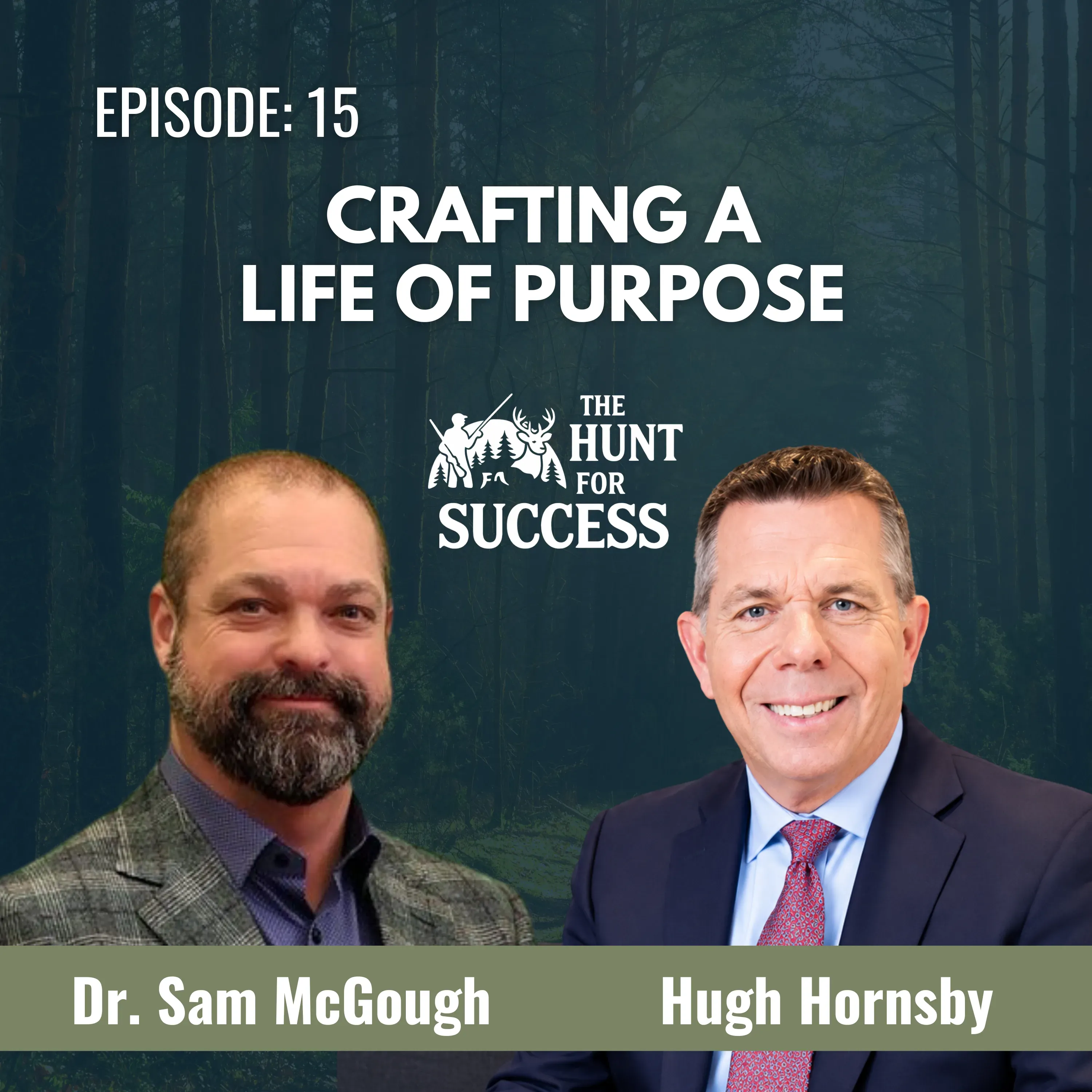
Episode 15 with Hugh Hornsby. Automatically generated and lightly edited for readability.
SAM McGOUGH · 01:03
I’m your host, Dr. Sam McGough, here with The Hunt for Success podcast. Today I’ve got one of my best friends out in the world — we just met, but we’ve gotten really close in the last couple of months. I feel like we have a kinship. His name is Hugh Hornsby. He’s got a long list of accolades, but in the trades, he’s a legend. Hugh, welcome to the show. Tell us a little about yourself.
HUGH HORNSBY · 01:34
Using the word legend is kind of scary. It means you’re getting old, and you haven’t been fired enough. But I’m very faithful, and I’m more faithful today than I was a year and a half ago, when I was diagnosed with stage four cancer. It’s funny — sometimes you think you’re just being set in a place you’re supposed to be. For me it started with epilepsy at the age of ten, a disorder nobody knew much about back then. I had an incredible mom and an incredible dad. She sat with me in the hospital with a tear in her eye and said: never let anybody hold you back, especially yourself.
SAM McGOUGH · 02:50
You didn’t know at the time that was setting you up.
HUGH HORNSBY · 03:06
I didn’t. With the seizures and the medication, it just became something I had to fight through, and it changed who I was. I’m not the brightest bulb out there, but I’m one of the hardest workers and I probably care the most. My mom used to say, you don’t have a disability — you’ve been given something special and you need to use it for the betterment of people. And she’d drop these underdog books on my bed. Always the bad-news-bears team. So I was always about the underdog, about looking at the world from a different perspective.
SAM McGOUGH · 04:36
When did you get into the trades?
HUGH HORNSBY · 05:07
There’s a company called Ferguson Enterprises — Ferguson is a $34 billion gorilla now. When I started with them they were $150 million in sales. I came out of college, got a job in the ’80s, and that’s how I became part of the industry. I only stayed about three years. It really didn’t work out. It was my first sales job, and it was the first sales job I got fired from. But I stayed in the industry — went to a manufacturers’ rep, then some factories — and I learned from all of it that it’s usually not the success that moves you forward. It’s the failures.
SAM McGOUGH · 06:00
How much of that was the mentality you’d already built?
HUGH HORNSBY · 06:08
I grew up in an environment where people were telling me I couldn’t be whatever it was, so when I got knocked down, I could step back and say, okay, what can I do differently next time? It would have been easy — especially on that first sales job — to blame the president at the time, because he’d done some things he shouldn’t have. But the day I realized I needed to take personal responsibility, that’s the day I decided this industry was where I wanted to be and I was just going to make a difference. That was 1982, ‘83.
SAM McGOUGH · 07:39
It sounds like you had a really incredible mom.
HUGH HORNSBY · 08:09
We were the go-to house. We didn’t know it at the time, but that’s what we were — the place everybody came to visit, so my parents could get a look at our friends. The right ones stuck around and the wrong ones just seemed to disappear. My mom had been abandoned at the age of three. I didn’t find that out until she was in hospice. She lived in a mixed home for almost seven years while her dad was in one part of the state and she was in another, and she never saw her grandmother again. And she made a decision that we were going to be the go-to home. Every one of our best friends came from a broken house of some sort, and when they came over they just became part of the family.
SAM McGOUGH · 09:12
And now you’ve made a career out of giving people second chances.
HUGH HORNSBY · 09:44
In ninth grade they tried to send me to what they didn’t call special needs back then — they just said, you’re going to take this little bus and go way down that way. I remember coming home and telling my mom, and I’m looking for her to be mad. She doesn’t get mad. She takes my notebook, hands me a pen and says, go upstairs. What? Go upstairs and write down all the reasons you disagree with what that teacher just tried to say, and write down where it is that you want to go. I’m still angry, but I remember it like it was yesterday, because she was determined that if I was going to change things, I was going to have to change it from the inside of me — make sure people weren’t going to set me up in that box.
SAM McGOUGH · 10:44
And then college.
HUGH HORNSBY · 11:14
I figured out how to make it to college — my grades weren’t great. Junior college, then Radford University. I was looking for a fraternity to pledge and they all told me I couldn’t be president. What do you mean I can’t be president? Well, you’re only going to be here two years. So I’m walking back through the dorm and there’s a flyer: a new fraternity wants to come on campus. I called the next day. I went down to the card place and had cards made up — Hugh Hornsby, President — and I hadn’t even been voted president. Then I went door to door recruiting.
SAM McGOUGH · 11:45
Recruiting who?
HUGH HORNSBY · 12:15
All the people saying, I couldn’t get into such-and-such because I wasn’t a prep, I wasn’t a jock, I wasn’t this. And I’d say, no — we’re building something different, something you can really be part of, bigger than yourself. I got voted president. When you recruit enough of your own people, you’re going to get voted president. I was president of one, because I started with myself. By the end of that first year we were by far the largest fraternity on campus. And that’s where my business model came from — the one I used to build out ten other companies. Finding people, finding something in them, and having them become part of something bigger than themselves.
SAM McGOUGH · 14:18
When did it start coming together for you?
HUGH HORNSBY · 14:50
Somewhere in there I started to realize I looked at the world differently and I didn’t fit into anybody’s box. I’ll be honest with you, Sam, I don’t fit into anybody’s box today — it gets me in trouble with corporate America, because they don’t know what to do with me. I wasn’t the biggest guy. I was 155 pounds and I ended up starting at noseguard at 155 pounds. The guys next to me were 265. The guy I lined up against is in the Hall of Fame. If I tried to go straight up on a 265-pound man, he was going to kill me. But if I got lower than him and I was quicker than him, he couldn’t catch me. I was always figuring out how to do something a little differently than the other person, and I turned that into what I do in business every day.
SAM McGOUGH · 16:22
So when you started turning companies around, what were you actually seeing?
HUGH HORNSBY · 16:54
It was all about people. My dad was a football coach back in the day, and he used to say, Hugh, you can’t coach the desire. But when you find somebody who has desire — who wants to change, wants more, but got stuck, and maybe started to believe it — that’s who I try to bring on. I just finished writing my book and I started going through all the people I’ve helped, and you don’t even think about it at the time. There’s something in me that’s just a burning desire to help.
SAM McGOUGH · 18:00
First rule of Think and Grow Rich, right?
HUGH HORNSBY · 18:31
One of my good friends is the executive director there — Don Green. I got the opportunity to spend a day with Don Green, and don’t even ask me how that happened. We jumped in his car and drove around Wise, Virginia, in the middle of the coal mines, and he showed me where he grew up, a coal mine house, and where Napoleon Hill grew up. We just talked as friends. I shared some stuff I’d been carrying a long time. And I remember him telling me: all right, I want you to go home and dig deep. There’s more going on with you. Let’s have a conversation another time.
SAM McGOUGH · 20:06
Let’s shift gears. When did you start hunting and fishing?
HUGH HORNSBY · 20:37
My family were watermen. I live in Gloucester, Virginia — right across from Yorktown, Williamsburg, Virginia Beach. They worked the water. They hunted to live, they fished to live. Every morning I look out the back door and see the crab boats with these big lights on, three-thirty, four in the morning, those people getting up. It’s part of my DNA. I’ve got pictures on my wall of my grandfather in a suit and a bow tie with a gun, and the ducks hanging, and the fish hanging. They used to go out at lunch and hunt, cigarettes hanging out of their mouths. Hunting and fishing has always just been a way of life.
SAM McGOUGH · 22:09
It didn’t feel like a hobby or a sport back then. It was just what you did when it was season.
HUGH HORNSBY · 22:41
And you ate what you killed. If you didn’t eat it, you gave it to somebody who would. When I grew up there were deer hunts that were dog-driven, and when the deer was killed it got split up between everybody — seven, eight, ten guys, all split evenly.
SAM McGOUGH · 23:44
My dad got me my gun young and taught me how to use it. And even if you didn’t see a duck, it was just a special time to be with him — the four a.m. breakfast at the little sloppy joint down the road.
HUGH HORNSBY · 24:14
Something people don’t talk about today is camaraderie. It’s been proven out — men typically start to separate as they get older and do their own thing, where women have different kinds of organizations they go to. There’s a men’s group down there in Alabama for guys who by fifty have been successful executives and then retire and suddenly they’re alone. What you’re describing brings men together in a way where they’ll talk about business, but also about life. And business is about life.
SAM McGOUGH · 25:45
I was in a room full of really successful people about a month ago, and their biggest concern was how to raise their kids and keep them from being jerks. These guys could buy anything, and the thing they couldn’t buy was the struggle that taught them what they know.
HUGH HORNSBY · 27:17
Second generation often doesn’t make it through, and it’s because they haven’t gone through the hard times. It’s the hard times that make us better. I always say health, wealth, and self. If you don’t have your health, your wealth and yourself don’t really matter. But some people think wealth is nothing but money — and you’ve probably seen those people. They make all this money and they’re still not happy. Wealth is kind of an inside-out thing. That’s a tough one for a lot of business owners, because they’re gone a lot, and sometimes by the time they start to worry about it, it’s too late.
SAM McGOUGH · 28:51
With your background, what do these companies you turn around actually have wrong?
HUGH HORNSBY · 29:23
They’re not all the way broken. They just have certain things they can’t do themselves, and it’s usually people — they don’t know how to manage the people part of it. I’m heavy on the sales side. And no matter what kind of company you have, you have a system. It just may not be a good one. The system I’m able to fix is the sales system. The people system.
SAM McGOUGH · 31:54
A lot of good people are so worried about doing the wrong thing or ripping somebody off that they shoot themselves in the foot.
HUGH HORNSBY · 32:24
I’ve got this thing called be, do, have — I didn’t make it up. You figure out who you want to become, then you go out and do it and make whatever the mistakes are. But more than that: you’ve got to figure out who you want to become important to. Hormozi talks about the niche. I’m really good at taking a small or medium-sized company and making it a lot bigger by figuring out the niche, and then figuring out who it is you want to be important to.
SAM McGOUGH · 33:24
I wrote that down. I’ve never heard it put like that.
HUGH HORNSBY · 33:54
I just got off a call with a friend who’s built another business, and I’m listening to his plan, and I said, Mark, I love you, but you can’t be all things to all people. Go back and figure out who you want to be important to. When I started my own business, I was going through cancer and I thought everybody needed what I had — I still think they do, most of the time. But I had to zero back in on HVAC, plumbing, wholesale. That’s my niche. That’s the 80/20. Twenty percent of what you do gives you 80% of your results, so figure out who that 20% is, figure out who that 10% is, and become important to them. That’s exactly how I got fired from my first job — I went out and found all these new customers and lost the business I had, because I wasn’t taking care of the ones who’d been taking care of me.
SAM McGOUGH · 35:28
If nobody gets anything else out of this conversation, that’s the one.
HUGH HORNSBY · 35:58
Think about those business owners who’ve been gone all that time. Now they want their kids to do a certain thing. You’ve got to become important to those people, and hopefully it’s not too late. We’ve all made our mistakes — I’ve got three kids, I know what mistakes look like. I think we’re way too busy trying to be liked by everybody. We don’t need to be liked by everybody. We need to be liked by certain people who fit. I said the other day: the more people that dislike me, the richer I get. My coach says your network is what your net worth is going to be. Pick the people you really want to be around — the ones who make a difference, sometimes way above yourself.
SAM McGOUGH · 37:30
That’s what this podcast is for me. Be around the people I want to be around, and figure out how we go duck hunting and talk about business.
HUGH HORNSBY · 38:30
And you may not even see a duck. I remember sitting in duck blinds with my dad. He was an entrepreneur, busy all the time — but when we got in that blind, we could have some conversations. You forget about those days and then you reflect back on them. Maybe you tell some of those friends of yours that they need to take their kids hunting and hang out with them in a blind for a couple of days.
SAM McGOUGH · 39:00
I’m taking my boy turkey hunting in two weeks. You get to have conversations you don’t get to have otherwise. Young men need to be around men, to see how we interact with each other.
HUGH HORNSBY · 40:33
I’m doing comedy now, too. I did it in New York City after I finished cancer last year — the Westside Comedy Club in Manhattan. Don’t even ask me how that happened. I was abused at the age of eight and I never told anybody. My abuser was on my shoulder when I went in to do comedy that night, and I was able to let it all go. Now we’re doing comedy for men — Men in Blue, it’s called, for men going through prostate cancer. I’m MCing a benefit at the oldest comedy club in Virginia.
SAM McGOUGH · 42:06
That’s what I see with guys like you. You overcome it, you have success, and then you find ways to give back.
HUGH HORNSBY · 42:38
There are so many people hurting out there right now, and we grow up just holding it all in. That’s really what New York was about. I didn’t tell anybody any of that had happened to me until my mom was in hospice. So if there’s one hard thing somebody picks up off this podcast today: figure out who you want to be important to, but make sure that one person you want to be important to is yourself. Starting with you.
SAM McGOUGH · 42:59
Which is what your mom told you. Don’t let anybody hold you back, especially yourself.
HUGH HORNSBY · 43:41
That’s my motto, and it’s in my comedy. Comedy is pretty amazing, because I’m not a professional comedian — but it’s about being vulnerable. Don Green told me to go deep. I went deep. Once I was able to let that go, I knew going up on that stage wasn’t about me. It wasn’t about being funny. It was about a cause, about helping people who’ve gone through whatever the trauma is and being able to laugh at some of it. I walked in that night and Rodney Dangerfield and Jerry Seinfeld are up on the wall, and my mind’s trying to tell me, what in the hell are you doing here? My wife had told me I’d lost my mind — she said, you’re not even funny. And I said, no, honey. This is bigger than me. I’m sitting in the green room with professional comedians and I get this tap on my shoulder, and it’s the kid who abused me at eight. And he’s like, hey — we got this. I let it go, and when I went on stage it was like something bigger just took off.
SAM McGOUGH · 46:12
Let me ask you about the industry. My theory is you’ve got to get big — private equity is going to crush a lot of the small guys.
HUGH HORNSBY · 47:42
If you Google it, something like 800 companies got sucked up last year in the trades alone. Drive down the road and everybody’s a home service provider now, where they used to be HVAC, used to be plumbing, used to be electrical. What private equity does a nice job of is creating the systems, because a lot of those companies don’t have them. But there aren’t many private equity companies coming in that are really people-based. They’ve got one thing on their mind: build it and sell it. And you’ve got twenty-four-year-old kids in the middle of private equity telling everybody else how to run their business, and guys who’ve been running it looking at them like, have they lost their mind? I’m on a couple of AI boards, too — AI isn’t the answer. It’s a tool that’ll help businesses get better at some of the harder things.
SAM McGOUGH · 49:45
You’ve always been the underdog against the big guys.
HUGH HORNSBY · 50:17
I’ve always worked for companies smaller than everybody else, and then you figure out how to go beat them. I love the big guys — Ferguson is an incredible company — but at $34 billion they leave so much on the table behind them, because what they have to do is so different from an independent who can still go do the things that need to be done. And you can make quick decisions. You don’t have to go through eight people and a we-don’t-have-a-policy-on-that.
SAM McGOUGH · 52:23
Still sales, though. You have to sell the right person.
HUGH HORNSBY · 52:53
Everything is sales. You’re selling from the minute you wake up to the minute you go to sleep. I’ve been married going on thirty-nine years — it’s no different. She thinks I’m nuts, but she’s really smart and she puts me in my place. It’s figure out who you want to be important to. When they told me it was stage four, I remember looking at her with tears in my eyes and saying, it’s not supposed to be like this. And she looked at me and said, I don’t care what happens, we’re going to make every minute count. That conversation was a difference maker, because when you’re going through it — and it’s the same with business problems — you start to worry about all the wrong things. If there’s anything I say on this podcast: we all have an opportunity to make every minute count.
SAM McGOUGH · 53:57
That’s really good. We’ve learned so much from you today, Hugh. I appreciate you being on the show.
HUGH HORNSBY · 56:29
Thank you for the friendship. One of the great things you’re doing here is bringing people together. Our good friend Marlin brought us together — and what I said about your network being your net worth, I mean that a lot more than just money.
SAM McGOUGH · 73:20
Before we go, let me ask about the exit side. The statistic I’ve seen on baby boomer businesses is millions on the market and single-digit percentages actually selling.
HUGH HORNSBY · 73:51
Because they don’t have anything to sell. My cousins have Hornsby Tire — been around for years. He’s sixty-some years old and they don’t have a plan. What are you going to do with it? Maybe call private equity, but if it isn’t set up right they’ll just run it down and he’ll end up with nothing.
SAM McGOUGH · 74:21
I did due diligence on about a hundred businesses last year and didn’t buy one. I looked at a restoration company that wanted $600,000 — less than $100,000 of equipment, about $75,000 of debt, profiting about $70,000. And they want a multiple. You don’t get multiples on a business with no management. I’m not buying a job. Half of them have never heard the term EBITDA, and the ones who have think it made this much so it’s worth three times that. If you can’t walk away for a month, maybe two, you don’t even have a sellable business.
HUGH HORNSBY · 83:40
I took a company from $65 million to $155 million in two and a half years — during COVID, during the supply chain. And my number one salesman had been in prison fourteen years earlier. Another one ran a lawnmower crew. Another was a finished carpenter. Another was a burned-out guy who’d run an HVAC company. And they kept telling me we couldn’t find people for this industry. Their sales are through the roof right now. It went so quick they couldn’t keep up with it. I keep saying, guys, it’s not that hard — same day, next day, 98% complete. You give me that and I can make it a billion-dollar company tomorrow.
SAM McGOUGH · 86:17
How did you get into Everflow in the first place?
HUGH HORNSBY · 86:48
I was in a board meeting and all the old guys are sitting around saying they can’t find anybody, everybody wants to go into pharmaceuticals, listing all the reasons they can’t hire people. They got to me and I said: do you think you’re looking for people in all the wrong places, and do you think you’re having the wrong conversation? Because I wouldn’t go to work for you either. Then I found Everflow — a Hasidic Jewish company out of New York City. David had built it out of the back of his truck. I sat down with him and said, if we integrate your transactional style and my transformational style, we’re going to turn this thing upside down. He hired me thinking I’d make it six months. I tore that thing apart. I said, you just let me hire the people I need to hire — and that became my platform to bring more people into this incredible industry.
SAM McGOUGH · 92:30
My oldest son asked me a while back: how much is enough? I said I don’t even think about a number. For me, enough is when I can do whatever I want to do, wherever I want to do it, with whoever I want to do it, for as long as I choose to do it.
HUGH HORNSBY · 93:00
My big thing when I went through cancer — I’m actually looking at it right here — is the law of polarity. I was a big Bob Proctor guy at one time. The opposite of worry and doubt is faith, and I was able to flip the switch. To live a life with ease and freedom, and do what you want to do, when you want to do it, with who you want to do it. Too many people are living the other one: worry, fear, anxiety, procrastination, depression, disease. Cancer really taught me that. I went through all of it, and I realized there was a lot more going on — it wasn’t about the cancer. I was able to flip the script. Because you can’t be grateful and be angry at the same time.
SAM McGOUGH · 94:33
No, you can’t. That’s the note to end on.